Public Health Institute, Liverpool John Moores University, Liverpool, United Kingdom.
National Infection Service, Public Health England, London, United Kingdom.
Euro Surveill. 2018 Nov;23(47). doi: 10.2807/1560-7917.ES.2018.23.47.1700635.
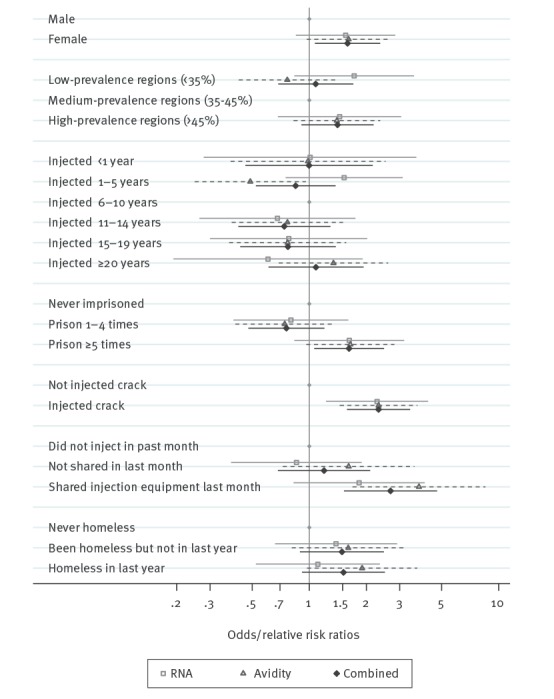
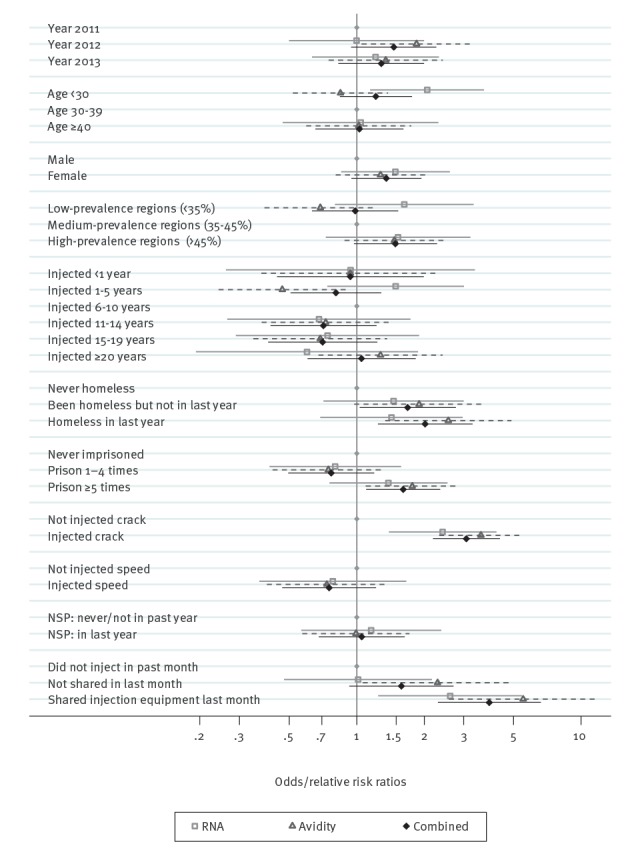
BackgroundMonitoring hepatitis C virus (HCV) incidence is important for assessing intervention impact. Longitudinal studies of people who inject drugs (PWID), using repeated biological tests, are costly; alternatively, incidence can be estimated using biological markers of recent infection in cross-sectional studies.AimWe aimed to compare incidence estimates obtained from two different biological markers of recent infection in a cross-sectional study to inform monitoring approaches for HCV elimination strategies.MethodSamples from an unlinked anonymous bio-behavioural survey of PWID were tested for two recent infection markers: HCV RNA with anti-HCV negative ('RNA') and low-avidity anti-HCV with HCV RNA present ('avidity'). These two markers were used separately and in combination to estimate HCV incidence.ResultsBetween 2011 and 2013, 2,816 anti-HIV-negative PWID (25% female) who had injected during the preceding year were either HCV-negative or had one of the two markers of recent infection: 57 (2.0%) had the RNA marker and 90 (3.2%) the avidity marker. The two markers had similar distributions of risk and demographic factors. Pooled estimated incidence was 12.3 per 100 person-years (pyrs) (95% credible interval: 8.8-17.0) and not significantly different to avidity-only (p = 0.865) and RNA-only (p = 0.691) estimates. However, the RNA marker is limited by its short duration before anti-HCV seroconversion and the avidity marker by uncertainty around its duration.ConclusionBoth markers have utility in monitoring HCV incidence among PWID. When HCV transmission is high, one marker may provide an accurate estimate of incidence; when it is low or decreasing, a combination may be required.
监测丙型肝炎病毒(HCV)的发病率对于评估干预措施的效果非常重要。使用重复的生物检测对注射吸毒者(PWID)进行纵向研究,成本很高;或者,可以使用横断面研究中近期感染的生物标志物来估计发病率。
我们旨在比较横断面研究中两种不同近期感染生物标志物获得的发病率估计值,以告知 HCV 消除策略监测方法。
对未关联匿名生物行为调查的 PWID 样本进行了两种近期感染标志物的检测:抗 HCV 阴性时的 HCV RNA(“RNA”)和 HCV RNA 存在时的低亲和力抗 HCV(“亲和力”)。这两种标志物单独使用和联合使用均可估计 HCV 发病率。
在 2011 年至 2013 年期间,2816 名抗 HIV 阴性(25%为女性)且在过去一年中曾注射过毒品的 PWID 中,要么 HCV 阴性,要么存在两种近期感染标志物之一:57 人(2.0%)有 RNA 标志物,90 人(3.2%)有亲和力标志物。这两种标志物的风险和人口统计学因素分布相似。合并估计的发病率为每 100 人年 12.3 例(95%可信区间:8.8-17.0),与仅亲和力(p=0.865)和仅 RNA(p=0.691)估计值无显著差异。然而,RNA 标志物受到抗 HCV 血清转换前持续时间短的限制,而亲和力标志物受到其持续时间不确定的限制。
两种标志物均在监测 PWID 中 HCV 发病率方面具有实用性。当 HCV 传播率较高时,一种标志物可能提供准确的发病率估计值;当传播率较低或下降时,可能需要联合使用两种标志物。