Division of General Pediatrics, Center for Pediatric Clinical Effectiveness, and PolicyLab, The Children's Hospital of Philadelphia, Phildelphia, Pennsylvania, USA.
The Leonard Davis Institute of Health Economics, The University of Pennsylvania, Philadelphia, Pennsylvania, USA.
J Hosp Med. 2018 Nov;13(11):743-751. doi: 10.12788/jhm.3070.
To inform resource allocation toward a continuum of care for youth at risk of suicide, we examined unplanned 30-day readmissions after pediatric hospitalization for either suicide ideation (SI) or suicide attempt (SA).
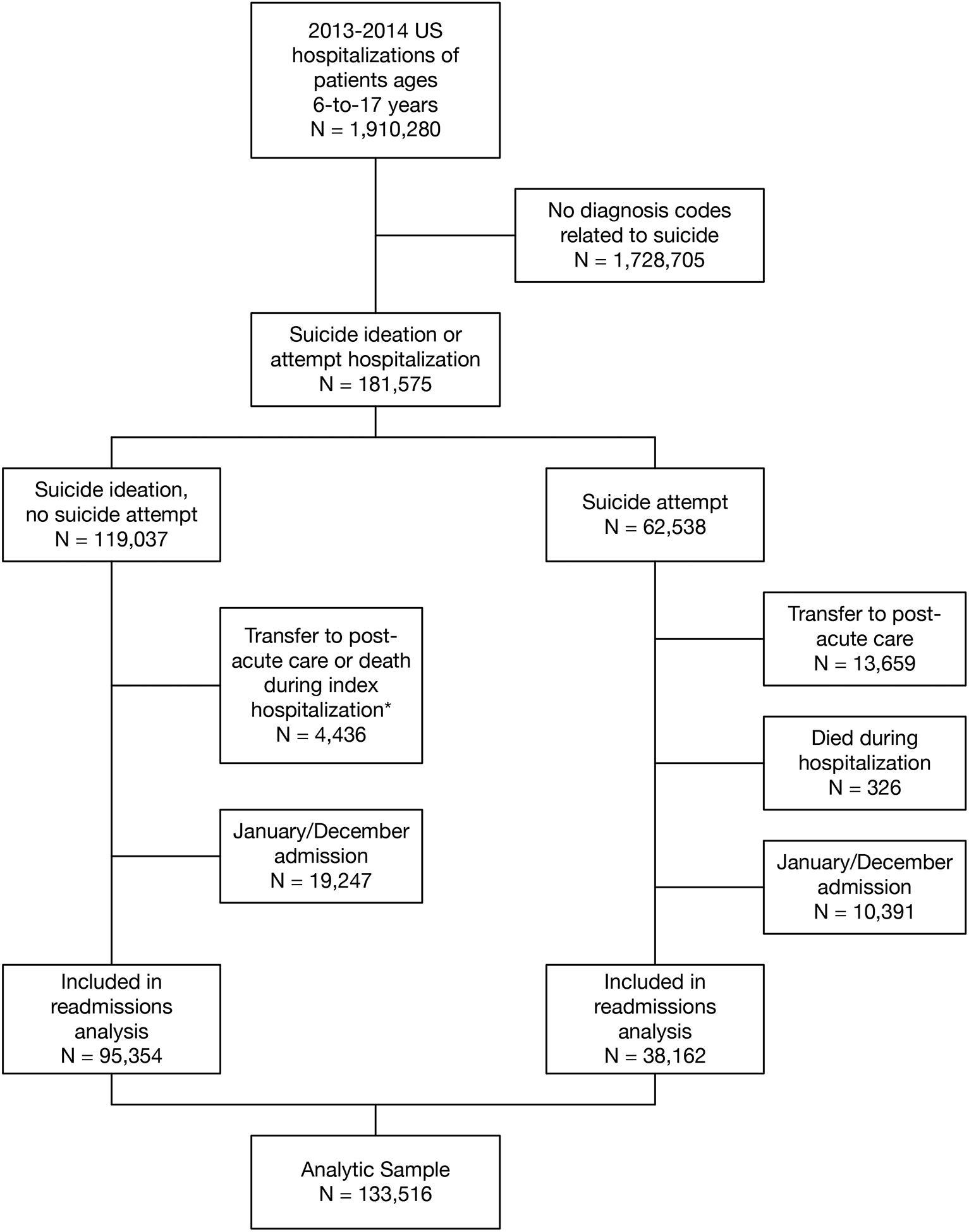
We conducted a retrospective cohort study of a nationally representative sample of 133,516 hospitalizations for SI or SA among 6- to 17-year-olds to determine prevalence, risk factors, and characteristics of 30-day readmissions using the 2013 and 2014 Nationwide Readmissions Dataset (NRD). Risk factors for readmission were modeled using logistic regression.
We identified 95,354 hospitalizations for SI and 38,162 hospitalizations for SA. Readmission rates within 30 days were 8.5% for SI and SA hospitalizations. Among 30-day readmissions, more than one-third (34.1%) occurred within 7 days. Among patients with any 30-day readmission, 11% had more than one readmission within 30 days. The strongest risk factors for readmission were SI or SA hospitalization in the 30 days preceding the index SI/SA hospitalization (adjusted odds ratio [AOR]: 3.14, 95% CI: 2.73-3.61) and hospitalization for other indications in the previous 30 days (AOR: 3.18, 95% CI: 2.67-3.78). Among readmissions, 94.5% were for a psychiatric condition and 63.4% had a diagnosis of SI or SA.
Quality improvement interventions to reduce unplanned 30-day readmissions among children hospitalized for SI or SA should focus on children with a recent prior hospitalization and should be targeted to the first week following hospital discharge.
Dr. Zima received funding from the Behavioral Health Centers of Excellence for California (SB852).
为了为有自杀风险的青少年提供连续护理资源,我们调查了因自杀意念(SI)或自杀未遂(SA)住院后 30 天内的非计划性再入院情况。
我们对全国范围内 6 至 17 岁因 SI 或 SA 住院的 133516 名患者进行了回顾性队列研究,使用 2013 年和 2014 年全国再入院数据库(NRD)确定 30 天再入院的患病率、危险因素和特征。使用逻辑回归模型对再入院的危险因素进行建模。
我们确定了 95354 例 SI 住院和 38162 例 SA 住院。SI 和 SA 住院 30 天内的再入院率分别为 8.5%。在 30 天内再入院的患者中,超过三分之一(34.1%)发生在 7 天内。在任何 30 天内再入院的患者中,11%在 30 天内有一次以上的再入院。再入院的最强危险因素是在 SI/SA 住院前 30 天内进行的 SI 或 SA 住院(调整后比值比 [AOR]:3.14,95%置信区间:2.73-3.61)和前 30 天内因其他原因住院(AOR:3.18,95%置信区间:2.67-3.78)。在再入院中,94.5%是为了治疗精神疾病,63.4%有 SI 或 SA 的诊断。
为减少因 SI 或 SA 住院的儿童非计划性 30 天内再入院,质量改进干预措施应重点关注近期有住院史的儿童,并应针对出院后第一周进行干预。
Zima 博士收到了加利福尼亚行为健康卓越中心(SB852)的资助。