Department of Obstetrics and Gynecology, Kobe University Graduate School of Medicine, Kobe 650-0017, Japan.
Int J Mol Sci. 2018 Nov 27;19(12):3760. doi: 10.3390/ijms19123760.
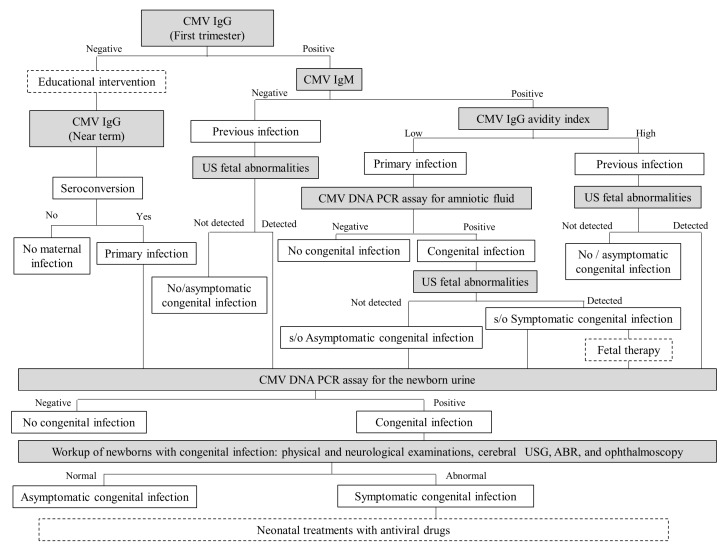
Early diagnosis and treatment of infants with symptomatic congenital cytomegalovirus (CMV) infection may improve neurological outcomes. For this reason, prenatal detection of newborns at high risk for congenital CMV infection is important. A polymerase chain reaction (PCR) assay for CMV DNA in the amniotic fluid is the gold standard for the diagnosis of intrauterine CMV infection; however, amniocentesis is an invasive procedure. Recently, we have found that the presence of CMV DNA in the maternal uterine cervical secretion is predictive of the occurrence of congenital CMV infection in CMV immunoglobulin M (IgM)-positive pregnant women. In contrast, we have suggested that maternal serological screening for primary CMV infection using CMV-specific immunoglobulin G (IgG), the IgG avidity index, or CMV-specific IgM overlooks a number of newborns with congenital CMV infection. We will review current knowledge of the potential biomarkers for predicting congenital CMV infection.
早期诊断和治疗有症状的先天性巨细胞病毒(CMV)感染的婴儿可能改善神经发育结局。因此,对先天性 CMV 感染高风险的新生儿进行产前检测很重要。聚合酶链反应(PCR)检测羊水内 CMV DNA 是诊断宫内 CMV 感染的金标准;然而,羊膜穿刺术是一种有创性操作。最近,我们发现母体宫颈分泌物中存在 CMV DNA 可预测 CMV 免疫球蛋白 M(IgM)阳性孕妇发生先天性 CMV 感染。相比之下,我们认为使用 CMV 特异性免疫球蛋白 G(IgG)、IgG 亲和指数或 CMV 特异性 IgM 对原发性 CMV 感染进行母体血清学筛查忽略了许多患有先天性 CMV 感染的新生儿。我们将回顾预测先天性 CMV 感染的潜在生物标志物的现有知识。