Division of Hematology.
Clinical and Translational Research Center, and.
Blood. 2019 Feb 14;133(7):633-643. doi: 10.1182/blood-2018-04-842641. Epub 2018 Nov 28.
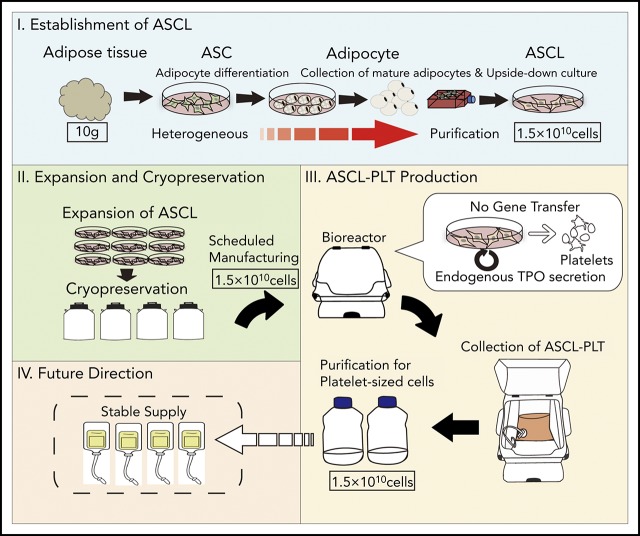
The clinical need for platelet transfusions is increasing; however, donor-dependent platelet transfusions are associated with practical problems, such as the limited supply and the risk of infection. Thus, we developed a manufacturing system for platelets from a donor-independent cell source: a human adipose-derived mesenchymal stromal/stem cell line (ASCL). The ASCL was obtained using an upside-down culture flask method and satisfied the minimal criteria for defining mesenchymal stem cells (MSCs) by The International Society for Cellular Therapy. The ASCL showed its proliferation capacity for ≥2 months without any abnormal karyotypes. The ASCL was cultured in megakaryocyte induction media. ASCL-derived megakaryocytes were obtained, with a peak at day 8 of culture, and ASCL-derived platelets (ASCL-PLTs) were obtained, with a peak at day 12 of culture. We observed that CD42b cells expressed an MSC marker (CD90) which is related to cell adhesion. Compared with peripheral platelets, ASCL-PLTs exhibit higher levels of PAC1 binding, P-selectin surface exposure, ristocetin-induced platelet aggregation, and ADP-induced platelet aggregation, as well as similar levels of fibrinogen binding and collagen-induced platelet aggregation. ASCL-PLTs have lower epinephrine-induced platelet aggregation. The pattern of in vivo kinetics after infusion into irradiated immunodeficient NOD.Cg-PrkdcIl2rg/SzJ mice was similar to that of platelet concentrates. ASCL-PLTs have similar characteristics to those of peripheral platelets and might have an additional function as MSCs. The establishment of the ASCL and its differentiation into ASCL-PLTs do not require gene transfer, and endogenous thrombopoietin is used for differentiation. The present protocol is a simple method that does not require feeder cells, further enhancing the clinical application of our approach.
临床对血小板输注的需求不断增加;然而,依赖供体的血小板输注存在一些实际问题,如供应有限和感染风险。因此,我们开发了一种从非供体来源的细胞制造血小板的系统:人脂肪间充质基质/干细胞系(ASCL)。ASCL 是使用倒扣培养瓶法获得的,符合国际细胞治疗学会定义间充质干细胞(MSCs)的最低标准。ASCL 表现出至少 2 个月的增殖能力,且没有任何异常核型。ASCL 在巨核细胞诱导培养基中培养。获得 ASCL 来源的巨核细胞,培养第 8 天达到高峰,获得 ASCL 来源的血小板(ASCL-PLTs),培养第 12 天达到高峰。我们观察到 CD42b 细胞表达与细胞黏附相关的 MSC 标志物(CD90)。与外周血小板相比,ASCL-PLTs 表现出更高水平的 PAC1 结合、P-选择素表面暴露、瑞斯托霉素诱导的血小板聚集和 ADP 诱导的血小板聚集,以及类似水平的纤维蛋白原结合和胶原诱导的血小板聚集。ASCL-PLTs 肾上腺素诱导的血小板聚集较低。将其输注到辐照免疫缺陷 NOD.Cg-PrkdcIl2rg/SzJ 小鼠体内后的体内动力学模式与血小板浓缩物相似。ASCL-PLTs 具有与外周血小板相似的特征,并且可能具有作为 MSCs 的额外功能。ASCL 的建立及其向 ASCL-PLTs 的分化不需要基因转移,并且内源性血小板生成素用于分化。本方案是一种简单的方法,不需要饲养细胞,进一步增强了我们方法的临床应用。