Vicens Alberto, Posada David
Department of Biochemistry, Genetics and Immunology, University of Vigo, 36310 Vigo, Spain.
Biomedical Research Center (CINBIO), University of Vigo, 36310 Vigo, Spain.
Genes (Basel). 2018 Nov 28;9(12):582. doi: 10.3390/genes9120582.
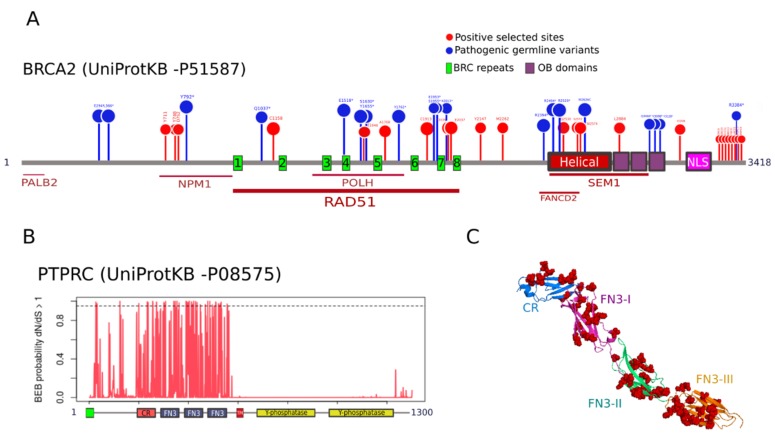
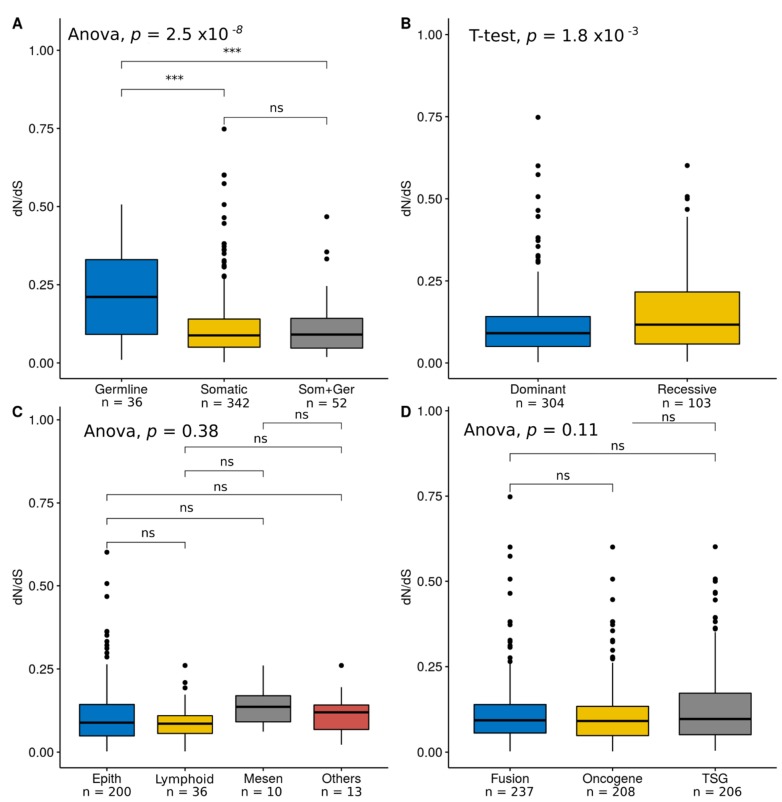
Cancer is a disease driven by both somatic mutations that increase survival and proliferation of cell lineages and the evolution of genes associated with cancer risk in populations. Several genes associated with cancer in humans, hereafter cancer genes, show evidence of germline positive selection among species. Taking advantage of a large collection of mammalian genomes, we systematically looked for signatures of germline positive selection in 430 cancer genes available in COSMIC. We identified 40 cancer genes with a robust signal of positive selection in mammals. We found evidence for fewer selective constraints-higher number of non-synonymous substitutions per non-synonymous site to the number of synonymous substitutions per synonymous site (dN/dS)-and higher incidence of positive selection-more positively selected sites-in cancer genes bearing germline and recessive mutations that predispose to cancer. This finding suggests a potential association between relaxed selection, positive selection, and risk of hereditary cancer. On the other hand, we did not find significant differences in terms of tissue or gene type. Human cancer genes under germline positive selection in mammals are significantly enriched in the processes of DNA repair, with high presence of Fanconi anaemia/Breast Cancer A (FA/BRCA) pathway components and T cell proliferation genes. We also show that the inferred positively selected sites in the two genes with the strongest signal of positive selection, i.e., and , are in regions of functional relevance, which could be relevant to cancer susceptibility.
癌症是一种由体细胞突变驱动的疾病,这些突变会增加细胞谱系的存活和增殖,同时也与人群中癌症风险相关基因的进化有关。一些与人类癌症相关的基因(以下简称癌症基因)在物种间显示出种系阳性选择的证据。利用大量哺乳动物基因组,我们系统地在COSMIC中可用的430个癌症基因中寻找种系阳性选择的特征。我们在哺乳动物中鉴定出40个具有强烈阳性选择信号的癌症基因。我们发现,在携带种系和隐性突变且易患癌症的癌症基因中,选择性限制较少(每个非同义位点的非同义替换数与每个同义位点的同义替换数之比,即dN/dS),阳性选择的发生率更高(更多的阳性选择位点)。这一发现表明宽松选择、阳性选择与遗传性癌症风险之间可能存在关联。另一方面,我们在组织或基因类型方面未发现显著差异。在哺乳动物中受到种系阳性选择的人类癌症基因在DNA修复过程中显著富集,范可尼贫血/乳腺癌A(FA/BRCA)通路成分和T细胞增殖基因高度存在。我们还表明,在阳性选择信号最强的两个基因(即 和 )中推断出的阳性选择位点位于功能相关区域,这可能与癌症易感性有关。