Safayi S R, Shahi F, Ghalamkari M, Mirzania M, Khatuni M, Hirmandi Niasar F
Assisstant Professor of Hematology Oncology, Tehran University of Medical Sciences, Tehran, Iran.
Associated Professor of Hematology Oncology, Tehran University of Medical Sciences, Tehran, Iran.
Int J Organ Transplant Med. 2018;9(3):112-116. Epub 2018 Aug 1.
Allogeneic hematopoietic stem cell transplantation (HSCT) is a potentially cure for acute myeloid leukemia (AML). Patients who undergone HSCT are at increased risk of infection due to impaired immunity.
To evaluate the rate of bacterial, viral and fungal infection and its relationship with 2-year overall survival of AML patients who had undergone HSCT.
This was a retrospective cross-sectional study of 49 patients who underwent allogenic bone marrow transplantation (BMT) from full-matched donors at BMT Center, Imam Khomeini Hospital Complex, Tehran, Iran, from 2006 to 2013. All autologous transplantations and promyelocytic leukemia (PML) transplantations were excluded.
All patients, except for one, had fever for a mean of 7 days post-transplantation and received broad-spectrum antibiotic. The rate of severe sepsis was 6.1%. None of the patients developed fungal infection during admission. The rate of admission due to sepsis after discharge was 27% in the alive group (mean onset of 54 days), and 73% in the deceased group (mean onset of 52 days) (p<0.05). The most common site of infection was lung (70%). The rate of cytomegalovirus (CMV) antigenemia (positive PP65) was 20% during the 2-year period after HSCT.
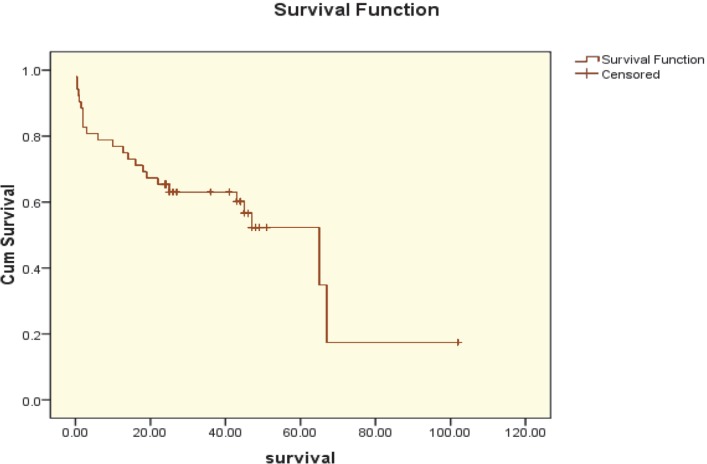
The rate of infection was a negative prognostic factor for 2-year overall survival. The rate of CMV antigenemia is less than similar studies (51%), which could be due to full-matched donor-recipients requiring less immunosuppression.
异基因造血干细胞移植(HSCT)是急性髓系白血病(AML)潜在的治愈方法。接受HSCT的患者由于免疫力受损而感染风险增加。
评估接受HSCT的AML患者的细菌、病毒和真菌感染率及其与2年总生存率的关系。
这是一项回顾性横断面研究,研究对象为2006年至2013年在伊朗德黑兰伊玛目霍梅尼医院综合中心骨髓移植中心接受来自完全匹配供体的异基因骨髓移植(BMT)的49例患者。排除所有自体移植和早幼粒细胞白血病(PML)移植。
除1例患者外,所有患者移植后平均发热7天,并接受了广谱抗生素治疗。严重脓毒症发生率为6.1%。住院期间无患者发生真菌感染。出院后因脓毒症入院率在存活组为27%(平均发病时间54天),在死亡组为73%(平均发病时间52天)(p<0.05)。最常见的感染部位是肺部(70%)。HSCT后2年期间巨细胞病毒(CMV)抗原血症(PP65阳性)发生率为20%。
感染率是2年总生存率的负性预后因素。CMV抗原血症发生率低于类似研究(51%),这可能是由于完全匹配的供受者所需免疫抑制较少。