• 文献检索
  • 文档翻译
  • 深度研究
  • 学术资讯
  • Suppr Zotero 插件Zotero 插件
  • 邀请有礼
  • 套餐&价格
  • 历史记录
应用&插件
Suppr Zotero 插件Zotero 插件浏览器插件Mac 客户端Windows 客户端微信小程序
定价
高级版会员购买积分包购买API积分包
服务
文献检索文档翻译深度研究API 文档MCP 服务
关于我们
关于 Suppr公司介绍联系我们用户协议隐私条款
关注我们

Suppr 超能文献

核心技术专利:CN118964589B侵权必究
粤ICP备2023148730 号-1Suppr @ 2026

文献检索

告别复杂PubMed语法,用中文像聊天一样搜索,搜遍4000万医学文献。AI智能推荐,让科研检索更轻松。

立即免费搜索

文件翻译

保留排版,准确专业,支持PDF/Word/PPT等文件格式,支持 12+语言互译。

免费翻译文档

深度研究

AI帮你快速写综述,25分钟生成高质量综述,智能提取关键信息,辅助科研写作。

立即免费体验

目前的重点是减少人工耳蜗植入项目中远程电极的通道相互作用。

Current Focusing to Reduce Channel Interaction for Distant Electrodes in Cochlear Implant Programs.

机构信息

1 Department of Hearing and Speech Sciences, University of Maryland, College Park, MD, USA.

2 Department of Speech and Hearing Sciences, University of Washington, Seattle, WA, USA.

出版信息

Trends Hear. 2018 Jan-Dec;22:2331216518813811. doi: 10.1177/2331216518813811.

DOI:10.1177/2331216518813811
PMID:30488764
原文链接:https://pmc.ncbi.nlm.nih.gov/articles/PMC6277758/
Abstract

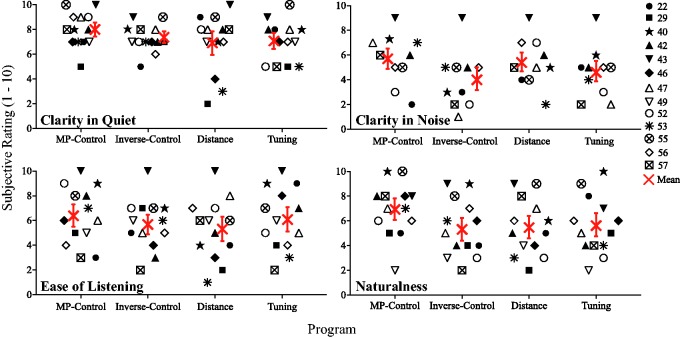
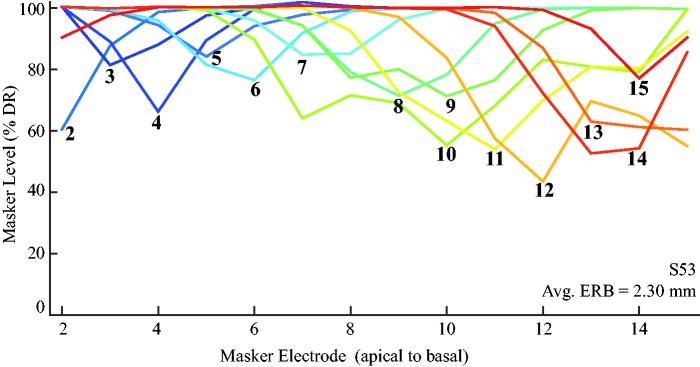
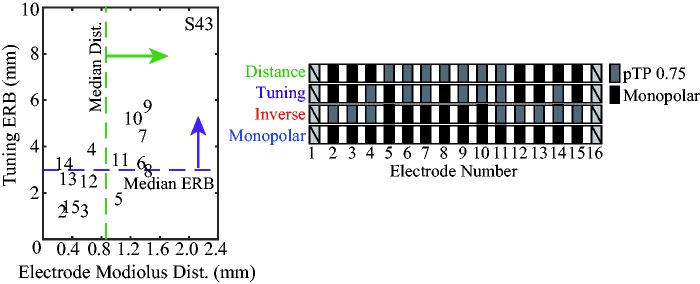
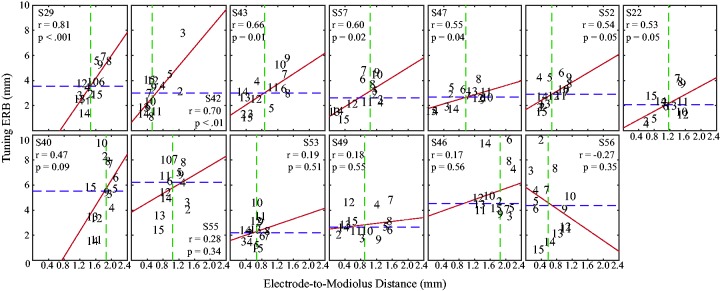
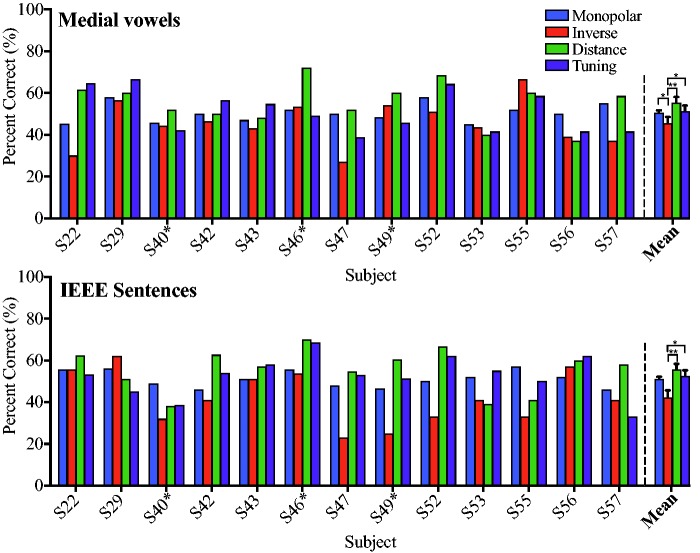
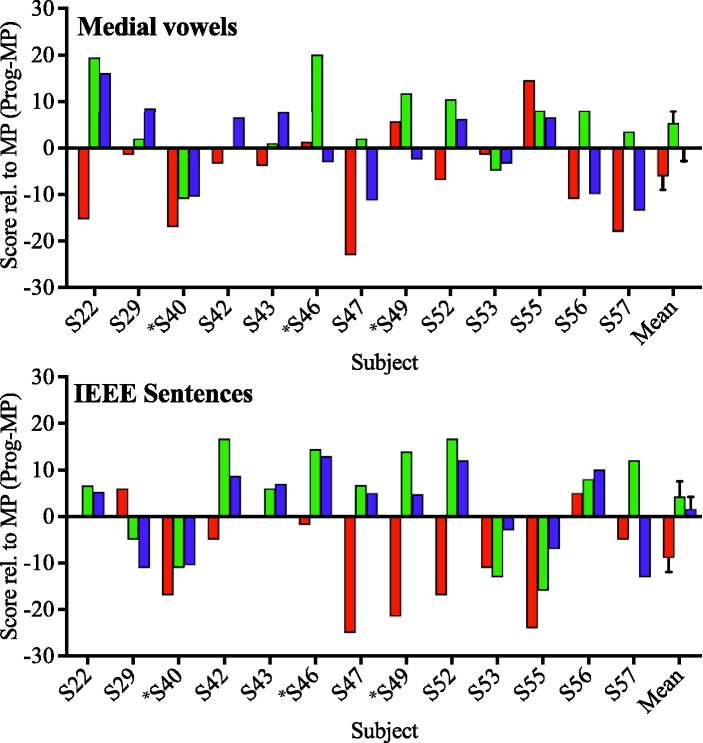
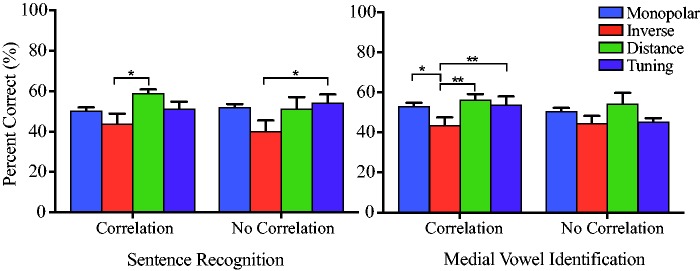
Speech understanding abilities are highly variable among cochlear implant (CI) listeners. Poor electrode-neuron interfaces (ENIs) caused by sparse neural survival or distant electrode placement may lead to increased channel interaction and reduced speech perception. Currently, it is not possible to directly measure neural survival in CI listeners; therefore, obtaining information about electrode position is an alternative approach to assessing ENIs. This information can be estimated with computerized tomography (CT) imaging; however, postoperative CT imaging is not often available. A reliable method to assess channel interaction, such as the psychophysical tuning curve (PTC), offers an alternative way to identify poor ENIs. This study aimed to determine (a) the within-subject relationship between CT-estimated electrode distance and PTC bandwidths, and (b) whether using focused stimulation on channels with suspected poor ENI improves vowel identification and sentence recognition. In 13 CI listeners, CT estimates of electrode-to-modiolus distance and PTCs bandwidths were measured for all available electrodes. Two test programs were created, wherein a subset of electrodes used focused stimulation based on (a) broad PTC bandwidth (Tuning) and (b) far electrode-to-modiolus distance (Distance). Two control programs were also created: (a) Those channels not focused in the Distance program (Inverse-Control), and (b) an all-channel monopolar program (Monopolar-Control). Across subjects, scores on the Distance and Tuning programs were significantly higher than the Inverse-Control program, and similar to the Monopolar-Control program. Subjective ratings were similar for all programs. These findings suggest that focusing channels suspected to have a high degree of channel interaction result in quite different outcomes, acutely.

摘要

人工耳蜗(CI)使用者的言语理解能力差异很大。稀疏的神经元存活或电极放置较远导致的电极-神经元界面(ENI)不良可能会导致更多的通道相互作用,从而降低言语感知能力。目前,无法直接测量 CI 使用者的神经元存活情况;因此,获得有关电极位置的信息是评估 ENI 的一种替代方法。可以使用计算机断层扫描(CT)成像来估计这些信息;但是,术后 CT 成像通常不可用。可靠的方法评估通道相互作用,如心理物理调谐曲线(PTC),为识别不良 ENI 提供了另一种方法。本研究旨在确定:(a)CT 估计的电极距离与 PTC 带宽之间的个体内关系,以及(b)使用疑似不良 ENI 的通道进行聚焦刺激是否可以改善元音识别和句子识别。在 13 位 CI 使用者中,对所有可用电极进行了 CT 估计的电极-蜗轴距离和 PTC 带宽测量。创建了两个测试程序,其中基于(a)宽 PTC 带宽(调谐)和(b)远电极-蜗轴距离(距离)对一部分电极使用聚焦刺激。还创建了两个对照程序:(a)Distance 程序中未聚焦的通道(Inverse-Control),以及(b)所有通道的单极程序(Monopolar-Control)。在所有受试者中,Distance 和 Tuning 程序的得分明显高于 Inverse-Control 程序,与 Monopolar-Control 程序相似。所有程序的主观评分均相似。这些发现表明,聚焦被怀疑具有高度通道相互作用的通道会导致截然不同的结果,尤其是在急性情况下。
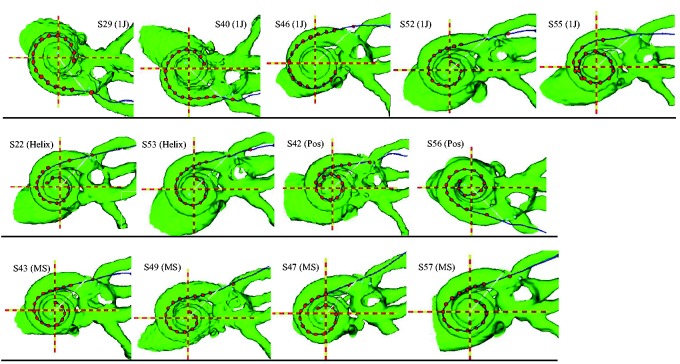
https://cdn.ncbi.nlm.nih.gov/pmc/blobs/83f4/6277758/3ebd9afb001b/10.1177_2331216518813811-fig9.jpg
https://cdn.ncbi.nlm.nih.gov/pmc/blobs/83f4/6277758/d858e153a85d/10.1177_2331216518813811-fig1.jpg
https://cdn.ncbi.nlm.nih.gov/pmc/blobs/83f4/6277758/d666c056c523/10.1177_2331216518813811-fig2.jpg
https://cdn.ncbi.nlm.nih.gov/pmc/blobs/83f4/6277758/aadda9b4d6d6/10.1177_2331216518813811-fig3.jpg
https://cdn.ncbi.nlm.nih.gov/pmc/blobs/83f4/6277758/cf711b83283a/10.1177_2331216518813811-fig4.jpg
https://cdn.ncbi.nlm.nih.gov/pmc/blobs/83f4/6277758/7a895171bdb1/10.1177_2331216518813811-fig5.jpg
https://cdn.ncbi.nlm.nih.gov/pmc/blobs/83f4/6277758/285e8830a1a1/10.1177_2331216518813811-fig6.jpg
https://cdn.ncbi.nlm.nih.gov/pmc/blobs/83f4/6277758/36555a70ae21/10.1177_2331216518813811-fig7.jpg
https://cdn.ncbi.nlm.nih.gov/pmc/blobs/83f4/6277758/1dfe1de6f1c8/10.1177_2331216518813811-fig8.jpg
https://cdn.ncbi.nlm.nih.gov/pmc/blobs/83f4/6277758/3ebd9afb001b/10.1177_2331216518813811-fig9.jpg
https://cdn.ncbi.nlm.nih.gov/pmc/blobs/83f4/6277758/d858e153a85d/10.1177_2331216518813811-fig1.jpg
https://cdn.ncbi.nlm.nih.gov/pmc/blobs/83f4/6277758/d666c056c523/10.1177_2331216518813811-fig2.jpg
https://cdn.ncbi.nlm.nih.gov/pmc/blobs/83f4/6277758/aadda9b4d6d6/10.1177_2331216518813811-fig3.jpg
https://cdn.ncbi.nlm.nih.gov/pmc/blobs/83f4/6277758/cf711b83283a/10.1177_2331216518813811-fig4.jpg
https://cdn.ncbi.nlm.nih.gov/pmc/blobs/83f4/6277758/7a895171bdb1/10.1177_2331216518813811-fig5.jpg
https://cdn.ncbi.nlm.nih.gov/pmc/blobs/83f4/6277758/285e8830a1a1/10.1177_2331216518813811-fig6.jpg
https://cdn.ncbi.nlm.nih.gov/pmc/blobs/83f4/6277758/36555a70ae21/10.1177_2331216518813811-fig7.jpg
https://cdn.ncbi.nlm.nih.gov/pmc/blobs/83f4/6277758/1dfe1de6f1c8/10.1177_2331216518813811-fig8.jpg
https://cdn.ncbi.nlm.nih.gov/pmc/blobs/83f4/6277758/3ebd9afb001b/10.1177_2331216518813811-fig9.jpg

相似文献

1
Current Focusing to Reduce Channel Interaction for Distant Electrodes in Cochlear Implant Programs.目前的重点是减少人工耳蜗植入项目中远程电极的通道相互作用。
Trends Hear. 2018 Jan-Dec;22:2331216518813811. doi: 10.1177/2331216518813811.
2
Psychophysical Tuning Curves as a Correlate of Electrode Position in Cochlear Implant Listeners.心理物理调谐曲线与人工耳蜗植入者电极位置的相关性
J Assoc Res Otolaryngol. 2018 Oct;19(5):571-587. doi: 10.1007/s10162-018-0678-4. Epub 2018 Jun 4.
3
Fitting prelingually deafened adult cochlear implant users based on electrode discrimination performance.基于电极辨别性能为语前聋成年人工耳蜗使用者进行适配。
Int J Audiol. 2017 Mar;56(3):174-185. doi: 10.1080/14992027.2016.1243262. Epub 2016 Oct 19.
4
Spatial tuning curves from apical, middle, and basal electrodes in cochlear implant users.人工耳蜗使用者的顶端、中部和底部电极的空间调谐曲线。
J Acoust Soc Am. 2011 Jun;129(6):3916-33. doi: 10.1121/1.3583503.
5
Identifying cochlear implant channels with poor electrode-neuron interface: partial tripolar, single-channel thresholds and psychophysical tuning curves.识别电极-神经元界面不良的人工耳蜗通道:部分三角波刺激、单通道阈值和心理物理调谐曲线。
Ear Hear. 2010 Apr;31(2):247-58. doi: 10.1097/AUD.0b013e3181c7daf4.
6
Improving speech perception in noise with current focusing in cochlear implant users.利用当前聚焦技术改善人工耳蜗使用者在噪声环境下的言语感知能力。
Hear Res. 2013 May;299:29-36. doi: 10.1016/j.heares.2013.02.004. Epub 2013 Mar 1.
7
Forward masking patterns by low and high-rate stimulation in cochlear implant users: Differences in masking effectiveness and spread of neural excitation.人工耳蜗使用者的低频和高频刺激的前向掩蔽模式:掩蔽效果和神经兴奋扩散的差异。
Hear Res. 2020 Apr;389:107921. doi: 10.1016/j.heares.2020.107921. Epub 2020 Feb 15.
8
Re-examining the relationship between number of cochlear implant channels and maximal speech intelligibility.重新审视人工耳蜗通道数量与最大言语可懂度之间的关系。
J Acoust Soc Am. 2017 Dec;142(6):EL537. doi: 10.1121/1.5016044.
9
Cortical auditory evoked potentials in cochlear implant listeners via single electrode stimulation in relation to speech perception.人工耳蜗植入者通过单电极刺激产生的皮质听觉诱发电位与言语感知的关系。
Int J Audiol. 2018 Dec;57(12):933-940. doi: 10.1080/14992027.2018.1514469. Epub 2018 Oct 8.
10
Adding simultaneous stimulating channels to reduce power consumption in cochlear implants.增加同步刺激通道以降低人工耳蜗的功耗。
Hear Res. 2017 Mar;345:96-107. doi: 10.1016/j.heares.2017.01.010. Epub 2017 Jan 16.

引用本文的文献

1
A deep learning framework for understanding cochlear implants.一个用于理解人工耳蜗的深度学习框架。
bioRxiv. 2025 Jul 21:2025.07.16.665227. doi: 10.1101/2025.07.16.665227.
2
Cochlear implant re-mapping informed by measures of viability of the electrode-neural interface: a systematic review with meta-analysis.基于电极-神经界面活力测量的人工耳蜗重新映射:一项系统评价与荟萃分析
Sci Rep. 2025 Jul 30;15(1):27795. doi: 10.1038/s41598-025-09610-x.
3
Model-Based Inference of Electrode Distance and Neuronal Density from Measured Detection Thresholds in Cochlear Implant Listeners.

本文引用的文献

1
Psychophysical Tuning Curves as a Correlate of Electrode Position in Cochlear Implant Listeners.心理物理调谐曲线与人工耳蜗植入者电极位置的相关性
J Assoc Res Otolaryngol. 2018 Oct;19(5):571-587. doi: 10.1007/s10162-018-0678-4. Epub 2018 Jun 4.
2
Dynamic Current Focusing: A Novel Approach to Loudness Coding in Cochlear Implants.动态电流聚焦:一种新型的人工耳蜗响度编码方法。
Ear Hear. 2019 Jan/Feb;40(1):34-44. doi: 10.1097/AUD.0000000000000593.
3
A Dynamically Focusing Cochlear Implant Strategy Can Improve Vowel Identification in Noise.
基于模型从人工耳蜗佩戴者的测量检测阈值推断电极距离和神经元密度
J Assoc Res Otolaryngol. 2025 Apr;26(2):185-201. doi: 10.1007/s10162-025-00978-1. Epub 2025 Mar 6.
4
Investigating the Effect of Blurring and Focusing Current in Cochlear Implant Users with the Panoramic ECAP Method.使用全景电刺激听觉脑干反应(ECAP)方法研究人工耳蜗使用者中模糊和聚焦电流的影响。
J Assoc Res Otolaryngol. 2024 Dec;25(6):591-609. doi: 10.1007/s10162-024-00966-x. Epub 2024 Oct 16.
5
Cochlear-implant simulated spectral degradation attenuates emotional responses to environmental sounds.人工耳蜗模拟的频谱退化会减弱对环境声音的情绪反应。
Int J Audiol. 2025 May;64(5):518-524. doi: 10.1080/14992027.2024.2385552. Epub 2024 Aug 15.
6
Effects of spectral smearing on speech understanding and masking release in simulated bilateral cochlear implants.光谱弥散对模拟双侧人工耳蜗言语理解和掩蔽释放的影响。
PLoS One. 2023 Nov 2;18(11):e0287728. doi: 10.1371/journal.pone.0287728. eCollection 2023.
7
Relationship between electrode position and temporal modulation sensitivity in cochlear implant users: Are close electrodes always better?人工耳蜗使用者电极位置与时间调制敏感性之间的关系:距离近的电极总是更好吗?
Heliyon. 2022 Dec 22;9(2):e12467. doi: 10.1016/j.heliyon.2022.e12467. eCollection 2023 Feb.
8
Questions and controversies surrounding the perception and neural coding of pitch.围绕音高感知与神经编码的问题及争议。
Front Neurosci. 2023 Jan 9;16:1074752. doi: 10.3389/fnins.2022.1074752. eCollection 2022.
9
Polarity Sensitivity of Human Auditory Nerve Fibers Based on Pulse Shape, Cochlear Implant Stimulation Strategy and Array.基于脉冲形状、人工耳蜗刺激策略和阵列的人类听觉神经纤维的极性敏感性
Front Neurosci. 2021 Dec 8;15:751599. doi: 10.3389/fnins.2021.751599. eCollection 2021.
10
Using the electrically-evoked compound action potential (ECAP) interphase gap effect to select electrode stimulation sites in cochlear implant users.利用电诱发复合动作电位(ECAP)的相间间隙效应来选择人工耳蜗植入患者的电极刺激部位。
Hear Res. 2021 Jul;406:108257. doi: 10.1016/j.heares.2021.108257. Epub 2021 Apr 28.
一种动态聚焦的人工耳蜗策略可以提高噪声中的元音识别能力。
Ear Hear. 2018 Nov/Dec;39(6):1136-1145. doi: 10.1097/AUD.0000000000000566.
4
Evaluating Multipulse Integration as a Neural-Health Correlate in Human Cochlear Implant Users: Effects of Stimulation Mode.评估多脉冲积分作为人工耳蜗使用者神经健康关联指标:刺激模式的影响
J Assoc Res Otolaryngol. 2018 Feb;19(1):99-111. doi: 10.1007/s10162-017-0643-7. Epub 2017 Oct 30.
5
Vowel and consonant confusions from spectrally manipulated stimuli designed to simulate poor cochlear implant electrode-neuron interfaces.旨在模拟人工耳蜗电极 - 神经元接口不佳情况的经频谱处理刺激所导致的元音和辅音混淆。
J Acoust Soc Am. 2016 Dec;140(6):4404. doi: 10.1121/1.4971420.
6
Evaluating multipulse integration as a neural-health correlate in human cochlear-implant users: Relationship to spatial selectivity.评估多脉冲积分作为人工耳蜗使用者神经健康相关指标:与空间选择性的关系。
J Acoust Soc Am. 2016 Sep;140(3):1537. doi: 10.1121/1.4962230.
7
Reducing Channel Interaction Through Cochlear Implant Programming May Improve Speech Perception: Current Focusing and Channel Deactivation.通过耳蜗植入编程减少通道间相互作用可能改善言语感知:当前的聚焦和通道失活。
Trends Hear. 2016 Jun 17;20:2331216516653389. doi: 10.1177/2331216516653389.
8
Assessing the Electrode-Neuron Interface with the Electrically Evoked Compound Action Potential, Electrode Position, and Behavioral Thresholds.通过电诱发复合动作电位、电极位置和行为阈值评估电极-神经元界面
J Assoc Res Otolaryngol. 2016 Jun;17(3):237-52. doi: 10.1007/s10162-016-0557-9. Epub 2016 Feb 29.
9
Reduction in spread of excitation from current focusing at multiple cochlear locations in cochlear implant users.人工耳蜗使用者中,当前聚焦于多个耳蜗位置时兴奋扩散的减少。
Hear Res. 2016 Mar;333:98-107. doi: 10.1016/j.heares.2016.01.002. Epub 2016 Jan 8.
10
Initial Results With Image-guided Cochlear Implant Programming in Children.儿童影像引导下人工耳蜗编程的初步结果
Otol Neurotol. 2016 Feb;37(2):e63-9. doi: 10.1097/MAO.0000000000000909.