Department of Neurology, Medical University of Graz, Graz, Austria.
Division of Neuroradiology, Vascular and Interventional Neuroradiology, Medical University of Graz, Graz, Austria.
Eur J Neurol. 2019 May;26(5):727-732. doi: 10.1111/ene.13879. Epub 2019 Jan 9.
Information on the prevalence and course of post-stroke cognitive impairment in young stroke patients is limited. The aim was to assess a consecutive sample of acute young ischaemic stroke patients (18-55 years) for the presence and development of neuropsychological deficits.
Patients prospectively underwent a comprehensive clinical and cognitive assessment, examining general cognitive function, processing speed, attention, flexibility/executive function and word fluency within the first 3 weeks after hospital admission (median assessment at day 6) and at a 3 months' follow-up (FU). Cognitive dysfunction was defined in comparison to age-standardized published norms.
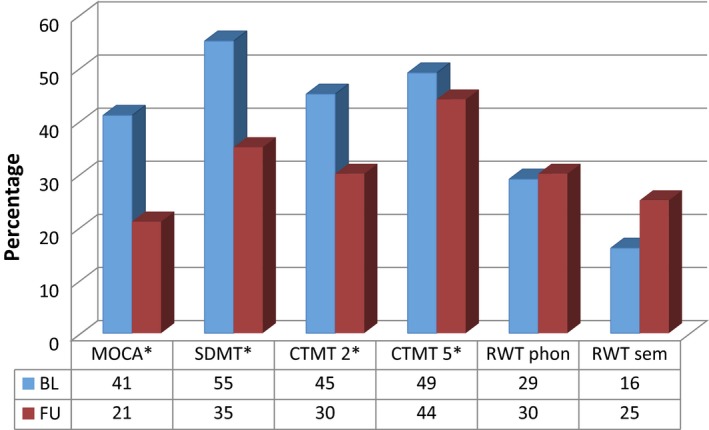
At baseline (N = 114), deficits were highly prevalent in processing speed (56.0%), flexibility/executive function (49.5%), attention (46.4%) and general cognitive function (42.1%). These frequencies were comparable for those with FU assessment (N = 87). In most domains, cognitive performance improved within 3 months, except for word fluency. However, in about one-third of patients, cognitive deficits (as defined by 1.5 standard deviations below the standardized mean) were still present 3 months after stroke. At FU, 44.0% were impaired in the domain flexibility/executive function, 35.0% in processing speed and 30.0% in attention.
The high prevalence of cognitive deficits in acute young patients with ischaemic stroke highlights the importance of early post-stroke cognitive assessment to capture a patient's dysfunction in a comprehensive manner and to offer adequate rehabilitation. The role of factors which promote neuropsychological deficits needs further exploration.
有关年轻脑卒中患者卒中后认知障碍的患病率和病程的信息有限。本研究旨在评估一系列连续的急性年轻缺血性脑卒中患者(18-55 岁)是否存在神经心理缺陷,并评估其发展情况。
患者前瞻性地接受了全面的临床和认知评估,在入院后 3 周内(中位数评估时间为第 6 天)和 3 个月随访时(FU)检查了一般认知功能、处理速度、注意力、灵活性/执行功能和词汇流畅性。认知功能障碍与年龄标准化的发表标准进行比较。
在基线时(N=114),处理速度(56.0%)、灵活性/执行功能(49.5%)、注意力(46.4%)和一般认知功能(42.1%)方面的缺陷非常普遍。这些频率与 FU 评估时(N=87)相似。在大多数领域,认知表现都在 3 个月内得到改善,只有词汇流畅性除外。然而,约三分之一的患者在卒中后 3 个月仍存在认知缺陷(定义为低于标准化平均值 1.5 个标准差)。在 FU 时,44.0%的患者在灵活性/执行功能域受损,35.0%的患者在处理速度方面受损,30.0%的患者在注意力方面受损。
急性年轻缺血性脑卒中患者中认知缺陷的高患病率强调了早期卒中后认知评估的重要性,以便全面评估患者的功能障碍,并提供适当的康复。需要进一步探讨促进神经心理缺陷的因素的作用。