Department of Surgery, University of Nebraska Medical Center, Omaha, Nebraska, United States of America.
Department of Surgery, VA Nebraska-Western Iowa Health Care System, Omaha, Nebraska, United States of America.
PLoS One. 2018 Nov 29;13(11):e0207708. doi: 10.1371/journal.pone.0207708. eCollection 2018.
We hypothesized that slow crystalloid resuscitation would result in less blood loss and a smaller hemoglobin decrease compared to a rapid resuscitation during uncontrolled hemorrhage.
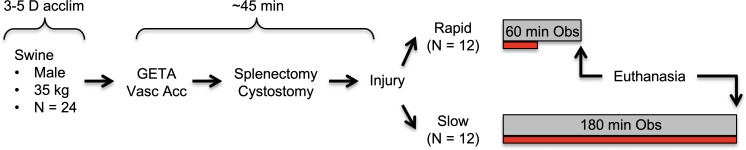
Anesthetized, splenectomized domestic swine underwent hepatic lobar hemitransection. Lactated Ringers was given at 150 or 20 mL/min IV (rapid vs. slow, respectively, N = 12 per group; limit of 100 mL/kg). Primary endpoints were blood loss and serum hemoglobin; secondary endpoints included survival, vital signs, coagulation parameters, and blood gases.
The slow group had a less blood loss (1.6 vs. 2.7 L, respectively) and a higher final hemoglobin concentration (6.0 vs. 3.4 g/dL).
Using a fixed volume of crystalloid resuscitation in this porcine model of uncontrolled intraabdominal hemorrhage, a slow IV infusion rate produced less blood loss and a smaller hemoglobin decrease compared to rapid infusion.
我们假设与快速复苏相比,在不受控制的出血期间进行缓慢的晶体液复苏将导致出血量减少和血红蛋白下降幅度较小。
麻醉、脾切除的家猪接受肝叶半肝切除术。乳酸林格氏液以 150 或 20 mL/min IV 给予(分别为快速与缓慢,每组 12 只;限制 100 mL/kg)。主要终点是出血量和血清血红蛋白;次要终点包括存活、生命体征、凝血参数和血气。
缓慢组出血量较少(分别为 1.6 和 2.7 L),最终血红蛋白浓度较高(分别为 6.0 和 3.4 g/dL)。
在这个猪模型中,使用固定体积的晶体液复苏,与快速输注相比,缓慢的 IV 输注速度可减少出血量和血红蛋白下降幅度。