Munakampe Margarate Nzala, Zulu Joseph Mumba, Michelo Charles
Department of Health Policy and Management, School of Public Health, University of Zambia, Nationalist Road, P.O Box 50110, Lusaka, Zambia.
Strategic Centre for Health Systems Metrics & Evaluations (SCHEME), Department of Epidemiology & Biostatistics, School of Public Health, University of Zambia, Lusaka, Zambia.
BMC Health Serv Res. 2018 Nov 29;18(1):909. doi: 10.1186/s12913-018-3722-5.
Adolescents face significant barriers to contraception access and utilization that result in adverse health effects of early pregnancy and childbirth. Unsafe abortions continue to occur partly due to failure to prevent pregnancies, with Sub-Saharan Africa contributing the most significant burden of all unsafe abortions among young people globally, of which a quarter occurs in those aged 15-19 years. We aimed to conduct a systematic review of the contraceptive and abortion knowledge, attitudes and practices of adolescents in low and middle-income countries to increase the understanding of the sexual and reproductive health dynamics that they face.
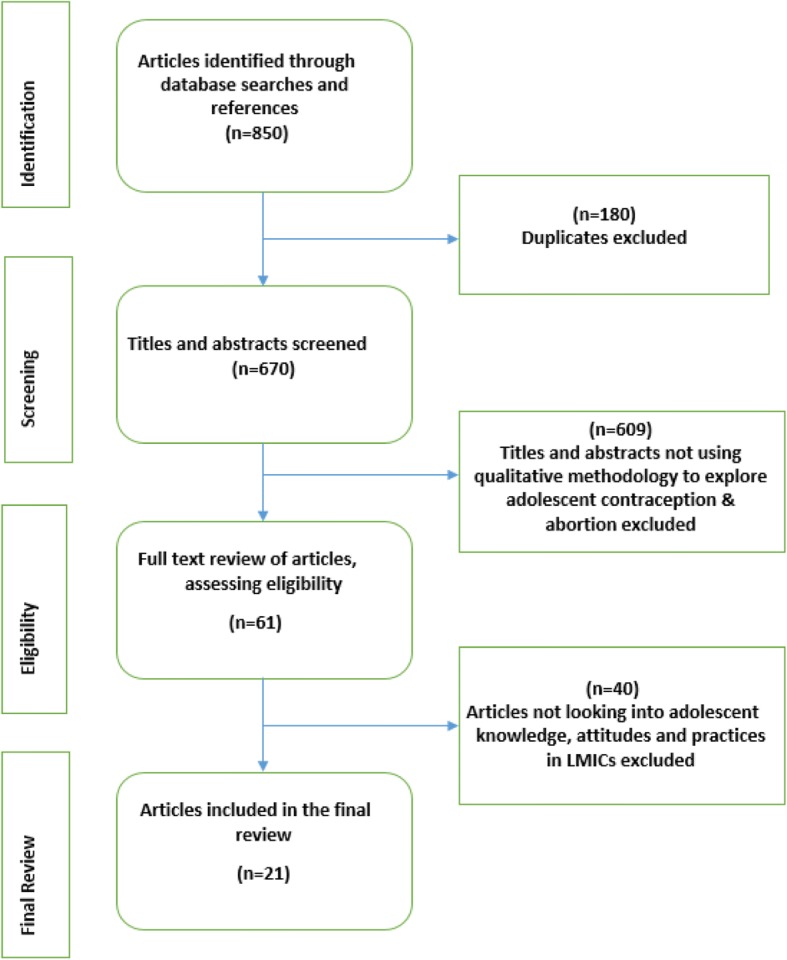
Literature searches from 6 databases; PubMed, Science Direct, Google Scholar, BioMed Central, CINAHL, MEDLINE, were conducted, covering the period from 1970 to 2016 and concerning the adolescents aged 15-19 years and 21 studies were read and analyzed using thematic analysis.
Limited knowledge about sexual and reproductive health among adolescents was a significant cause of reduced access to contraception and safe abortion services, especially among unmarried adolescents. Reduced access to reproductive health services for some resulted in extreme methods of contraception and abortion such as the use of battery acid and crushed bottles. Despite all adolescents having limited access to information and services, girls faced more consequences such as being blamed for pregnancy or dealing with the effects of unsafe abortions. Parents, health workers, and teachers were cited as trusted sources of information but often received the most information from peers and other family members instead, and the girls mostly confided in their aunties, cousins and peers while the boys resorted to peers, media and even pornography.
The reported observations suggest severe limitations in the access to safe and effective methods of contraception and safe abortion services. There is a need for an urgent response in reducing the "unmet needs" for contraception and to improve access to contraception, abortion information, and services in this group. Interventions which target the involvement of parents and teachers should be considered, to carry one wholesome message to the adolescents.
青少年在获取和使用避孕措施方面面临重大障碍,这导致早孕和分娩产生不良健康影响。不安全堕胎仍在发生,部分原因是未能预防怀孕,撒哈拉以南非洲在全球年轻人所有不安全堕胎负担中占比最大,其中四分之一发生在15 - 19岁的人群中。我们旨在对低收入和中等收入国家青少年的避孕和堕胎知识、态度及行为进行系统综述,以增进对他们所面临的性与生殖健康动态的理解。
对6个数据库进行文献检索,包括PubMed、Science Direct、Google Scholar、BioMed Central、CINAHL、MEDLINE,检索时间跨度为1970年至2016年,涉及15 - 19岁青少年,共阅读并分析了21项研究,采用主题分析法。
青少年对性与生殖健康知识有限是获取避孕和安全堕胎服务减少的重要原因,尤其是未婚青少年。一些人获取生殖健康服务受限导致采取极端的避孕和堕胎方法,如使用电瓶酸和碎瓶子。尽管所有青少年获取信息和服务的机会都有限,但女孩面临更多后果,如因怀孕而受到指责或应对不安全堕胎的影响。父母、卫生工作者和教师被视为可靠的信息来源,但青少年往往更多地从同龄人及其他家庭成员处获取信息,女孩大多向阿姨、表姐妹和同龄人倾诉,而男孩则求助于同龄人、媒体甚至色情内容。
报告的观察结果表明,在获取安全有效的避孕方法和安全堕胎服务方面存在严重限制。迫切需要采取措施减少避孕方面的“未满足需求”,并改善该群体获取避孕、堕胎信息及服务的机会。应考虑针对父母和教师参与的干预措施,向青少年传达全面健康的信息。