Alharthi Abdulrahman S, Batistel Fernanda, Abdelmegeid Mohamed K, Lascano Gustavo, Parys Claudia, Helmbrecht Ariane, Trevisi Erminio, Loor Juan J
1Mammalian NutriPhysioGenomics, Department of Animal Sciences and Division of Nutritional Sciences, University of Illinois, Urbana, IL 61801 USA.
2Department of Animal, Dairy and Veterinary Sciences, Utah State University, Logan, UT 84322 USA.
J Anim Sci Biotechnol. 2018 Nov 23;9:83. doi: 10.1186/s40104-018-0298-1. eCollection 2018.
Pregnancy and early life are critical periods of plasticity during which the fetus and neonate may be influenced by environmental factors such as nutrition. Maternal methionine (Met) supply in non-ruminants during pregnancy can affect offspring development and growth. Thus, the objective of this study was to investigate if increasing Met supply during late-pregnancy affects developmental parameters of the calf at birth and if either maternal Met or colostrum from Met-fed cows alters calf growth. Calves born to Holstein cows individually-fed a basal control [CON; 1.47 Mcal/kg dry matter (DM) and 15.3% crude protein] diet with no added Met or CON plus ethylcellulose rumen-protected Met (MET; Mepron® at 0.09% of diet DM; Evonik Nutrition & Care GmbH, Germany) during the last 28 ± 2 d of pregnancy were used. A total of 39 calves were in CON ( = 22 bulls, 17 heifers) and 42 in MET ( = 20 bulls, 22 heifers). At birth, calves were randomly allocated considering dam treatment and colostrum as follows: 1) calves from CON cows and colostrum from CON cows ( = 21); 2) calves from CON cows and colostrum from MET cows ( = 18); 3) calves from MET cows and colostrum from MET cows ( = 22); and 4) calves from MET cows and colostrum from CON cows ( = 20). All calves were housed, managed, and fed individually during the first 9 wk of life.
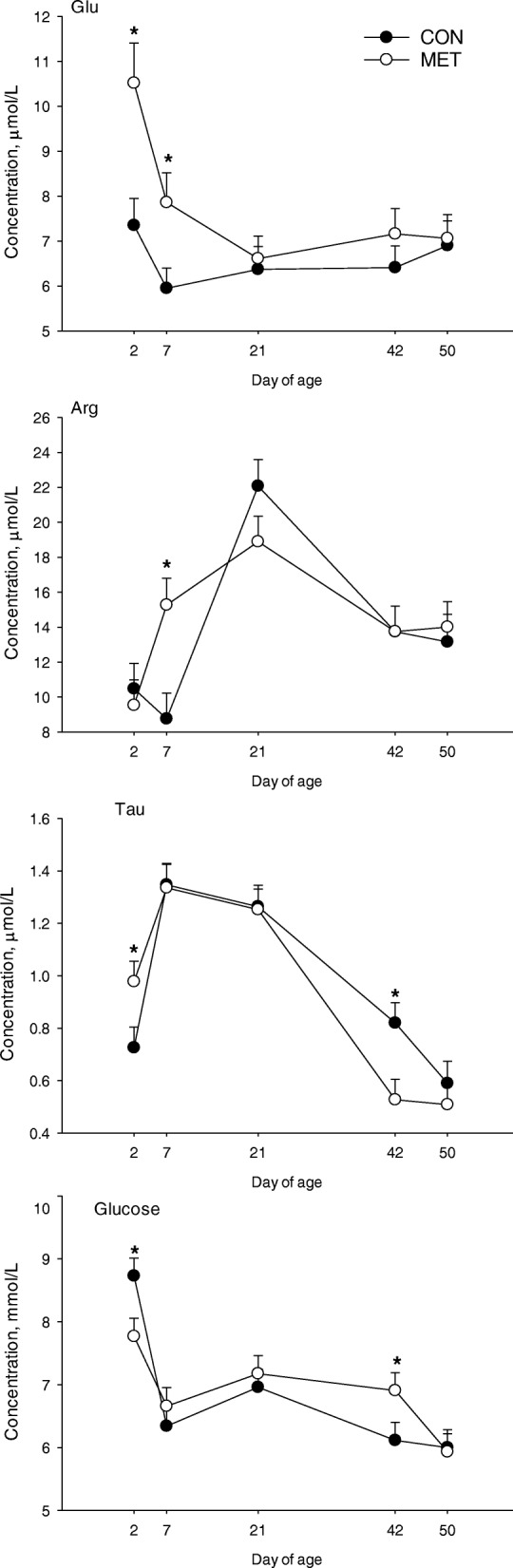
Despite greater daily DM intake pre-partum in cows fed MET (15.7 vs. 14.4 ± 0.12 kg/d, < 0.05), colostrum quality and quantity were not affected by maternal diet. At birth, MET calves had greater ( ≤ 0.05) body weight (BW, 44.1 vs. 42.1 ± 0.70 kg), hip height (HH, 81.3 vs. 79.6 ± 0.53 cm) and wither height (WH, 77.8 vs. 75.9 ± 0.47 cm). In contrast, concentrations of His, Lys, and Asn in plasma were lower ( ≤ 0.05) in MET calves. Regardless of colostrum source, the greater BW, HH, and WH in MET calves at birth persisted through 9 wk of age resulting in average responses of + 3.1 kg BW, + 1.9 cm HH, and + 1.8 cm WH compared with CON. Average daily gain during the 9 wk was ( < 0.05) 0.72 ± 0.02 kg/d in MET compared with 0.67 ± 0.02 kg/d in CON calves. Respiratory scores were normal and did not differ ( > 0.05) due to maternal Met supply or colostrum source. However, fecal scores tended to be lower ( ≤ 0.10) in MET calves regardless of colostrum source.
Increasing the maternal supply of MET during late-pregnancy enhanced growth in utero as well as during the pre-weaning and early post-weaning periods. Although the ~ 1 kg/d greater DM intake during the last 2-3 wk prior to parturition could explain a portion of the 2 kg extra body mass of MET calves at birth, other mechanisms potentially encompassing nutrient assimilation efficiency likely played a role. Assessing the exact mechanisms sensitive to supply of Met or total amino acid supply during the latter stages of growth in utero merit further research.
怀孕期和生命早期是可塑性的关键时期,在此期间,胎儿和新生儿可能会受到营养等环境因素的影响。非反刍动物孕期的母体蛋氨酸(Met)供应会影响后代的发育和生长。因此,本研究的目的是调查妊娠后期增加Met供应是否会影响犊牛出生时的发育参数,以及母体Met或来自Met饲喂母牛的初乳是否会改变犊牛生长。使用在妊娠最后28±2天单独饲喂基础对照[CON;1.47Mcal/kg干物质(DM)和15.3%粗蛋白]日粮且不添加Met的荷斯坦奶牛所产犊牛,或在基础对照日粮中添加乙基纤维素瘤胃保护Met(MET;Mepron®,占日粮DM的0.09%;赢创营养护理有限公司,德国)的犊牛。CON组共有39头犊牛(22头公牛,17头小母牛),MET组有42头犊牛(20头公牛,22头小母牛)。出生时,根据母牛处理和初乳情况将犊牛随机分配如下:1)CON组母牛所产犊牛且初乳来自CON组母牛(n = 21);2)CON组母牛所产犊牛且初乳来自MET组母牛(n = 18);3)MET组母牛所产犊牛且初乳来自MET组母牛(n = 22);4)MET组母牛所产犊牛且初乳来自CON组母牛(n = 20)。所有犊牛在出生后的前9周单独饲养、管理和饲喂。
尽管饲喂MET的母牛产前每日DM摄入量更高(15.7对14.4±0.12kg/d,P<0.05),但初乳质量和数量不受母体日粮影响。出生时,MET组犊牛体重(BW,44.1对42.1±0.70kg)、臀高(HH,81.3对79.6±0.53cm)和肩高(WH,77.8对75.9±0.47cm)更大(P≤0.05)。相反,MET组犊牛血浆中His、Lys和Asn的浓度较低(P≤0.05)。无论初乳来源如何,MET组犊牛出生时更大的BW、HH和WH在9周龄时仍然存在,与CON组相比,BW平均增加3.1kg,HH增加1.9cm,WH增加1.8cm。9周龄期间的平均日增重MET组为0.72±0.02kg/d,显著高于CON组的0.67±0.02kg/d(P<0.05)。呼吸评分正常,且不因母体Met供应或初乳来源而有差异(P>0.05)。然而,无论初乳来源如何,MET组犊牛的粪便评分往往较低(P≤0.10)。
妊娠后期增加母体Met供应可促进子宫内生长以及断奶前和断奶后早期的生长。尽管分娩前最后2 - 3周每日DM摄入量增加约1kg/d可以解释MET组犊牛出生时额外2kg体重的一部分,但其他潜在机制可能包括营养同化效率,也可能发挥了作用。评估子宫内生长后期对Met供应或总氨基酸供应敏感的确切机制值得进一步研究。