Departamento de Neurociencia Cognitiva, Instituto de Fisiología Celular, UNAM. Av. Universidad 3000, C.U. Coyoacán, Ciudad de México. C.P. 04510, Mexico.
Unidad de Neurobiología Dinámica, Departamento de Neuroquímica, INNN. Av. Insurgentes Sur #3877 Col. La Fama, Ciudad de México. C.P. 14269, Mexico.
Int J Mol Sci. 2018 Nov 29;19(12):3800. doi: 10.3390/ijms19123800.
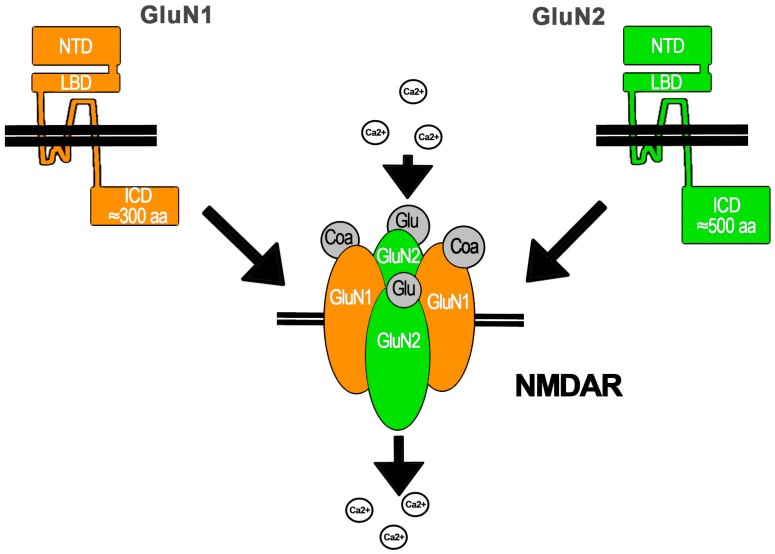
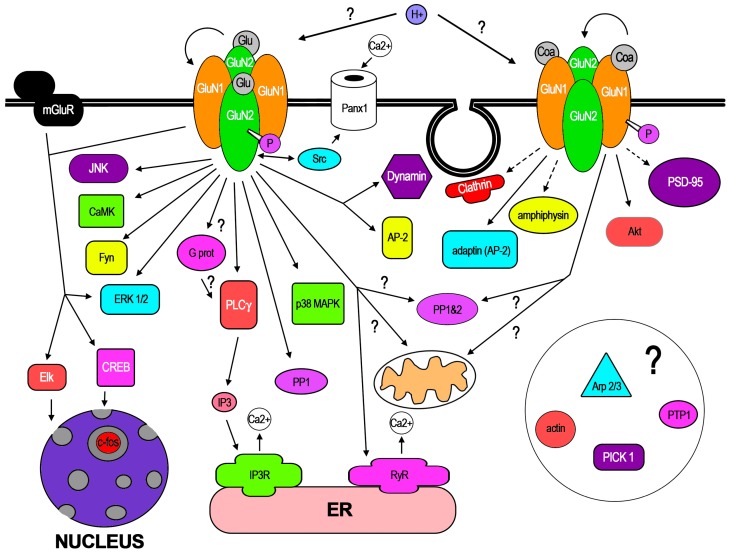
The glutamate (Glu) N-methyl-d-aspartate (NMDA) receptor (NMDAR) plays a critical role in synaptic communication given mainly by its ionotropic function that permeates Ca. This in turn activates calmodulin that triggers CaMKII, MAPK, CREB, and PI3K pathways, among others. However, NMDAR signaling is more complex. In the last two decades several groups have shown that the NMDAR also elicits flux-independent signaling (f-iNMDARs). It has been demonstrated that agonist (Glu or NMDA) or co-agonist (Glycine or d-Serine) bindings initiate intracellular events, including conformational changes, exchange of molecular interactions, release of second messengers, and signal transduction, that result in different cellular events including endocytosis, LTD, cell death, and neuroprotection, among others. Interestingly, f-iNMDARs has also been observed in pathological conditions and non-neuronal cells. Here, the molecular and cellular events elicited by these flux-independent actions (non-canonical or metabotropic-like) of the NMDAR are reviewed. Considering the NMDAR complexity, it is possible that these flux-independent events have a more relevant role in intracellular signaling that has been disregarded for decades. Moreover, considering the wide expression and function of the NMDAR in non-neuronal cells and other tissues beyond the nervous system and some evolutionary traits, f-iNMDARs calls for a reconsideration of how we understand the biology of this complex receptor.
谷氨酸(Glu)N-甲基-D-天冬氨酸(NMDA)受体(NMDAR)主要通过其离子型功能在突触通讯中发挥关键作用,该功能可使 Ca 通透。这反过来又激活钙调蛋白,触发 CaMKII、MAPK、CREB 和 PI3K 等途径。然而,NMDAR 信号转导更为复杂。在过去的二十年中,有几个研究小组已经表明,NMDAR 还会引发非离子流依赖性信号转导(f-iNMDARs)。已经证明,激动剂(Glu 或 NMDA)或共激动剂(Glycine 或 d-Serine)结合会引发细胞内事件,包括构象变化、分子相互作用的交换、第二信使的释放和信号转导,从而导致不同的细胞事件,包括内吞作用、 LTD、细胞死亡和神经保护等。有趣的是,在病理条件下和非神经元细胞中也观察到了 f-iNMDARs。在这里,我们综述了这些非离子流依赖性作用(非经典或代谢型样)引发的 NMDAR 的分子和细胞事件。考虑到 NMDAR 的复杂性,这些非离子流依赖性事件在细胞内信号转导中可能具有更重要的作用,而这一作用在过去几十年中一直被忽视。此外,鉴于 NMDAR 在非神经元细胞和神经系统以外的其他组织中的广泛表达和功能,以及一些进化特征,f-iNMDARs 需要重新考虑我们如何理解这个复杂受体的生物学。