Sakata Yoshihiko, Kawamura Kodai, Shingu Naoki, Hiroshige Shigeo, Yasuda Yuko, Eguchi Yoshitomo, Anan Keisuke, Hisanaga Junpei, Nitawaki Tatsuya, Nakano Aiko, Ichikado Kazuya
Division of Respiratory Medicine, Saiseikai Kumamoto Hospital, Kumamoto, Japan.
Asia Pac J Clin Oncol. 2020 Apr;16(2):e113-e117. doi: 10.1111/ajco.13103. Epub 2018 Dec 2.
Epidermal growth factor receptor tyrosine kinase inhibitors (EGFR-TKIs) are used to treat patients with non-small cell lung cancer (NSCLC) and EGFR driver mutations. Although some patients discontinued these treatments because of adverse events, it is unclear whether switching EGFR-TKI because of adverse events provides a benefit.
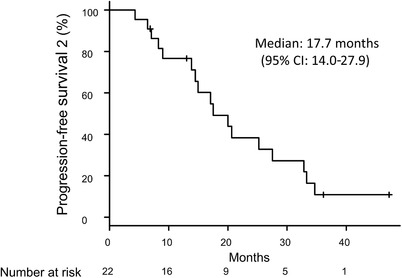
This retrospective study evaluated data from 22 patients with EGFR mutation-positive NSCLC who received at least two EGFR-TKIs that were switched because of adverse events (March 2011 to September 2017). Progression-free survival 2 (PFS2) was defined as the time from starting of the first EGFR-TKI treatment to disease progression during the second EGFR-TKI treatment.
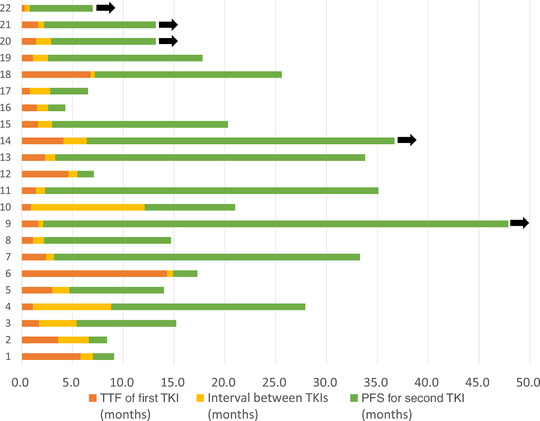
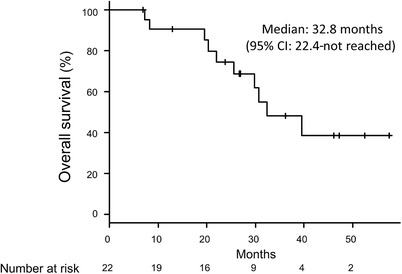
Seventeen patients received gefitinib as the first EGFR-TKI treatment, while four patients received afatinib and one patient received erlotinib. The median time to failure of the first EGFR-TKI treatment was 1.6 months. The EGFR-TKIs were switched because of hepatotoxicity (n = 16), interstitial lung disease (n = 3), and other reasons (n = 3). The median washout period was 1.1 months. Seventeen patients received erlotinib as the second EGFR-TKI treatment, while three patients received gefitinib and two patients received afatinib. The median PFS for the second EGFR-TKI treatment was 15.2 months. The median PFS2 was 17.7 months and the median overall survival was 32.8 months.
Switching EGFR-TKIs because of adverse events provided a clinical benefit for patients with EGFR mutation-positive NSCLC. Appropriate judgment regarding switching from one EGFR-TKI to another may improve the performance status and prognosis of patients with EGFR mutation-positive NSCLC.
表皮生长因子受体酪氨酸激酶抑制剂(EGFR-TKIs)用于治疗非小细胞肺癌(NSCLC)且有EGFR驱动基因突变的患者。尽管一些患者因不良事件而停用这些治疗,但尚不清楚因不良事件而更换EGFR-TKI是否有益。
这项回顾性研究评估了22例EGFR突变阳性NSCLC患者的数据,这些患者接受了至少两种因不良事件而更换的EGFR-TKIs(2011年3月至2017年9月)。无进展生存期2(PFS2)定义为从首次EGFR-TKI治疗开始至第二次EGFR-TKI治疗期间疾病进展的时间。
17例患者接受吉非替尼作为首次EGFR-TKI治疗,4例患者接受阿法替尼,1例患者接受厄洛替尼。首次EGFR-TKI治疗失败的中位时间为1.6个月。更换EGFR-TKIs的原因是肝毒性(n = 16)、间质性肺病(n = 3)和其他原因(n = 3)。中位洗脱期为1.1个月。17例患者接受厄洛替尼作为第二次EGFR-TKI治疗,3例患者接受吉非替尼,2例患者接受阿法替尼。第二次EGFR-TKI治疗的中位PFS为15.2个月。中位PFS2为17.7个月,中位总生存期为32.8个月。
因不良事件而更换EGFR-TKI为EGFR突变阳性NSCLC患者带来了临床益处。关于从一种EGFR-TKI转换为另一种EGFR-TKI的适当判断可能会改善EGFR突变阳性NSCLC患者的功能状态和预后。