Section of Hepatobiliary Surgery and Liver Transplantation, Department of Surgery, University of Groningen, University Medical Center Groningen, Groningen, the Netherlands.
Surgical Research Laboratory, Department of Surgery, University of Groningen, University Medical Center Groningen, Groningen, the Netherlands.
Hepatology. 2019 Apr;69(4):1719-1734. doi: 10.1002/hep.30365. Epub 2019 Mar 5.
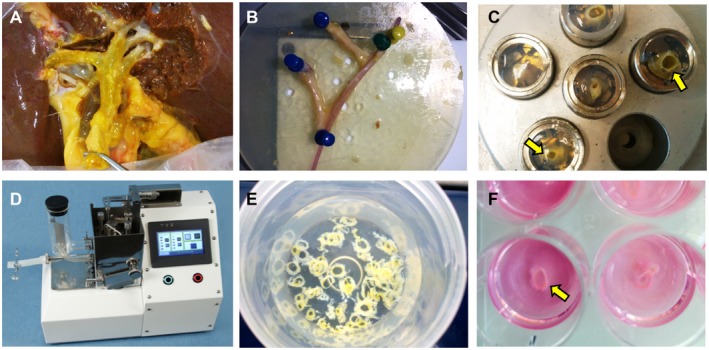
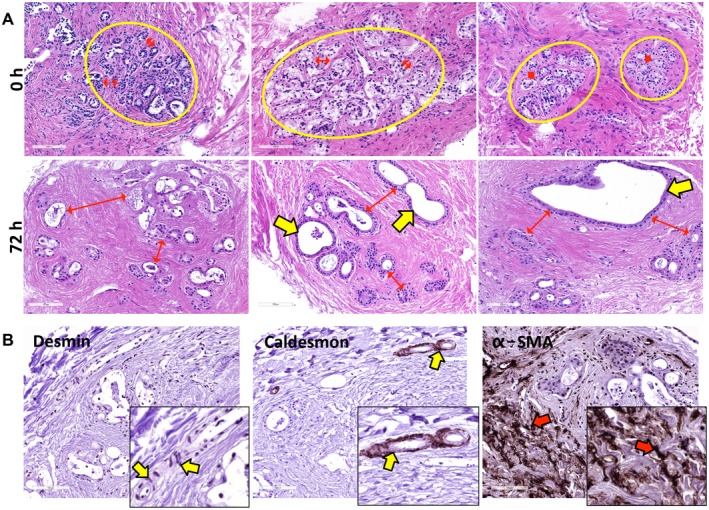
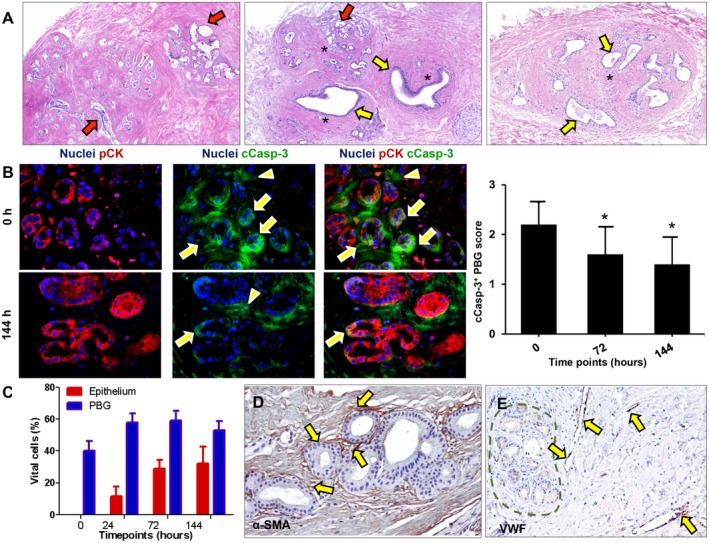
Peribiliary glands (PBG) are a source of stem/progenitor cells organized in a cellular network encircling large bile ducts. Severe cholangiopathy with loss of luminal biliary epithelium has been proposed to activate PBG, resulting in cell proliferation and differentiation to restore biliary epithelial integrity. However, formal evidence for this concept in human livers is lacking. We therefore developed an ex vivo model using precision-cut slices of extrahepatic human bile ducts obtained from discarded donor livers, providing an intact anatomical organization of cell structures, to study spatiotemporal differentiation and migration of PBG cells after severe biliary injury. Postischemic bile duct slices were incubated in oxygenated culture medium for up to a week. At baseline, severe tissue injury was evident with loss of luminal epithelial lining and mural stroma necrosis. In contrast, PBG remained relatively well preserved and different reactions of PBG were noted, including PBG dilatation, cell proliferation, and maturation. Proliferation of PBG cells increased after 24 hours of oxygenated incubation, reaching a peak after 72 hours. Proliferation of PBG cells was paralleled by a reduction in PBG apoptosis and differentiation from a primitive and pluripotent (homeobox protein Nanog+/ sex-determining region Y-box 9+) to a mature (cystic fibrosis transmembrane conductance regulator+/secretin receptor+) and activated phenotype (increased expression of hypoxia-inducible factor 1 alpha, glucose transporter 1, and vascular endothelial growth factor A). Migration of proliferating PBG cells in our ex vivo model was unorganized, but resulted in generation of epithelial monolayers at stromal surfaces. Conclusion: Human PBG contain biliary progenitor cells and are able to respond to bile duct epithelial loss with proliferation, differentiation, and maturation to restore epithelial integrity. The ex vivo spatiotemporal behavior of human PBG cells provides evidence for a pivotal role of PBG in biliary regeneration after severe injury.
胆小管周围腺(PBG)是一种以细胞网络形式存在的干细胞/祖细胞来源,围绕在大的胆管周围。人们提出,严重的胆管病变导致管腔上皮丢失会激活 PBG,引起细胞增殖和分化,从而恢复胆管上皮的完整性。然而,目前在人类肝脏中缺乏这一概念的明确证据。因此,我们建立了一种使用从废弃供体肝脏中获得的离体人外胆管的精确切割切片的体外模型,该模型提供了细胞结构的完整解剖组织,以研究严重胆管损伤后 PBG 细胞的时空分化和迁移。缺血后的胆管切片在含氧的培养介质中孵育长达一周。在基线时,明显存在严重的组织损伤,表现为管腔上皮衬里丢失和壁层基质坏死。相比之下,PBG 相对保存完好,并且观察到 PBG 的不同反应,包括 PBG 扩张、细胞增殖和成熟。在含氧孵育 24 小时后,PBG 细胞的增殖增加,在 72 小时后达到高峰。PBG 细胞的增殖伴随着 PBG 凋亡的减少和从原始多能性(同源盒蛋白 Nanog+/性别决定区 Y 框 9+)向成熟(囊性纤维化跨膜电导调节体+/分泌素受体+)和激活表型(缺氧诱导因子 1α、葡萄糖转运蛋白 1 和血管内皮生长因子 A 表达增加)的分化。在我们的体外模型中,增殖的 PBG 细胞的迁移是无组织的,但导致在基质表面生成上皮单层。结论:人 PBG 含有胆管祖细胞,并且能够对胆管上皮丢失做出反应,通过增殖、分化和成熟来恢复上皮完整性。人 PBG 细胞的体外时空行为为 PBG 在严重损伤后胆管再生中的关键作用提供了证据。