Ahmadi Badi Sara, Khatami S Hohreh, Irani S Hiva, Siadat Seyed Davar
Department of Biology, Science and Research Branch, Islamic Azad University, Tehran, Iran.
Department of Biochemistry, Pasteur Institute of Iran, Tehran, Iran.
Cell J. 2019 Apr;21(1):57-61. doi: 10.22074/cellj.2019.5750. Epub 2018 Nov 18.
Gastrointestinal (GI) tract, like other mucosal surface, is colonized with a microbial population known as gut microbiota. Outer membrane vesicles (OMVs) which are produced by gram negative bacteria could be sensed by Toll like receptors (TLRs). The interaction between gut microbiota and TLRs affects homeostasis and immune responses. In this study, we evaluated TLR2, TLR4 genes expression and cytokines concentration in Caco-2 cell line treated with Bacteroides fragilis (B. fragilis) and its OMVs.
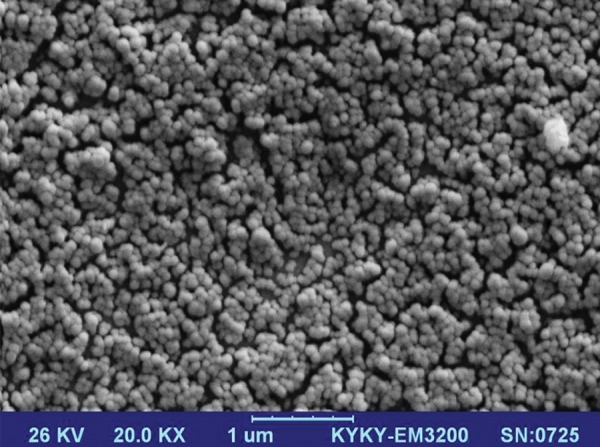
In this experimental study, OMVs were extracted using sequential centrifugation and their physicochemical properties were evaluated as part of quality control assessment. Caco-2 cells were treated with B. fragilis and its OMVs (180 and 350 μg/ml). Quantitative reverse transcriptase-polymerase chain reaction (qRT-PCR) was performed to assess TLR2 and TLR4 mRNA expression levels. Pro-inflammatory (IFNᵧ) and anti-inflammatory (IL- 4 and IL-10) cytokines were evaluated by ELISA.
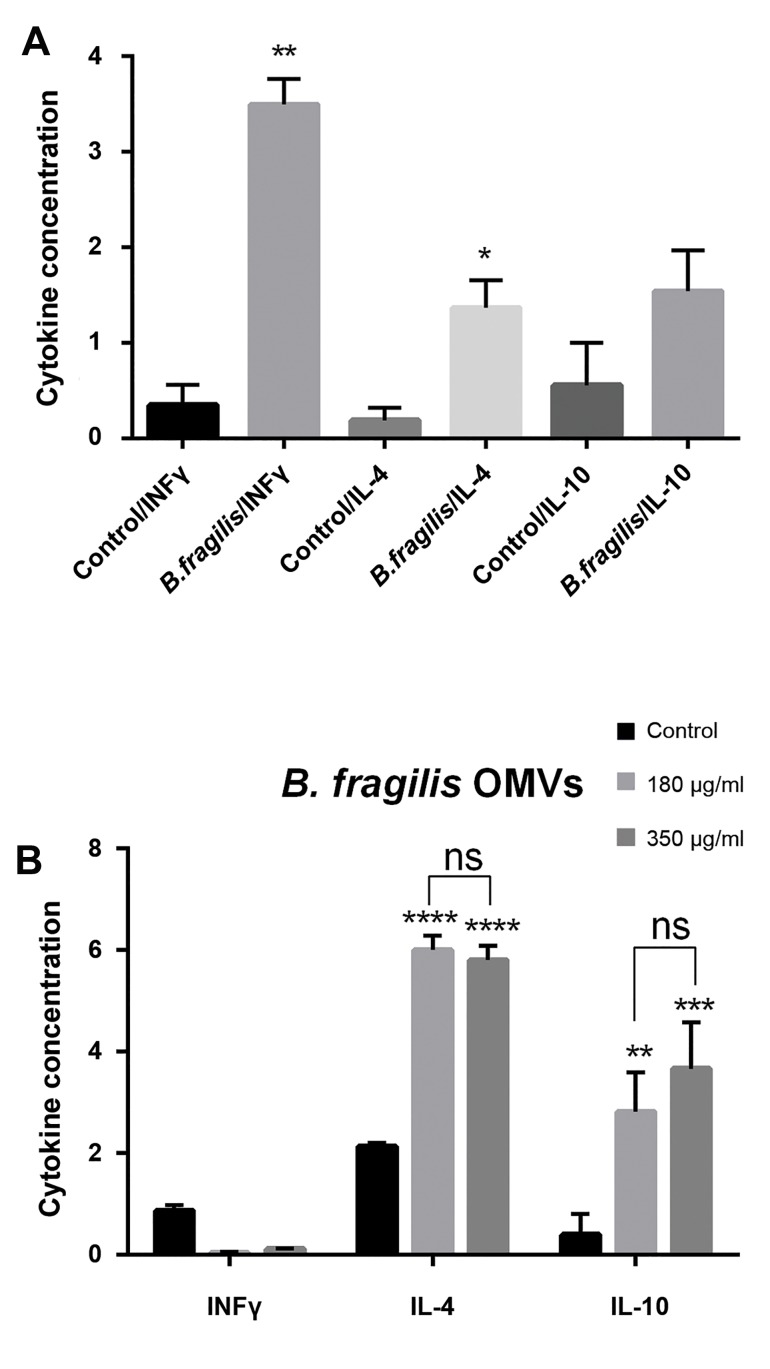
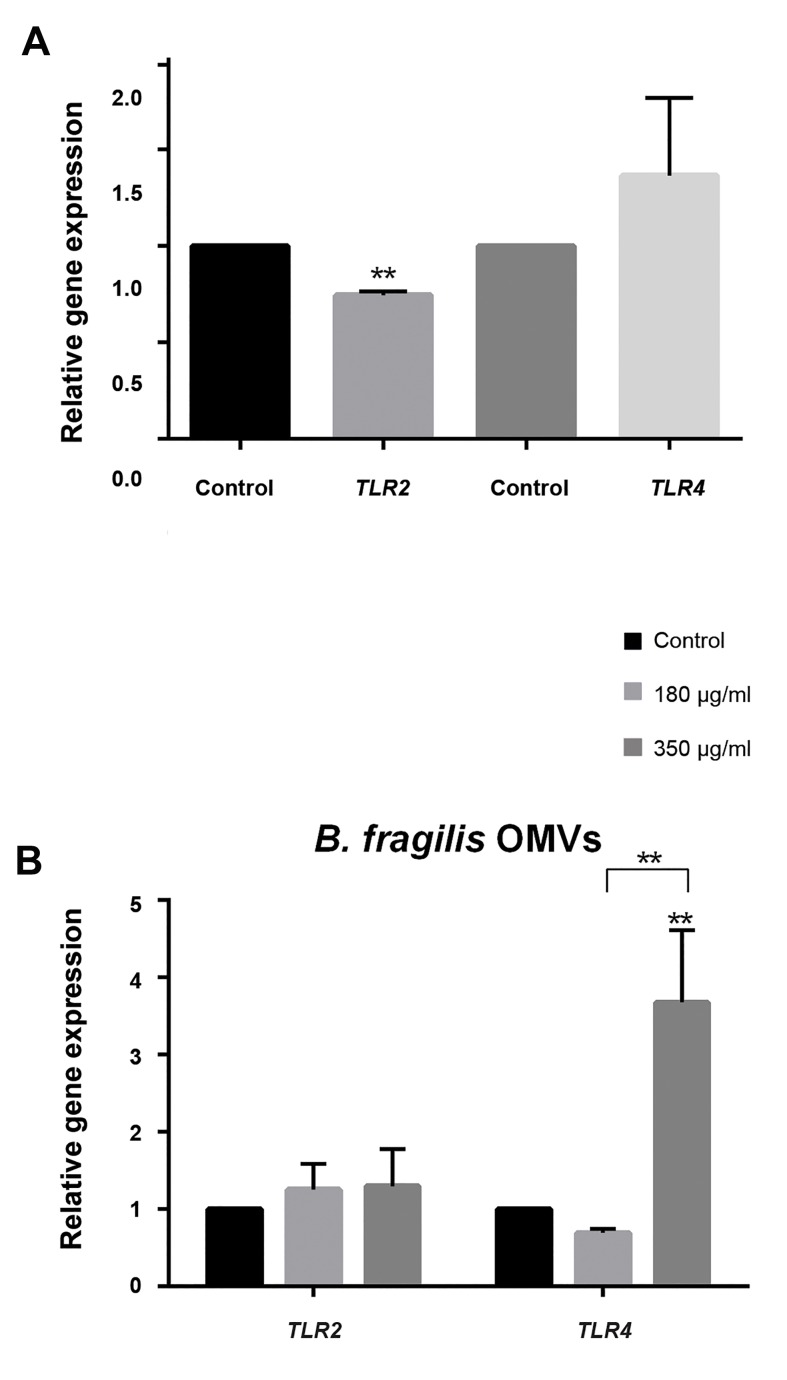
B. fragilis significantly decreased TLR2 and slightly increased TLR4 mRNA levels in Caco-2 cell line. The TLR2 mRNA level was slightly increased at 180 and 350 μg/ml of OMVs. Conversely, the TLR4 mRNA level was decreased at 180 μg/ml of OMVs, while it was significantly increased at 350 μg/ml of OMVs. Furthermore, B. fragilis and its OMVs significantly increased and decreased IFNᵧ concentration, respectively. Anti-inflammatory cytokines were increased by B. fragilis and its OMVs.
B. fragilis and its OMVs have pivotal role in the cross talk between gut microbiota and the host especially in the modulation of the immune system. Based on the last studies on immunomodulatory effect of B. fragilis derived OMVs on immune cells and our results, we postulate that B. fragilis derived OMVs could be possible candidates for the reduction of immune responses.
胃肠道与其他黏膜表面一样,定植着一种称为肠道微生物群的微生物群体。革兰氏阴性菌产生的外膜囊泡(OMV)可被 Toll 样受体(TLR)感知。肠道微生物群与 TLR 之间的相互作用会影响体内平衡和免疫反应。在本研究中,我们评估了用脆弱拟杆菌(B. fragilis)及其 OMV 处理的 Caco-2 细胞系中 TLR2、TLR4 基因表达和细胞因子浓度。
在本实验研究中,通过连续离心提取 OMV,并对其理化性质进行评估作为质量控制评估的一部分。用脆弱拟杆菌及其 OMV(180 和 350 μg/ml)处理 Caco-2 细胞。进行定量逆转录聚合酶链反应(qRT-PCR)以评估 TLR2 和 TLR4 mRNA 表达水平。通过酶联免疫吸附测定(ELISA)评估促炎细胞因子(IFNᵧ)和抗炎细胞因子(IL-4 和 IL-10)。
脆弱拟杆菌显著降低了 Caco-2 细胞系中 TLR2 的表达,并略微增加了 TLR4 mRNA 水平。在 180 和 350 μg/ml 的 OMV 处理下,TLR2 mRNA 水平略有增加。相反,在 180 μg/ml 的 OMV 处理下,TLR4 mRNA 水平降低,而在 350 μg/ml 的 OMV 处理下显著增加。此外,脆弱拟杆菌及其 OMV 分别显著增加和降低了 IFNᵧ 浓度。脆弱拟杆菌及其 OMV 增加了抗炎细胞因子的表达。
脆弱拟杆菌及其 OMV 在肠道微生物群与宿主之间的相互作用中起关键作用,尤其是在免疫系统的调节方面。基于最近关于脆弱拟杆菌衍生的 OMV 对免疫细胞免疫调节作用的研究以及我们的结果,我们推测脆弱拟杆菌衍生的 OMV 可能是降低免疫反应的潜在候选物。