Nozari Ahoura, Aghaei-Moghadam Ehsan, Zeinaloo Aliakbar, Alavi Afagh, Ghasemi Firouzabdi Saghar, Minaee Shohre, Eskandari Hesari Marzieh, Behjati Farkhondeh
Genetics Research Center, University of Social Welfare and Rehabilitation Sciences, Tehran, Iran.
Department of Pediatrics Cardiology, Faculty of Medicine, Tehran University of Medical Sciences, Tehran, Iran.
Cell J. 2019 Apr;21(1):70-77. doi: 10.22074/cellj.2019.5734. Epub 2018 Nov 18.
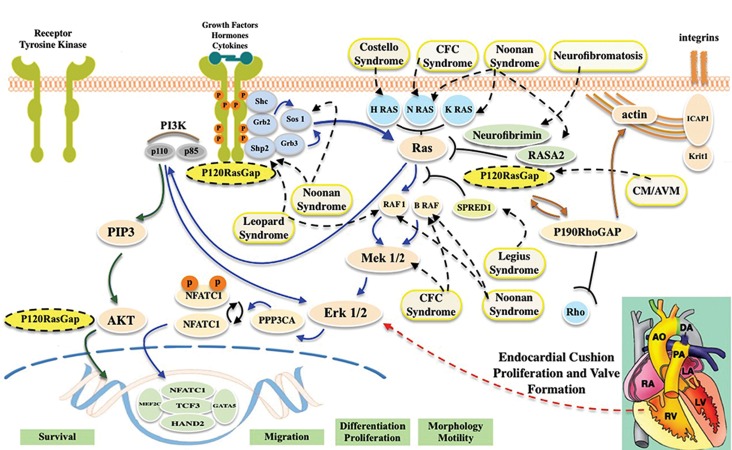
Tricuspid atresia (TA) is a rare life-threatening form of congenital heart defect (CHD). The genetic mechanisms underlying TA are not clearly understood. According to previous studies, the endocardial cushioning event, as the primary sign of cardiac valvulogenesis, is governed by several overlapping signaling pathways including Ras/ ERK pathway. RASA1, a regulator of cardiovascular development, is involved in this pathway and its haploinsufficiency (due to heterozygous mutations) has been identified as the underlying etiology of the autosomal dominant capillary malformation/arteriovenous malformation (CM/AVM).
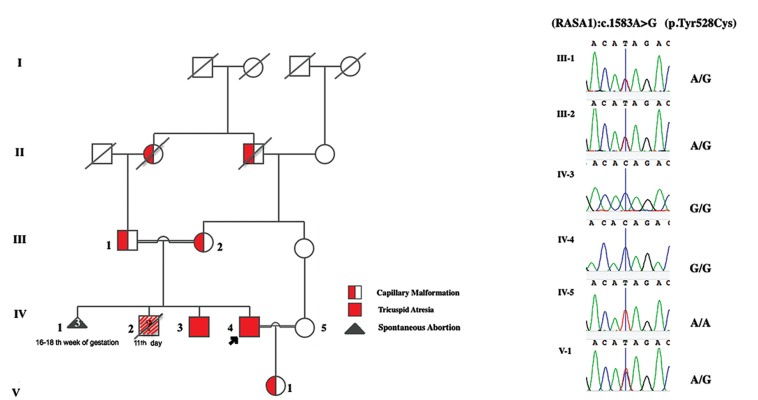
In this prospective study, we used whole exome sequencing (WES) followed by serial bioinformatics filtering steps for two siblings with TA and early onset CM. Their parents were consanguineous which had a history of recurrent abortions. Patients were carefully assessed to exclude extra-cardiac anomalies.
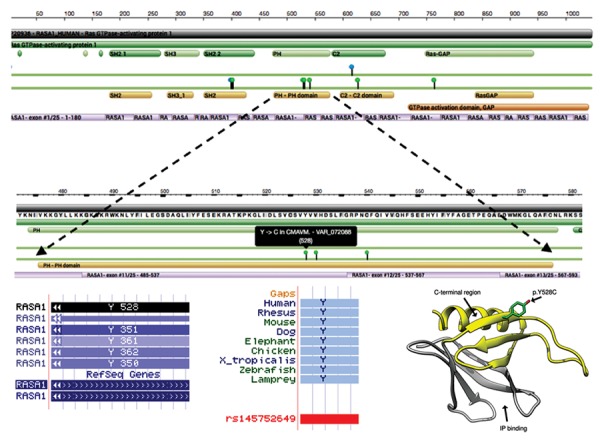
We identified a homozygous RASA1 germline mutation, c.1583A>G (p.Tyr528Cys) in the family. This mutation lies in the pleckstrin homology (PH) domain of the gene. The parents who were heterozygous for this variant displayed CM.
This is the first study reporting an adverse phenotypic outcome of a RASA1 homozygous mutation. Here, we propose that the phenotypic consequence of the homozygous RASA1 p.Tyr528Cys mutation is more serious than the heterozygous type. This could be responsible for the TA pathogenesis in our patients. We strongly suggest that parents with CM/AVM should be investigated for RASA1 heterozygous mutations. Prenatal diagnosis and fetal echocardiography should also be carried out in the event of pregnancy in heterozygous parents.
三尖瓣闭锁(TA)是一种罕见的、危及生命的先天性心脏缺陷(CHD)形式。TA的遗传机制尚不清楚。根据以往的研究,心内膜垫形成事件作为心脏瓣膜发生的主要标志,受包括Ras/ERK途径在内的几种重叠信号通路调控。RASA1是心血管发育的调节因子,参与该途径,其单倍体不足(由于杂合突变)已被确定为常染色体显性遗传性毛细血管畸形/动静脉畸形(CM/AVM)的潜在病因。
在这项前瞻性研究中,我们对两名患有TA和早发性CM的兄弟姐妹进行了全外显子组测序(WES),随后进行了一系列生物信息学筛选步骤。他们的父母是近亲,有反复流产史。对患者进行了仔细评估以排除心脏外异常。
我们在该家族中发现了一个纯合的RASA1种系突变,即c.1583A>G(p.Tyr528Cys)。该突变位于该基因的pleckstrin同源(PH)结构域。该变异的杂合子父母表现出CM。
这是第一项报道RASA1纯合突变不良表型结果的研究。在此,我们提出RASA1 p.Tyr528Cys纯合突变的表型后果比杂合型更严重。这可能是我们患者中TA发病机制的原因。我们强烈建议对患有CM/AVM的父母进行RASA1杂合突变检测。如果杂合子父母怀孕,还应进行产前诊断和胎儿超声心动图检查。