Spectroscopy and Imaging, Leibniz Institute of Photonic Technology, Jena, Germany.
Institute for Physical Chemistry and Abbe Center of Photonics, Friedrich Schiller University, Jena, Germany.
PLoS One. 2018 Dec 3;13(12):e0207380. doi: 10.1371/journal.pone.0207380. eCollection 2018.
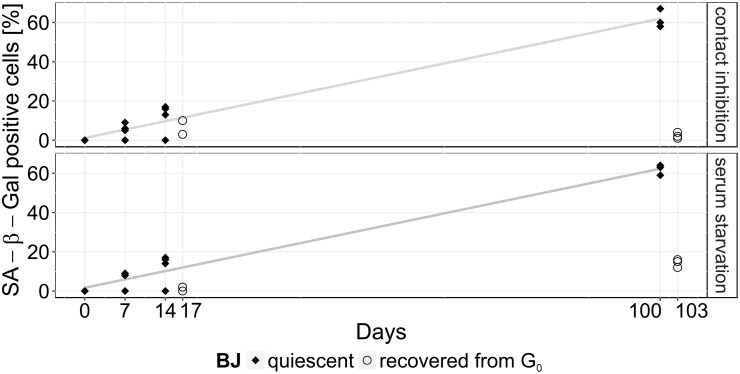
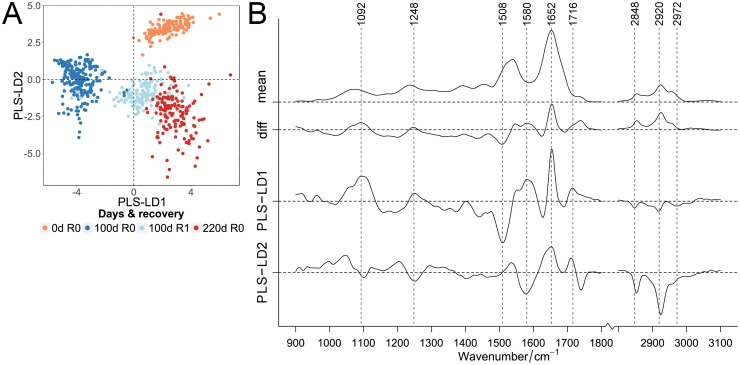
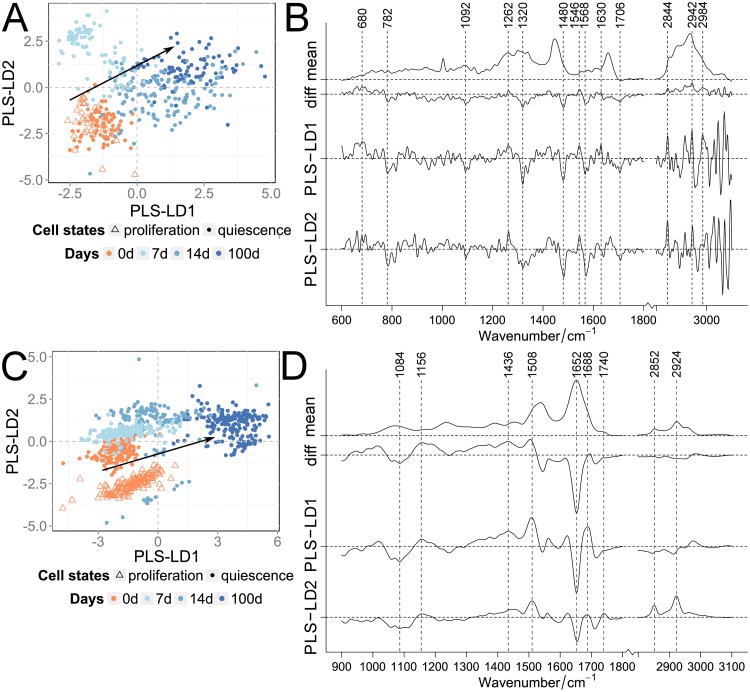
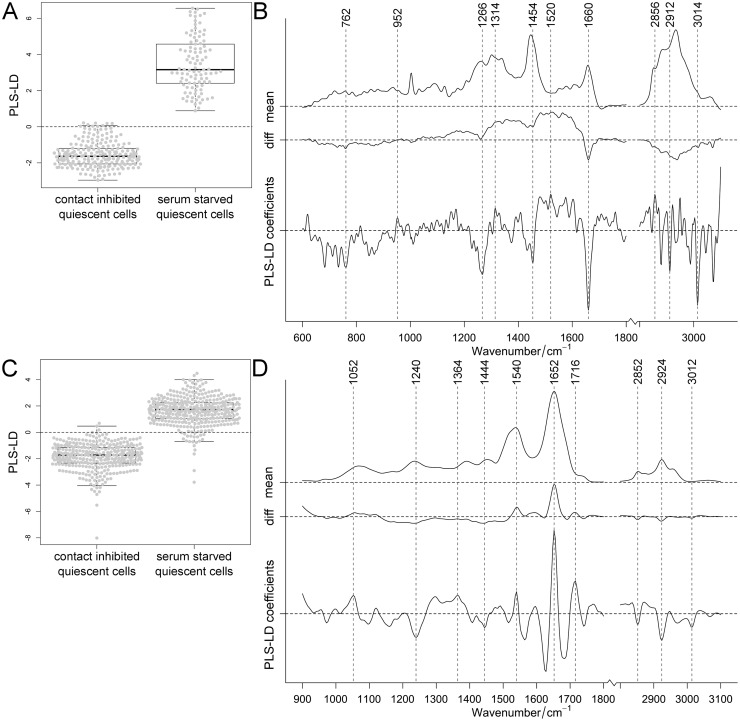
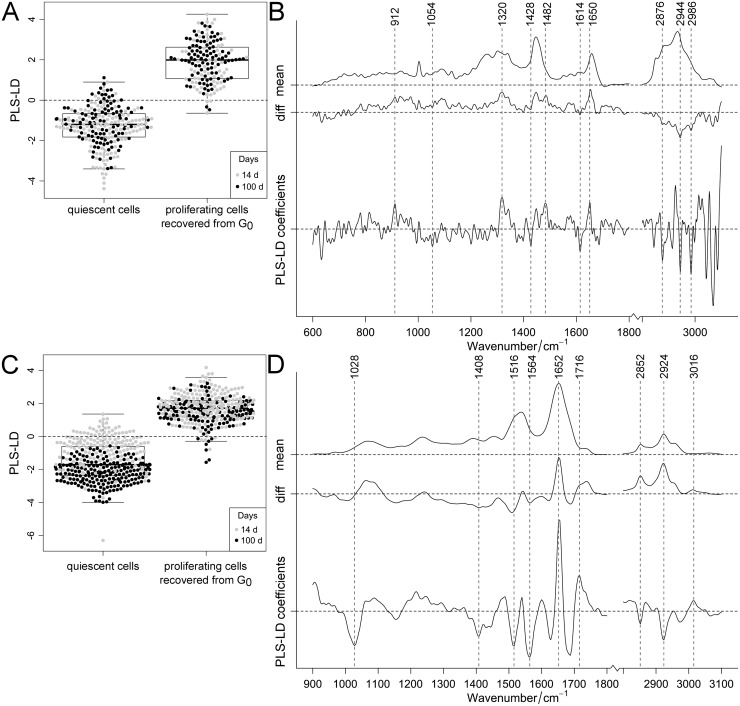
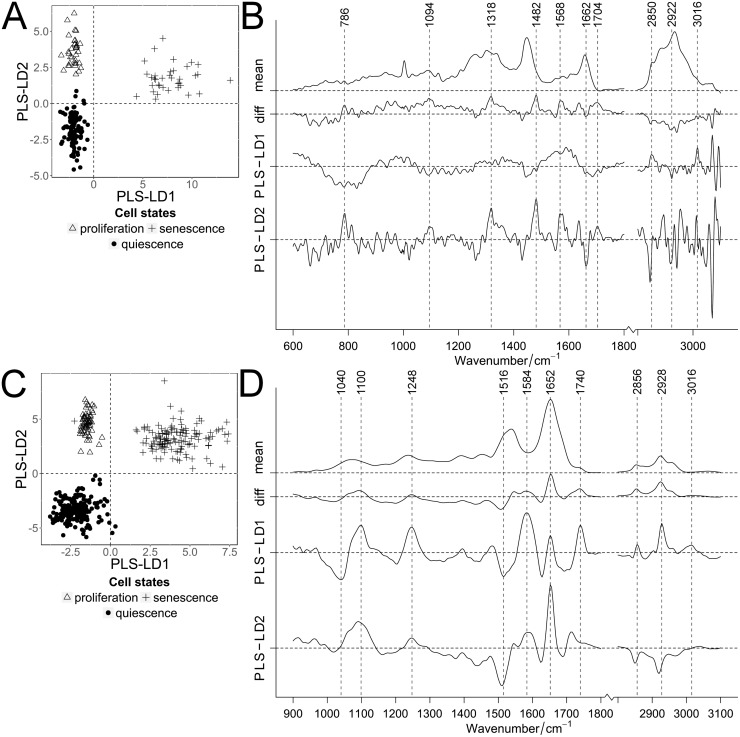
Dermal fibroblast cells can adopt different cell states such as proliferation, quiescence, apoptosis or senescence, in order to ensure tissue homeostasis. Proliferating (dividing) cells pass through the phases of the cell cycle, while quiescent and senescent cells exist in a non-proliferating cell cycle-arrested state. However, the reversible quiescence state is in contrast to the irreversible senescence state. Long-term quiescent cells transit into senescence indicating that cells age also when not passing through the cell cycle. Here, by label-free in vitro vibrational spectroscopy, we studied the biomolecular composition of quiescent dermal fibroblast cells and compared them with those of proliferating and senescent cells. Spectra were examined by multivariate statistical analysis using a PLS-LDA classification model, revealing differences in the biomolecular composition between the cell states mainly associated with protein alterations (variations in the side chain residues of amino acids and protein secondary structure), but also within nucleic acids and lipids. We observed spectral changes in quiescent compared to proliferating cells, which increased with quiescence cultivation time. Raman and infrared spectroscopy, which yield complementary biochemical information, clearly distinguished contact-inhibited from serum-starved quiescent cells. Furthermore, the spectra displayed spectral differences between quiescent cells and proliferating cells, which had recovered from quiescence. This became more distinct with increasing quiescence cultivation time. When comparing proliferating, (in particular long-term) quiescent and senescent cells, we found that Raman as well as infrared spectroscopy can separate these three cellular states from each other due to differences in their biomolecular composition. Our spectroscopic analysis shows that proliferating and quiescent fibroblast cells age by similar but biochemically not identical processes. Despite their aging induced changes, over long time periods quiescent cells can return into the cell cycle. Finally however, the cell cycle arrest becomes irreversible indicating senescence.
真皮成纤维细胞可以采用不同的细胞状态,如增殖、静止、凋亡或衰老,以确保组织内环境稳定。增殖(分裂)细胞经历细胞周期的各个阶段,而静止和衰老细胞则处于非增殖的细胞周期停滞状态。然而,可逆的静止状态与不可逆的衰老状态相反。长期静止的细胞会过渡到衰老状态,这表明即使不经过细胞周期,细胞也会衰老。在这里,我们通过无标记的体外振动光谱研究了静止真皮成纤维细胞的生物分子组成,并将其与增殖和衰老细胞进行了比较。通过使用 PLS-LDA 分类模型的多变量统计分析来检查光谱,揭示了细胞状态之间生物分子组成的差异主要与蛋白质变化(氨基酸侧链残基和蛋白质二级结构的变化)有关,但也与核酸和脂质有关。我们观察到静止细胞与增殖细胞相比,光谱发生了变化,这种变化随着静止培养时间的增加而增加。拉曼和红外光谱提供了互补的生化信息,清楚地区分了接触抑制和血清饥饿的静止细胞。此外,与恢复静止的增殖细胞相比,静止细胞的光谱显示出与增殖细胞不同的光谱差异。随着静止培养时间的增加,这种差异变得更加明显。当比较增殖、(特别是长期)静止和衰老细胞时,我们发现拉曼和红外光谱可以由于它们的生物分子组成的差异而将这三种细胞状态彼此区分开来。我们的光谱分析表明,增殖和静止的成纤维细胞通过相似但生化上不同的过程衰老。尽管它们的衰老诱导变化,但在很长一段时间内,静止细胞可以重新进入细胞周期。然而,最终细胞周期停滞变得不可逆,表明衰老。