Service de Gynécologie-Obstétrique, AP-HP, Hôpital Antoine Béclère, Université Paris Sud, 154 rue de la Porte de Trivaux, 92140, Clamart, France.
Department of Obstetrics and Gynecology, University Hospital Brugmann, Université Libre de Bruxelles, Brussels, Belgium.
J Transl Med. 2018 Dec 3;16(1):335. doi: 10.1186/s12967-018-1705-2.
Recent studies have suggested a possible association between heparin treatment at the time of cell-free DNA (cfDNA) testing and a non-reportable result. However, these studies lack of proper methodology and had a low level of proof to firmly incriminate heparin. Our objective was to investigate further the relationship between heparin treatment and cfDNA test results.
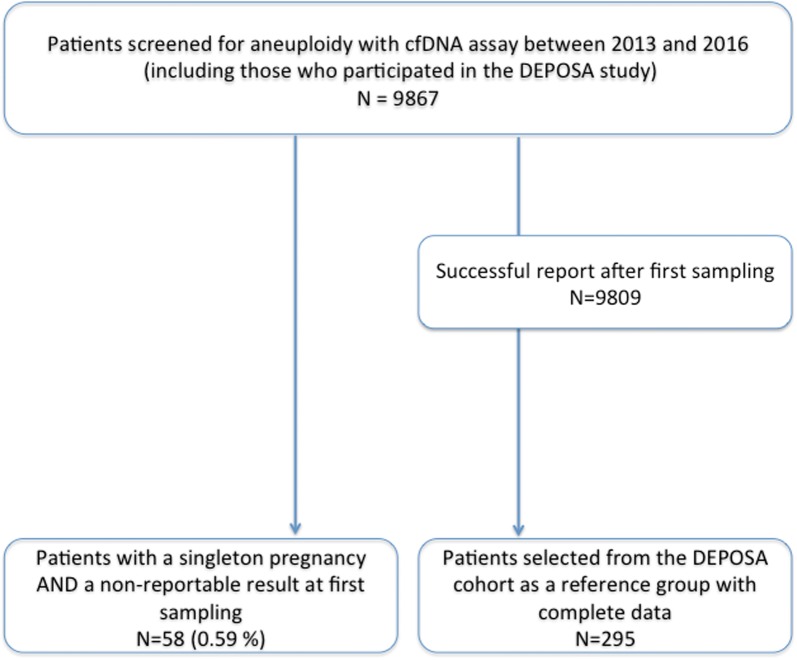
Two complementary approaches were used for the demonstration. First, we conducted a retrospective analysis of a cohort of patients with a singleton pregnancy, screened for aneuploidies by using cfDNA, but with a non-reportable cfDNA result. We included patients between 2013 and 2016 including the patients from the DEPOSA study as controls. CfDNA testing was performed by massive parallel sequencing by using a whole-genome approach. A multiple logistic regression was used to account for the influence of the variables included. Second, we performed in vitro experiments on mimic samples containing increased concentrations of heparin.
Of 9867 singleton pregnancies tested during the inclusion period, 58 (0.59%) had a non-reportable result and were compared to 295 control patients. Fifteen (25.9%) and 20 (6.8%) patients were treated with heparin in the group with a non-reportable cfDNA result and with a successful assay, respectively. In multivariable analysis, an increased calculated risk at the first-trimester combined screening (OR 28.8 CI 9.76-85.15, p < 0.001), maternal weight (OR 1.03, CI 1.01-1.06, p = 0.01), and the presence of an autoimmune disease (OR 10.38, CI 1.62-66.53, p = 0.01) were the only characteristics associated with a non-reportable result. In vitro experiments showed that heparin had no impact on fetal fraction measurement or the final result, no matter what the dose tested.
Treatment by heparin had no impact on cfDNA screening test for aneuploidies, while the presence of an autoimmune disorder is an independent predictor of a non-reportable result.
最近的研究表明,在无细胞游离 DNA(cfDNA)检测时使用肝素治疗与不可报告的结果之间可能存在关联。然而,这些研究缺乏适当的方法,且证明水平低,无法确定肝素的罪责。我们的目的是进一步研究肝素治疗与 cfDNA 检测结果之间的关系。
采用两种互补方法进行论证。首先,我们对一组接受 cfDNA 筛查的单胎妊娠患者进行了回顾性分析,但 cfDNA 结果不可报告。我们纳入了 2013 年至 2016 年期间的患者,包括 DEPOSA 研究的患者作为对照。cfDNA 检测采用全基因组方法进行大规模平行测序。采用多因素逻辑回归来解释所纳入变量的影响。其次,我们在含有肝素浓度增加的模拟样本中进行了体外实验。
在纳入期间,9867 例单胎妊娠中,58 例(0.59%)结果不可报告,并与 295 例对照患者进行了比较。在不可报告的 cfDNA 结果组和成功检测组中,分别有 15 例(25.9%)和 20 例(6.8%)患者接受了肝素治疗。多因素分析显示,早孕期联合筛查的计算风险增加(OR 28.8 CI 9.76-85.15,p<0.001)、产妇体重(OR 1.03,CI 1.01-1.06,p=0.01)和自身免疫性疾病(OR 10.38,CI 1.62-66.53,p=0.01)是与不可报告结果相关的唯一特征。体外实验表明,肝素对胎儿比例测量或最终结果没有影响,无论测试剂量如何。
肝素治疗对 cfDNA 筛查非整倍体无影响,而自身免疫性疾病的存在是不可报告结果的独立预测因素。