Robert Wood Johnson Medical School Institute for Neurological Therapeutics, Rutgers Biomedical and Health Sciences, Piscataway, NJ 08854.
Department of Neurology, Rutgers Robert Wood Johnson Medical School, Piscataway, NJ 08854.
Proc Natl Acad Sci U S A. 2018 Dec 18;115(51):E12053-E12062. doi: 10.1073/pnas.1813365115. Epub 2018 Dec 3.
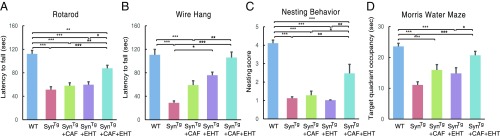
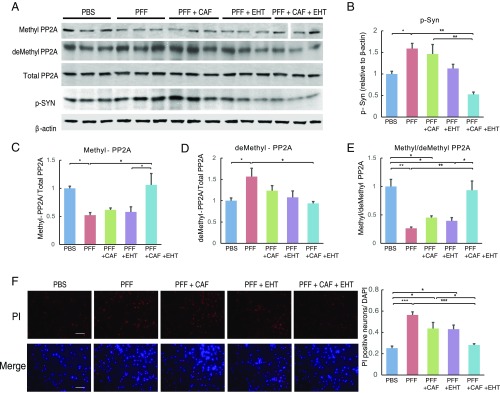
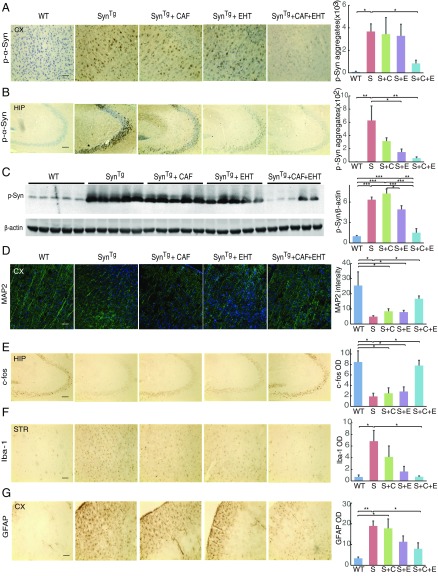
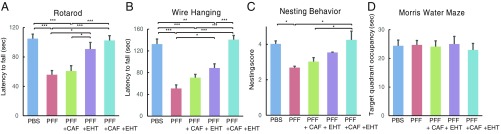
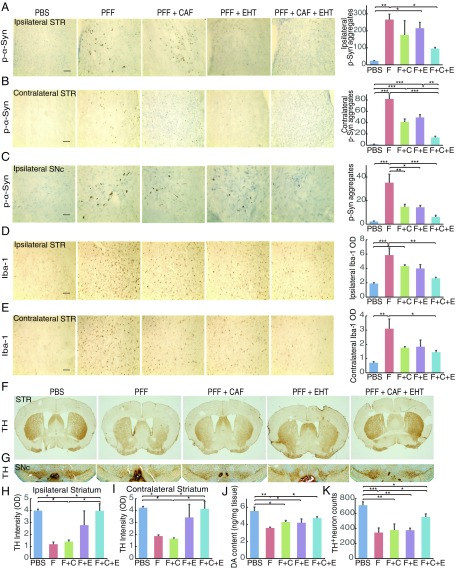
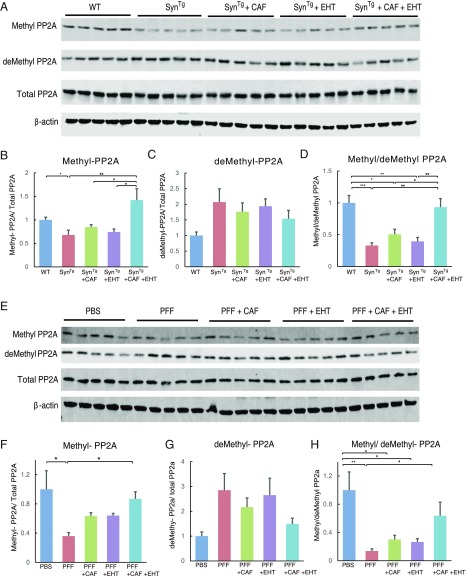
Hyperphosphorylated α-synuclein in Lewy bodies and Lewy neurites is a characteristic neuropathological feature of Parkinson's disease (PD) and Dementia with Lewy bodies (DLB). The catalytic subunit of the specific phosphatase, protein phosphatase 2A (PP2A) that dephosphorylates α-synuclein, is hypomethylated in these brains, thereby impeding the assembly of the active trimeric holoenzyme and reducing phosphatase activity. This phosphatase deficiency contributes to the accumulation of hyperphosphorylated α-synuclein, which tends to fibrillize more than unmodified α-synuclein. Eicosanoyl-5-hydroxytryptamide (EHT), a fatty acid derivative of serotonin found in coffee, inhibits the PP2A methylesterase so as to maintain PP2A in a highly active methylated state and mitigates the phenotype of α-synuclein transgenic (Syn) mice. Considering epidemiologic and experimental evidence suggesting protective effects of caffeine in PD, we sought, in the present study, to test whether there is synergy between EHT and caffeine in models of α-synucleinopathy. Coadministration of these two compounds orally for 6 mo at doses that were individually ineffective in Syn mice and in a striatal α-synuclein preformed fibril inoculation model resulted in reduced accumulation of phosphorylated α-synuclein, preserved neuronal integrity and function, diminished neuroinflammation, and improved behavioral performance. These indices were associated with increased levels of methylated PP2A in brain tissue. A similar profile of greater PP2A methylation and cytoprotection was found in SH-SY5Y cells cotreated with EHT and caffeine, but not with each compound alone. These findings suggest that these two components of coffee have synergistic effects in protecting the brain against α-synuclein-mediated toxicity through maintenance of PP2A in an active state.
在路易体和路易神经纤维中高度磷酸化的α-突触核蛋白是帕金森病(PD)和路易体痴呆(DLB)的特征性神经病理学特征。该蛋白的去磷酸化酶——特异性磷酸酶 2A(PP2A)的催化亚基在这些大脑中被低甲基化,从而阻碍了活性三聚体全酶的组装并降低了磷酸酶活性。这种磷酸酶缺乏导致了过度磷酸化的α-突触核蛋白的积累,这种蛋白比未修饰的α-突触核蛋白更容易聚集。花生四烯酰-5-羟色胺(EHT)是一种在咖啡中发现的 5-羟色胺的脂肪酸衍生物,它可以抑制 PP2A 甲基转移酶,从而使 PP2A 保持高度活跃的甲基化状态,并减轻α-突触核蛋白转基因(Syn)小鼠的表型。考虑到流行病学和实验证据表明咖啡因对 PD 具有保护作用,我们在本研究中试图测试 EHT 和咖啡因在α-突触核蛋白病模型中是否存在协同作用。这两种化合物以单独在 Syn 小鼠中无效的剂量口服共给药 6 个月,以及在纹状体α-突触核蛋白原纤维接种模型中,导致磷酸化α-突触核蛋白的积累减少,神经元完整性和功能得到保存,神经炎症减少,行为表现得到改善。这些指标与脑组织中甲基化 PP2A 水平的增加有关。在共处理 EHT 和咖啡因的 SH-SY5Y 细胞中也发现了类似的更大 PP2A 甲基化和细胞保护的特征,但每种化合物单独处理时没有发现。这些发现表明,咖啡中的这两种成分通过维持 PP2A 的活性状态,在保护大脑免受α-突触核蛋白介导的毒性方面具有协同作用。