Department of Public Health, University of Helsinki, Helsinki, Finland.
Finnish Institute of Occupational Health, PB 18, 00032, Helsinki, Finland.
Int Arch Occup Environ Health. 2019 Apr;92(3):337-345. doi: 10.1007/s00420-018-1393-5. Epub 2018 Dec 3.
We developed a job exposure matrix (JEM) to study the association between long-term exposure to heavy physical effort or heavy lifting and carrying at work with disability pension due to musculoskeletal disorders and premature all-cause mortality.
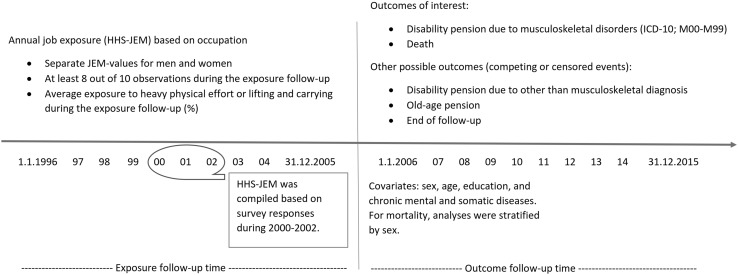
Exposure to heavy physical effort at work during 1996-2005 was estimated with JEM developed for this study population, where the exposure was based on occupational titles of the participants. We included all employees of the City of Helsinki, Finland, who had annual data of exposure for 8-10 years (1996-2005, n = 18387). The outcome variables were register-based, and the follow-up was from 2006 until 2015. The risk estimates were evaluated using competing risk survival analysis.
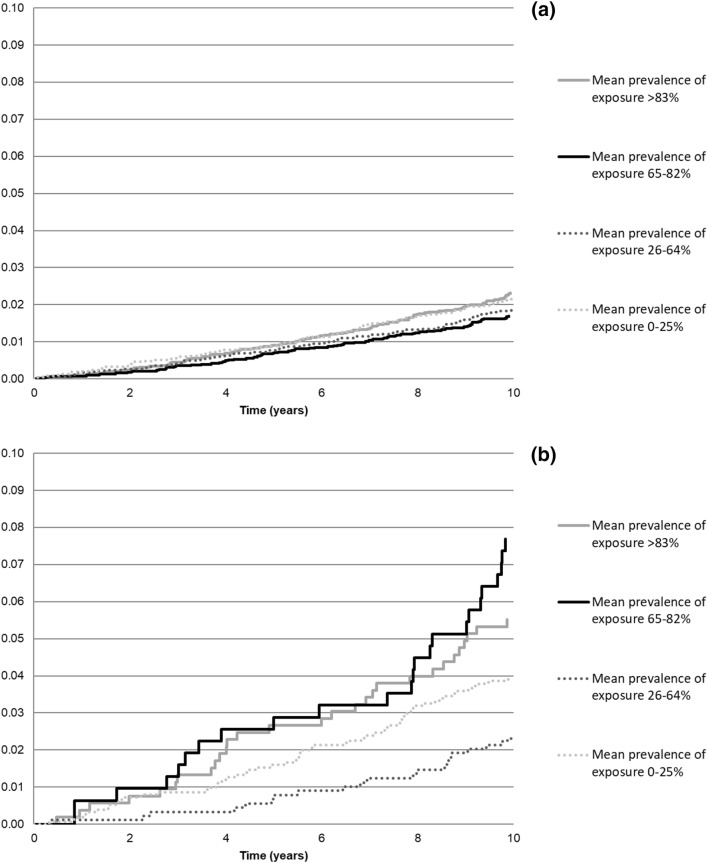
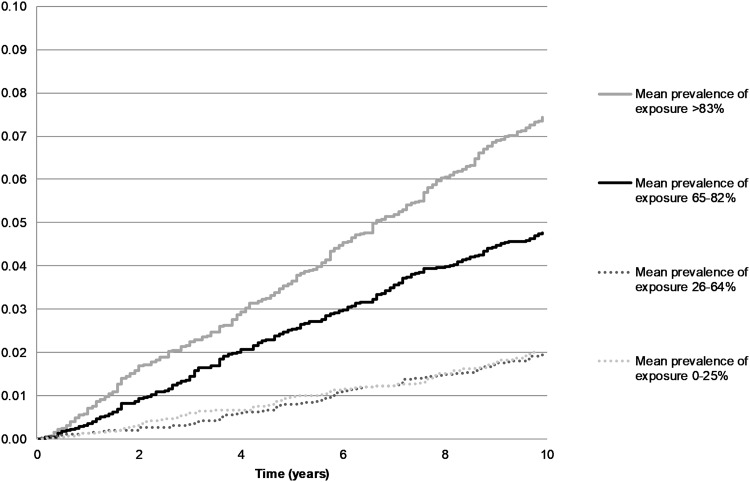
There were 530 (3%) disability pension events due to musculoskeletal disorders during the 10-year follow-up. After adjustment for sex, age, education and chronic diseases, employees in the second (SHR = 1.46, 95% CI 1.05-2.05), third (SHR = 2.73, 95% CI 2.00-2.29), and the highest exposure quartile (SHR = 2.56, 95% CI 1.88-3.50) had a higher risk of musculoskeletal disability pension than employees in the lowest quartile. A total of 110 (4%) men and 266 (2%) women died during the follow-up. Men in the third quartile (SHR = 2.29, 95% CI 1.23-4.24), and women in the highest exposure quartile (SHR = 1.54, 95% CI 0.99-2.41) had a higher risk of premature mortality than those in the lowest quartile.
Eight to ten years of exposure to heavy physical effort at work is strongly associated with disability pension due to musculoskeletal disorders. This exposure also increases the risk of premature mortality, particularly among men.
我们开发了一种工作暴露矩阵(JEM),以研究长期暴露于繁重体力劳动或搬运重物与肌肉骨骼疾病导致的残疾抚恤金和过早全因死亡率之间的关联。
使用为该研究人群开发的 JEM 估计 1996-2005 年工作期间的繁重体力劳动暴露情况,暴露情况基于参与者的职业头衔。我们纳入了芬兰赫尔辛基市的所有员工,他们在 8-10 年内(1996-2005 年)有年度暴露数据(n=18387)。结局变量是基于登记册的,随访时间从 2006 年到 2015 年。使用竞争风险生存分析评估风险估计值。
在 10 年的随访期间,有 530 例(3%)因肌肉骨骼疾病导致残疾抚恤金事件。在校正性别、年龄、教育程度和慢性病后,第二(SHR=1.46,95%CI 1.05-2.05)、第三(SHR=2.73,95%CI 2.00-2.29)和最高暴露四分位组(SHR=2.56,95%CI 1.88-3.50)的员工肌肉骨骼残疾抚恤金风险高于最低四分位组。在随访期间,共有 110 名男性(4%)和 266 名女性(2%)死亡。第三四分位组的男性(SHR=2.29,95%CI 1.23-4.24)和最高暴露四分位组的女性(SHR=1.54,95%CI 0.99-2.41)的过早死亡风险高于最低四分位组。
工作中 8-10 年的繁重体力劳动暴露与肌肉骨骼疾病导致的残疾抚恤金密切相关。这种暴露还会增加过早死亡的风险,尤其是男性。