King Abdullah University of Science and Technology (KAUST), Biological and Environmental Sciences and Engineering Division (BESE), Thuwal, 23955-6900, Saudi Arabia.
Department of Biochemistry, Genetics and Microbiology, Centre for Microbial Ecology and Genomics, University of Pretoria, Pretoria, South Africa.
Microbiome. 2018 Dec 4;6(1):215. doi: 10.1186/s40168-018-0597-y.
The rhizosheath-root system is an adaptive trait of sandy-desert speargrasses in response to unfavourable moisture and nutritional conditions. Under the deserts' polyextreme conditions, plants interact with edaphic microorganisms that positively affect their fitness and resistance. However, the trophic simplicity and environmental harshness of desert ecosystems have previously been shown to strongly influence soil microbial community assembly. We hypothesize that sand-driven ecological filtering constrains the microbial recruitment processes in the speargrass rhizosheath-root niche, prevailing over the plant-induced selection.
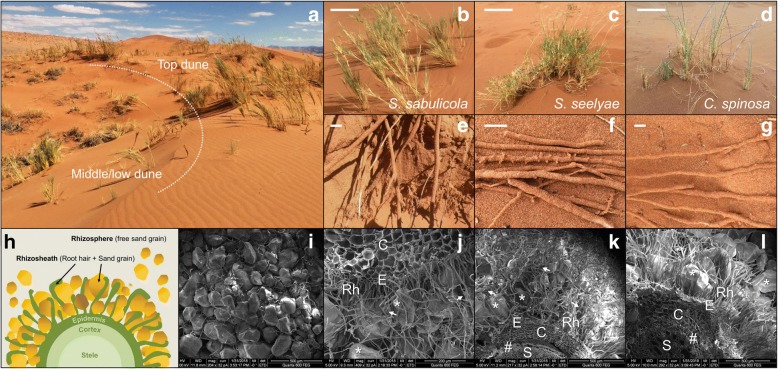
Bacterial and fungal communities from the rhizosheath-root compartments (endosphere root tissues, rhizosheath and rhizosphere) of three Namib Desert speargrass species (Stipagrostis sabulicola, S. seelyae and Cladoraphis spinosa) along with bulk sand have been studied to test our hypothesis. To minimize the variability determined by edaphic and climatic factors, plants living in a single dune were studied. We assessed the role of plant species vs the sandy substrate on the recruitment and selection, phylogenetic diversity and co-occurrence microbial networks of the rhizosheath-root system microbial communities.
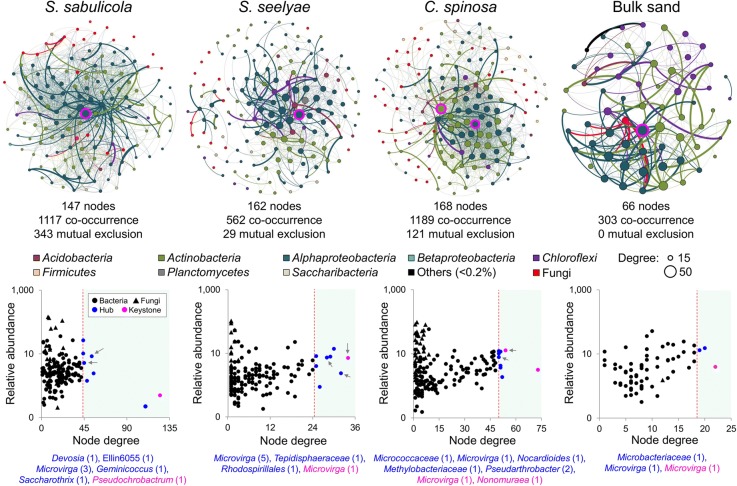
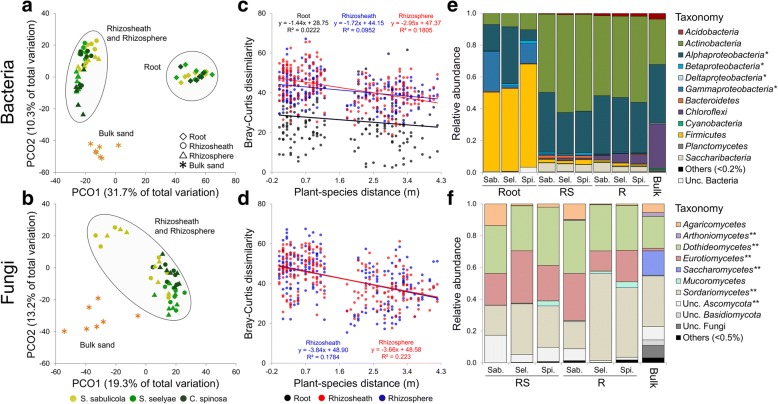
Microorganisms associated with the speargrass rhizosheath-root system were recruited from the surrounding bulk sand population and were significantly enriched in the rhizosheath compartments (10 and 10 of bacterial 16S rRNA and fungal ITS copies per gram of sand to up to 10 and 10 copies per gram, respectively). Furthermore, each rhizosheath-root system compartment hosted a specific microbial community demonstrating strong niche-partitioning. The rhizosheath-root systems of the three speargrass species studied were dominated by desert-adapted Actinobacteria and Alphaproteobacteria (e.g. Lechevalieria, Streptomyces and Microvirga) as well as saprophytic Ascomycota fungi (e.g. Curvularia, Aspergillus and Thielavia). Our results clearly showed a random phylogenetic turnover of rhizosheath-root system associated microbial communities, independent of the plant species, where stochastic factors drive neutral assembly. Co-occurrence network analyses also indicated that the bacterial and fungal community members of the rhizosheath-root systems established a higher number of interactions than those in the barren bulk sand, suggesting that the former are more stable and functional than the latter.
Our study demonstrates that the rhizosheath-root system microbial communities of desert dune speargrasses are stochastically assembled and host-independent. This finding supports the concept that the selection determined by the desert sand prevails over that imposed by the genotype of the different plant species.
根鞘-根系系统是沙生针茅适应沙漠不利水分和营养条件的一种特性。在沙漠的多极端条件下,植物与土壤微生物相互作用,这对它们的适应性和抗性有积极影响。然而,先前的研究表明,沙漠生态系统的营养简单性和环境严酷性强烈影响土壤微生物群落的组装。我们假设沙质生态过滤会限制针茅根鞘-根系生境中的微生物招募过程,而不是植物诱导的选择。
本研究对三种纳米比亚沙漠针茅(Stipagrostis sabulicola、S. seelyae 和 Cladoraphis spinosa)的根鞘-根系区室(根内组织、根鞘和根际)和大块沙中的细菌和真菌群落进行了研究,以验证我们的假设。为了最大限度地减少由土壤和气候因素决定的变异性,研究了生长在同一沙丘上的植物。我们评估了植物物种与沙质基质对根鞘-根系系统微生物群落的招募和选择、系统发育多样性和共生网络的影响。
与针茅根鞘-根系系统相关的微生物是从周围大块沙种群中招募而来的,并且在根鞘区室中显著富集(每克沙中细菌 16S rRNA 和真菌 ITS 拷贝数分别增加 10 倍和 10 倍,分别达到每克 10 和 10 拷贝)。此外,每个根鞘-根系系统区室都拥有特定的微生物群落,表现出强烈的生态位分区。研究的三种针茅的根鞘-根系系统主要由适应沙漠的放线菌和变形菌门(如 Lechevalieria、Streptomyces 和 Microvirga)以及腐生子囊菌门真菌(如 Curvularia、Aspergillus 和 Thielavia)组成。我们的研究结果清楚地表明,根鞘-根系系统相关微生物群落的系统发育随机转化与植物物种无关,其中随机因素驱动着中性组装。共生网络分析还表明,根鞘-根系系统的细菌和真菌群落成员之间建立了比贫瘠的大块沙更多的相互作用,这表明前者比后者更稳定和功能更强大。
本研究表明,沙漠沙丘针茅的根鞘-根系系统微生物群落是随机组装的,与植物无关。这一发现支持了这样一种观点,即由沙漠沙决定的选择超过了不同植物物种基因型所决定的选择。