Yusuf Fauzi, Adewiah Siti, Fatchiyah Fatchiyah
Divison of Gastroenterology-Hepatology, Department of Internal Medicine, Faculty of Medicine, Syiah Kuala University/Dr. Zainoel Abidin Centre Hospital, Banda Aceh, Indonesia.
Department of Internal Medicine, Faculty of Medicine, Syiah Kuala University, Banda Aceh, Indonesia.
Acta Inform Med. 2018 Oct;26(3):160-163. doi: 10.5455/aim.2018.26.160-163.
Microbial involvement in colorectal cancer (CRC) is now well established. Short Chain Fatty Acids (SCFA) is the main products of anaerobic microbial fermentation in the large intestine and affects colonic health. SCFA mainly produced as microbial metabolites, acetate, propionate, and butyrate acids. Several in vitro studies showed that butyrate induce expression of heat shock protein (HSP) 70 that has function in the beginning of apoptosis.
The aim of this study was investigating the differences level SCFA and HSP 70 expression in CRC compared with non-CRC patients.
The study consists of 14 patients diagnosed with CRC and 14 non-CRC patients. Stool sample were analyzed for SCFA (acetate, propionate, and butyrate acids) with gas chromatography and the result is given as μg/mL and the protein expression of HSP70 was determined by immunohistochemistry (IHC) and haematoxylin-eosin staining to determine the morphological changes in colon tissue.
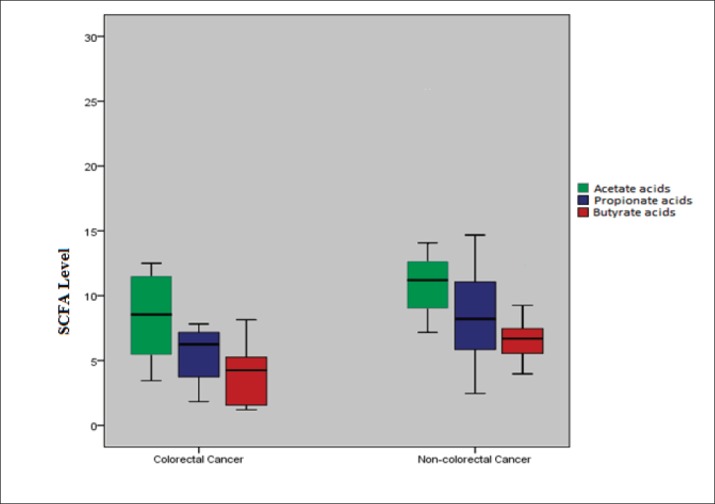
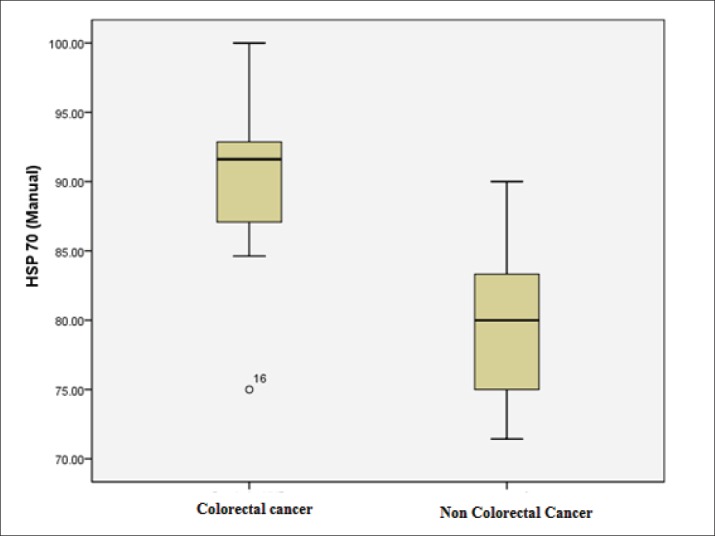
We found that CRC patients had lower level of acetate, propionate and butyrate acids than non-CRC. Whereas in CRC patients, the mean concentration of acetate was 8,55 μg/mL, propionate was 5,61 μg/mL and butyrate acids were 3,79 μg/mL respectively (all < 0.05). And among the samples of patients with colorectal cancer was obtained the highest expression of HSP-70.
Short chain fatty acids were indirectly contributed in the role of pathogenesis in CRC despite another factor could affect for this disease.
微生物与结直肠癌(CRC)的关联现已得到充分证实。短链脂肪酸(SCFA)是大肠厌氧微生物发酵的主要产物,影响结肠健康。SCFA主要作为微生物代谢产物产生,包括乙酸、丙酸和丁酸。多项体外研究表明,丁酸可诱导热休克蛋白(HSP)70的表达,HSP70在细胞凋亡起始阶段发挥作用。
本研究旨在调查CRC患者与非CRC患者中SCFA水平及HSP 70表达的差异。
该研究包括14例诊断为CRC的患者和14例非CRC患者。采用气相色谱法分析粪便样本中的SCFA(乙酸、丙酸和丁酸),结果以μg/mL表示,通过免疫组织化学(IHC)和苏木精-伊红染色测定HSP70的蛋白表达,以确定结肠组织的形态学变化。
我们发现CRC患者的乙酸、丙酸和丁酸水平低于非CRC患者。在CRC患者中,乙酸的平均浓度分别为8.55μg/mL,丙酸为5.61μg/mL,丁酸为3.79μg/mL(均<0.05)。在结直肠癌患者样本中获得了最高的HSP-70表达。
尽管可能有其他因素影响结直肠癌,但短链脂肪酸在CRC发病机制中起间接作用。