Department of Physical Pharmaceutics, Graduate School of Pharmaceutical Sciences, Kumamoto University, Kumamoto, Japan.
Laboratory of Adjuvant Innovation, Center for Vaccine and Adjuvant Research, National Institute of Biomedical Innovation, Health and Nutrition, Osaka, Japan.
Front Immunol. 2018 Nov 20;9:2619. doi: 10.3389/fimmu.2018.02619. eCollection 2018.
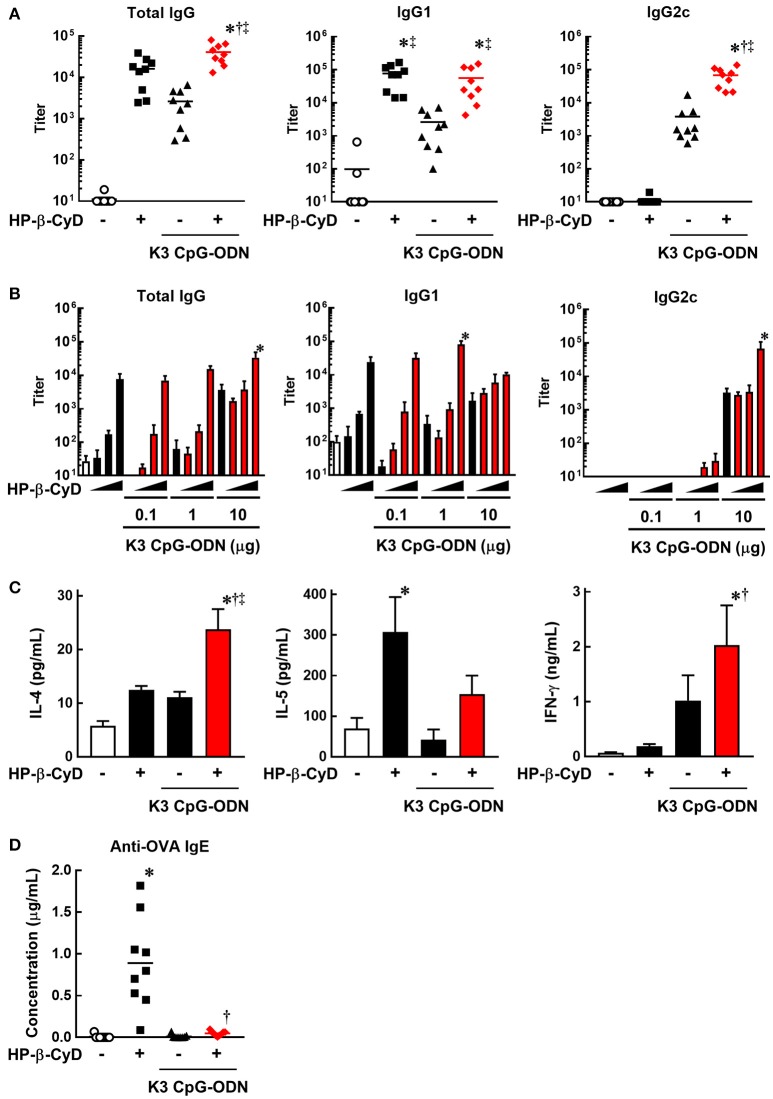
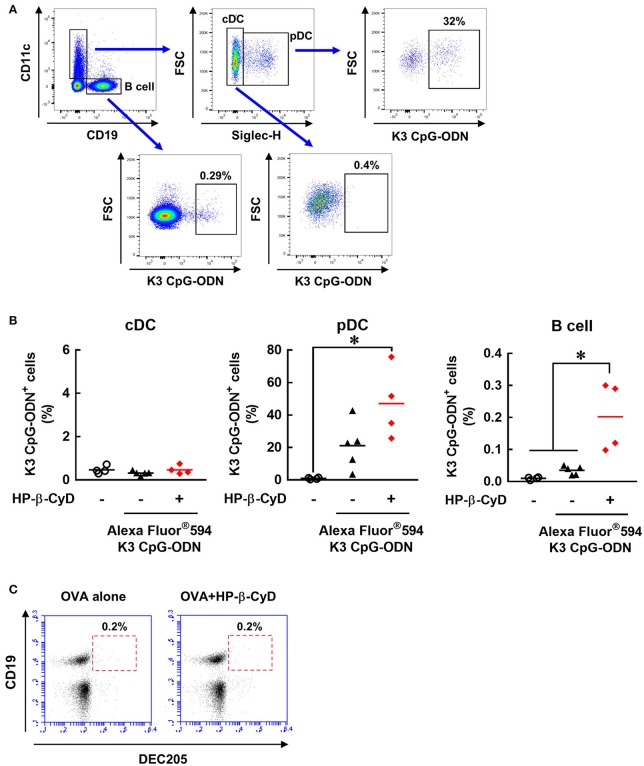
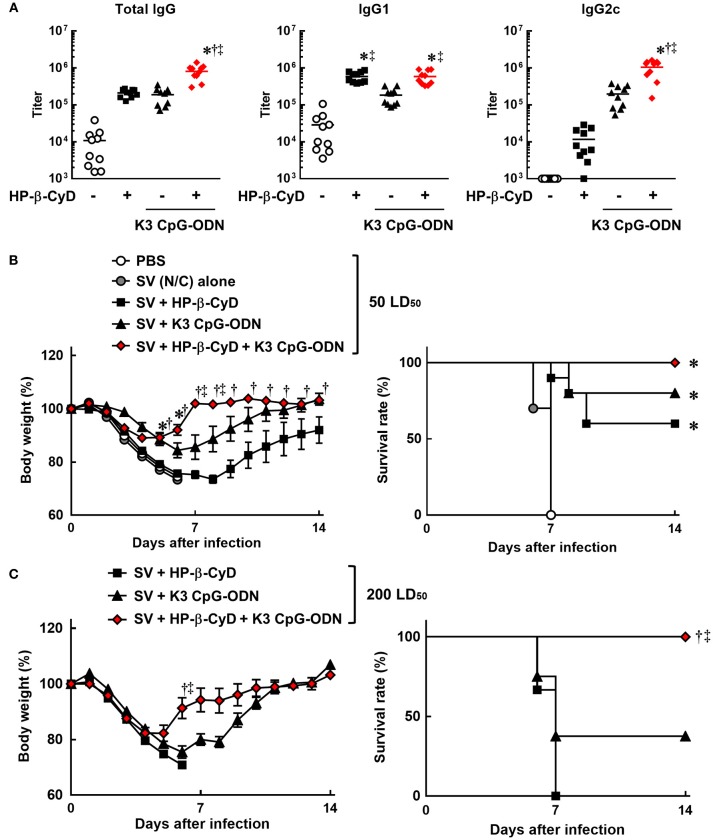
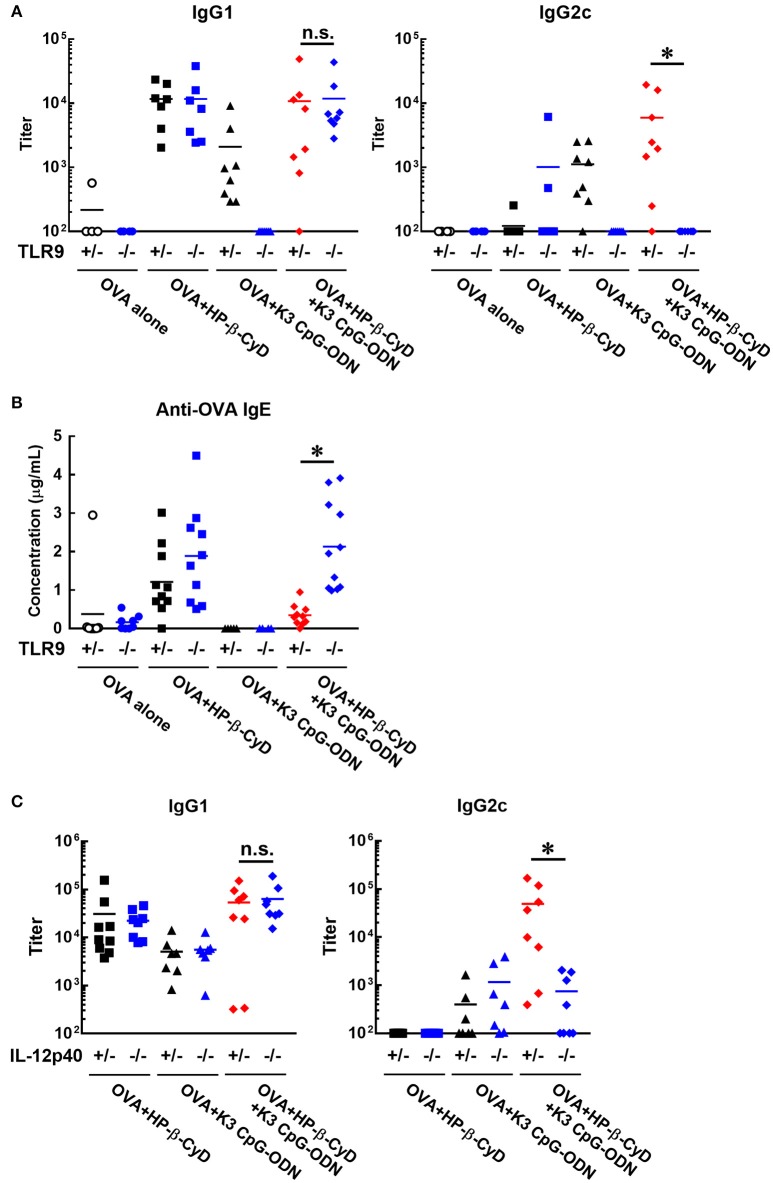
Recently, it was reported that 2-hydroxypropyl-β-cyclodextrin (HP-β-CyD), a common pharmaceutical additive, can act as a vaccine adjuvant to enhance protective type-2 immunogenicity to co-administered seasonal influenza split vaccine by inducing host-derived damage-associated molecular patterns (DAMPs). However, like most other DAMP-inducing adjuvants such as aluminum hydroxide (Alum), HP-β-CyD may not be sufficient for the induction of protective type-1 (cellular) immune responses, thereby leaving room for improvement. Here, we demonstrate that a combination of HP-β-CyD with a humanized TLR9 agonist, K3 CpG-ODN, a potent pathogen-associated molecular pattern (PAMP), enhanced the protective efficacy of the co-administered influenza split vaccine by inducing antigen-specific type-2 and type-1 immune responses, respectively. Moreover, substantial antigen-specific IgE induction by HP-β-CyD, which can cause an allergic response to immunized antigen was completely suppressed by the addition of K3 CpG-ODN. Furthermore, HP-β-CyD- and K3 CpG-ODN-adjuvanted influenza split vaccination protected the mice against lethal challenge with high doses of heterologous influenza virus, which could not be protected against by single adjuvant vaccines. Further experiments using gene deficient mice revealed the unique immunological mechanism of action , where type-2 and type-1 immune responses enhanced by the combined adjuvants were dependent on TBK1 and TLR9, respectively, indicating their parallel signaling pathways. Finally, the analysis of immune responses in the draining lymph node suggested that HP-β-CyD promotes the uptake of K3 CpG-ODN by plasmacytoid dendritic cells and B cells, which may contributes to the activation of these cells and enhanced production of IgG2c. Taken together, the results above may offer potential clinical applications for the combination of DAMP-inducing adjuvant and PAMP adjuvant to improve vaccine immunogenicity and efficacy by enhancing both type-2 and type-1 immune responses in a parallel manner.
最近有报道称,2-羟丙基-β-环糊精(HP-β-CyD)作为一种常见的药物添加剂,可通过诱导宿主来源的损伤相关分子模式(DAMPs)来充当疫苗佐剂,增强佐剂与季节性流感裂解疫苗的联合接种后的保护性 2 型免疫原性。然而,与大多数其他诱导 DAMPs 的佐剂(如氢氧化铝(Alum))一样,HP-β-CyD 可能不足以诱导保护性 1 型(细胞)免疫应答,因此仍有改进的空间。在这里,我们证明 HP-β-CyD 与一种人源化 TLR9 激动剂 K3 CpG-ODN 联合使用,K3 CpG-ODN 是一种有效的病原体相关分子模式(PAMP),可分别通过诱导抗原特异性 2 型和 1 型免疫应答来增强联合接种的流感裂解疫苗的保护效力。此外,HP-β-CyD 可引起免疫原过敏反应的大量抗原特异性 IgE 诱导完全被 K3 CpG-ODN 的添加所抑制。此外,HP-β-CyD 和 K3 CpG-ODN 佐剂的流感裂解疫苗接种可保护小鼠免受高剂量异源流感病毒的致死性攻击,而单一佐剂疫苗则无法保护。使用基因缺失小鼠的进一步实验揭示了这种联合佐剂的独特免疫作用机制,其中联合佐剂增强的 2 型和 1 型免疫应答分别依赖于 TBK1 和 TLR9,表明它们具有平行的信号通路。最后,引流淋巴结的免疫应答分析表明,HP-β-CyD 促进了 K3 CpG-ODN 被浆细胞样树突状细胞和 B 细胞的摄取,这可能有助于这些细胞的激活和 IgG2c 的产生增加。总之,这些结果可能为 DAMPs 诱导佐剂和 PAMP 佐剂的组合提供潜在的临床应用,通过平行增强 2 型和 1 型免疫应答来提高疫苗的免疫原性和疗效。