Hadji Peyman, Stoetzer Oliver, Decker Thomas, Kurbacher Christian M, Marmé Frederik, Schneeweiss Andreas, Mundhenke Christoph, Distelrath Andrea, Fasching Peter A, Lux Michael P, Lüftner Diana, Janni Wolfgang, Muth Mathias, Kreuzeder Julia, Quiering Claudia, Grischke Eva-Marie, Tesch Hans
Department of Bone Oncology, Endocrinology and Reproductive Medicine, North West Hospital, Steinbacher Hohl 2-26, 60488 Frankfurt am Main, Germany.
Philipps University of Marburg, Steinbacher Hohl 2-26, 60488 Marburg Frankfurt, Germany.
J Bone Oncol. 2018 Oct 2;14:010-10. doi: 10.1016/j.jbo.2018.09.010. eCollection 2019 Feb.
Breast cancer and its treatments are associated with a detrimental effect on bone health. Here we report the results of an exploratory analysis assessing changes in levels of biomarkers of bone metabolism in patients enrolled in the phase IIIb 4EVER study.
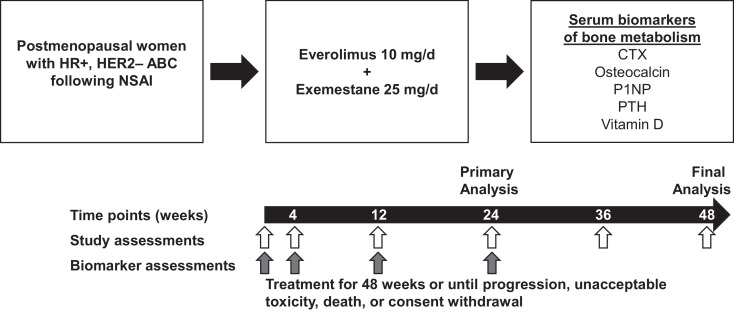
The 4EVER trial investigated everolimus in combination with exemestane in postmenopausal women with hormone receptor-positive, human epidermal growth factor receptor 2-negative locally advanced or metastatic breast cancer. In this prespecified exploratory analysis, changes in biomarkers of bone turnover were assessed in patients from baseline to weeks 4, 12, and 24. The serum bone markers assessed were procollagen type 1 N-terminal propeptide (P1NP), C-terminal cross-linking telopeptide of type 1 collagen (CTX), osteocalcin, parathyroid hormone (PTH), and 25-hydroxyvitamin D (25-OH-vitamin D). On-treatment changes in bone markers over time were described per subgroup of interest and efficacy outcomes.
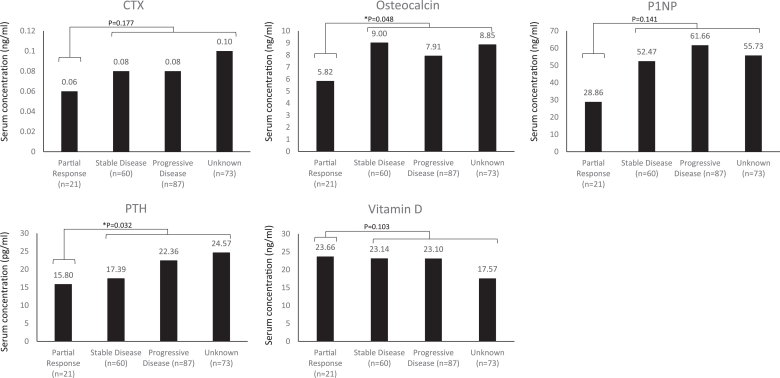
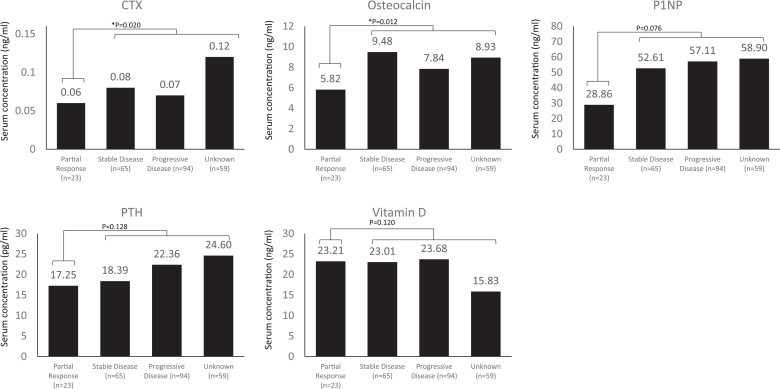
Bone marker data were available for 241 of 299 enrolled patients. At the final assessment, P1NP, osteocalcin, PTH, 25-OH-vitamin D (all < 0.001), and CTX ( = 0.036) were significantly decreased from baseline values per the Wilcoxon signed-rank test. At the last assessment (24 weeks or earlier), levels of serum CTX and PTH were significantly lower ( = 0.009 and = 0.034, respectively) among patients with vs. without prior antiresorptive treatment (ART). Serum CTX levels were significantly lower ( < 0.001), and 25-OH-vitamin D concentrations significantly higher ( = 0.029), at the last postbaseline assessment in patients receiving concomitant ART vs. those without ART. Changes from baseline in PTH and 25-OH-vitamin D concentrations to the final assessment were significantly smaller in patients with prior ART. Lower baseline serum concentrations of osteocalcin and PTH were associated with clinical response (partial vs. non-response) at 24 weeks. High serum levels of CTX and P1NP at baseline were risk factors for progression at 12 weeks.
These exploratory analyses support use of everolimus plus exemestane for the treatment of postmenopausal women with hormone receptor-positive, human epidermal growth factor receptor 2-negative advanced breast cancer, and add to the body of evidence suggesting a potentially favorable impact of everolimus on bone turnover.
NCT01626222. , https://clinicaltrials.gov/ct2/show/NCT01626222.
乳腺癌及其治疗方法会对骨骼健康产生不利影响。在此,我们报告一项探索性分析的结果,该分析评估了参与IIIb期4EVER研究的患者骨代谢生物标志物水平的变化。
4EVER试验研究了依维莫司联合依西美坦用于激素受体阳性、人表皮生长因子受体2阴性的局部晚期或转移性绝经后乳腺癌妇女。在这项预先设定的探索性分析中,评估了患者从基线到第4、12和24周骨转换生物标志物的变化。评估的血清骨标志物包括I型前胶原N端前肽(P1NP)、I型胶原C端交联端肽(CTX)、骨钙素、甲状旁腺激素(PTH)和25-羟基维生素D(25-OH-维生素D)。按感兴趣的亚组和疗效结果描述了治疗期间骨标志物随时间的变化。
299名入组患者中有241名患者的骨标志物数据可用。在最终评估时,根据Wilcoxon符号秩检验,P1NP、骨钙素、PTH、25-OH-维生素D(均<0.001)和CTX(=0.036)较基线值显著降低。在最后一次评估(24周或更早)时,与未接受过抗吸收治疗(ART)的患者相比,接受过ART的患者血清CTX和PTH水平显著更低(分别为=0.009和=0.034)。在基线后最后一次评估时,接受联合ART的患者血清CTX水平显著更低(<0.001),而25-OH-维生素D浓度显著更高(=0.029)。既往接受过ART的患者,从基线到最终评估时PTH和25-OH-维生素D浓度的变化显著更小。较低的骨钙素和PTH基线血清浓度与24周时的临床反应(部分缓解与无反应)相关。基线时高血清CTX和PINP水平是12周时疾病进展的危险因素。
这些探索性分析支持使用依维莫司联合依西美坦治疗激素受体阳性、人表皮生长因子受体2阴性的晚期绝经后乳腺癌妇女,并补充了证据表明依维莫司对骨转换可能有有利影响。
NCT01626222. ,https://clinicaltrials.gov/ct2/show/NCT01626222.