Yangpu Hospital, Tongji University School of Medicine, Shanghai 200090, China.
Department of Hepatic Surgery IV, The Eastern Hepatobiliary Surgery Hospital, Second Military Medical University, Shanghai 200438, China.
Biomed Res Int. 2018 Nov 1;2018:6304701. doi: 10.1155/2018/6304701. eCollection 2018.
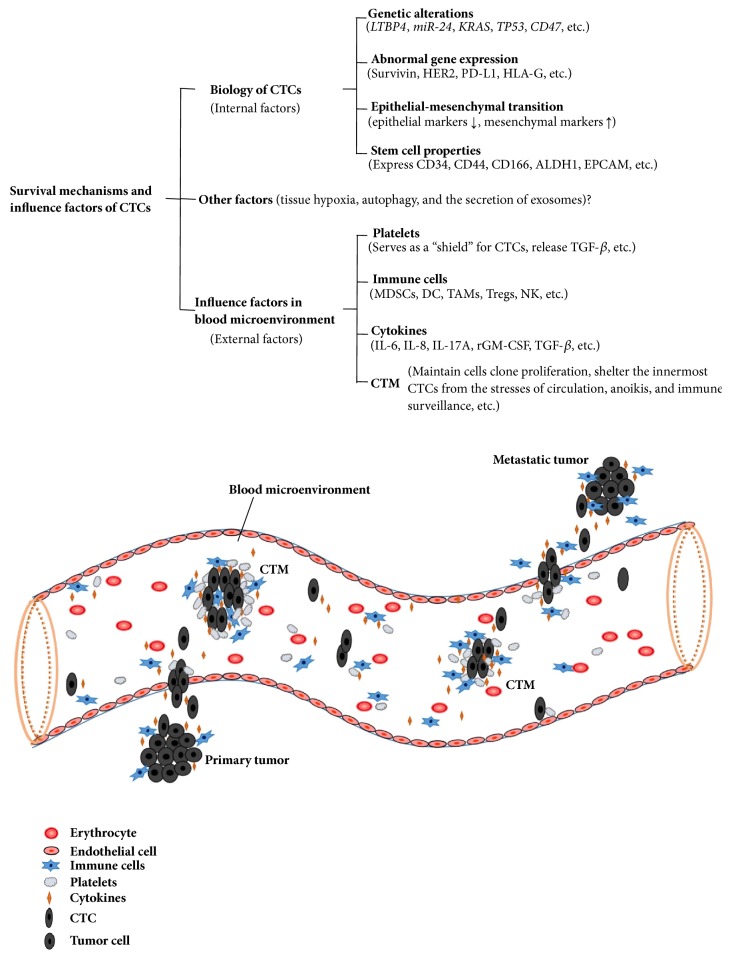
Circulating tumor cells (CTCs) are cancer cells shed from either the primary tumor or its metastases that circulate in the peripheral blood. The CTCs are regarded as the source of tumor recurrence and metastasis and speculated as the indicators of residual tumors, thereby indicating a poor prognosis. Although CTCs play a vital role in tumor metastasis and recurrence, little is known about the underlying survival mechanisms in the blood circulation. The accumulating evidence has revealed that CTCs might survive in the peripheral blood by overcoming the mechanical damage due to shear stress, resistance to anoikis, evasion of immune destruction, and resistance to chemotherapy. The present review addresses the putative survival mechanisms underlying the formation and migration of CTCs according to their biological characteristics and blood microenvironment. In addition, the relationship between CTCs and microenvironment is illustrated, and the influencing factors related to the interactions of CTCs with various components in the peripheral blood are reviewed with respect to the platelets, immune cells, cytokines, and circulating tumor microemboli (CTM). Furthermore, the recent advances in the new treatment strategies targeting the survival mechanisms of CTCs are also discussed.
循环肿瘤细胞(CTCs)是从原发性肿瘤或其转移灶脱落并循环于外周血中的癌细胞。CTCs 被认为是肿瘤复发和转移的根源,并被推测为残留肿瘤的标志物,从而预示着不良预后。尽管 CTCs 在肿瘤转移和复发中起着至关重要的作用,但人们对其在血液循环中的潜在生存机制知之甚少。越来越多的证据表明,CTCs 可能通过克服因剪切力造成的机械损伤、抵抗失巢凋亡、逃避免疫破坏以及抵抗化疗等方式在外周血中存活。本综述根据 CTCs 的生物学特性和血液微环境,探讨了其形成和迁移的潜在生存机制。此外,还阐述了 CTCs 与微环境的关系,并就血小板、免疫细胞、细胞因子和循环肿瘤微栓(CTM)等外周血中各种成分与 CTCs 的相互作用的影响因素进行了综述。此外,还讨论了针对 CTCs 生存机制的新治疗策略的最新进展。