Department of Neurology, CHA Bundang Medical Center, CHA University College of Medicine, Seongnam, Republic of Korea.
Biostatistics Collaboration Unit, Yonsei University College of Medicine, Seoul, Republic of Korea.
Cardiovasc Diabetol. 2018 Dec 5;17(1):155. doi: 10.1186/s12933-018-0799-4.
Increasing evidence suggest that statin therapy has a diabetogenic effect. Individual types of statin may have a different effect on glucose metabolism. Using the repeated nationwide population-based health screening data in Korea, we investigated the longitudinal changes in fasting glucose level of non-diabetic individuals by use of statins.
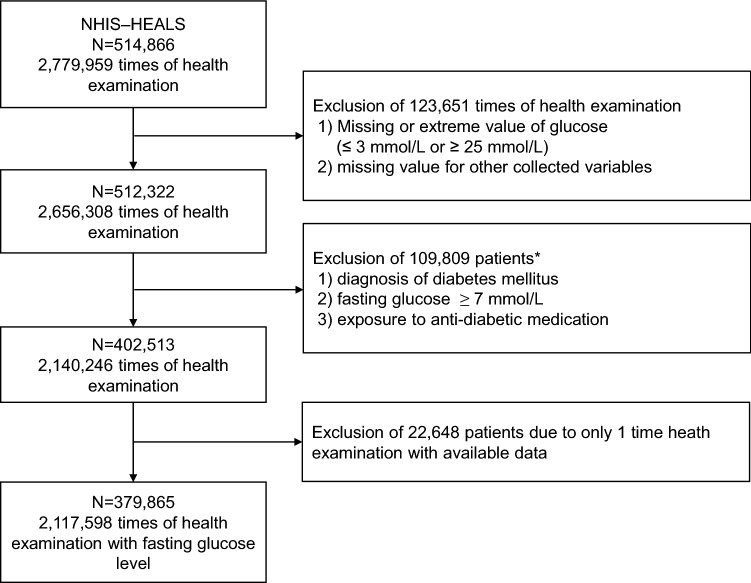
From the National Health Screening Cohort, we included 379,865 non-diabetic individuals who had ≥ 2 health screening examinations with fasting blood glucose level measured in 2002-2013. Using the prescription records of statins in the database, we calculated the proportion of days covered (PDC) and average number of defined daily doses per day (anDDD) by statins. We constructed multivariate linear mixed models to evaluate the effects of statins on the changes in fasting glucose (Δglu).
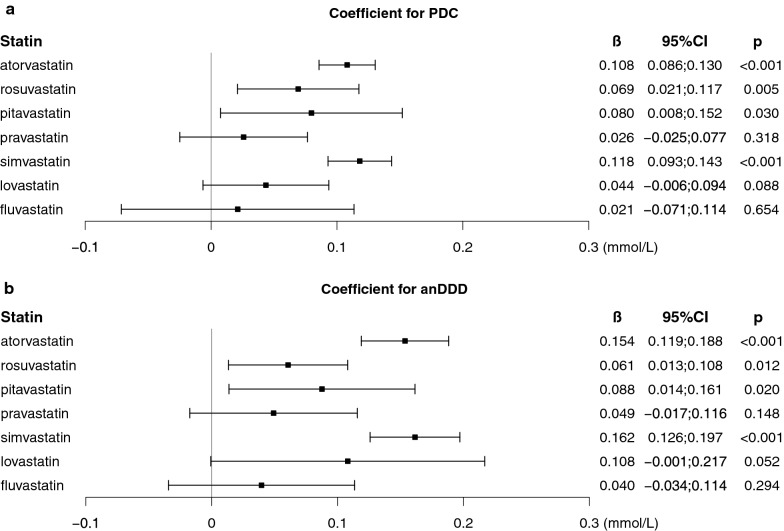
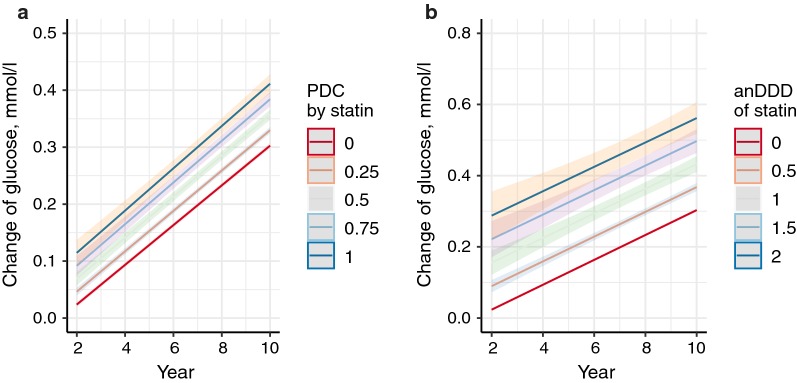
High PDC by statins had a significant positive effect on Δglu (coefficient for PDC 0.093 mmol/L, standard error 0.007, p < 0.001). anDDD by statins was also positively associated with Δglu (coefficient for anDDD 0.119 mmol/L, standard error 0.009, p < 0.001). Unlike statins, the PDC by fibrate and ezetimibe were not significantly associated with Δglu. There was no significant interaction effect on Δglu between time interval and statin. Considering individual types of statins, use of atorvastatin, rosuvastatin, pitavastatin, and simvastatin were significantly associated with increase of Δglu. Pravastatin, lovastatin, and fluvastatin were also positively associated with Δglu, but were not statistically significant.
More adherent and intensive use of statins was significantly associated with an increase in fasting glucose of non-diabetic individuals. In subgroup analysis of individual statins, use of atorvastatin, rosuvastatin, pitavastatin and simvastatin had significant association with increase in fasting glucose. Pravastatin, lovastatin, and fluvastatin had non-significant trend toward an increased fasting glucose. Our findings suggest the medication class effect of statins inducing hyperglycemia.
越来越多的证据表明,他汀类药物治疗具有致糖尿病作用。不同类型的他汀类药物可能对葡萄糖代谢有不同的影响。本研究利用韩国全国性的基于人群的健康筛查数据,调查了使用他汀类药物的非糖尿病个体空腹血糖水平的纵向变化。
我们从国家健康筛查队列中纳入了 379865 名在 2002 年至 2013 年期间接受了≥2 次健康筛查且空腹血糖水平检测结果的非糖尿病个体。我们利用数据库中的他汀类药物处方记录计算了他汀类药物的天数覆盖比例(PDC)和平均日定义剂量(anDDD)。我们构建了多变量线性混合模型来评估他汀类药物对空腹血糖变化(Δglu)的影响。
他汀类药物的高 PDC 对Δglu 有显著的正向影响(PDC 的系数为 0.093mmol/L,标准误差为 0.007,p<0.001)。他汀类药物的 anDDD 也与Δglu 呈正相关(anDDD 的系数为 0.119mmol/L,标准误差为 0.009,p<0.001)。与他汀类药物不同,贝特类药物和依折麦布的 PDC 与Δglu 无显著相关性。在Δglu 方面,他汀类药物的时间间隔与药物类型之间没有显著的交互作用。考虑到他汀类药物的不同类型,阿托伐他汀、瑞舒伐他汀、匹伐他汀和辛伐他汀的使用与Δglu 的增加显著相关。普伐他汀、洛伐他汀和氟伐他汀也与Δglu 呈正相关,但无统计学意义。
他汀类药物的更高依从性和更强化治疗与非糖尿病个体空腹血糖的升高显著相关。在他汀类药物的亚组分析中,阿托伐他汀、瑞舒伐他汀、匹伐他汀和辛伐他汀的使用与空腹血糖升高显著相关。普伐他汀、洛伐他汀和氟伐他汀与空腹血糖升高有非显著趋势。我们的研究结果提示他汀类药物引起高血糖的药物类别效应。