National Health Insurance Service, Wonju, Korea.
Big Data Steering Department, National Health Insurance Service, Wonju, Korea.
BMJ Open. 2017 Sep 24;7(9):e016640. doi: 10.1136/bmjopen-2017-016640.
The National Health Insurance Service-Health Screening Cohort (NHIS-HEALS) is a cohort of participants who participated in health screening programmes provided by the NHIS in the Republic of Korea. The NHIS constructed the NHIS-HEALS cohort database in 2015. The purpose of this cohort is to offer relevant and useful data for health researchers, especially in the field of non-communicable diseases and health risk factors, and policy-maker.
To construct the NHIS-HEALS database, a sample cohort was first selected from the 2002 and 2003 health screening participants, who were aged between 40 and 79 in 2002 and followed up through 2013. This cohort included 514 866 health screening participants who comprised a random selection of 10% of all health screening participants in 2002 and 2003.
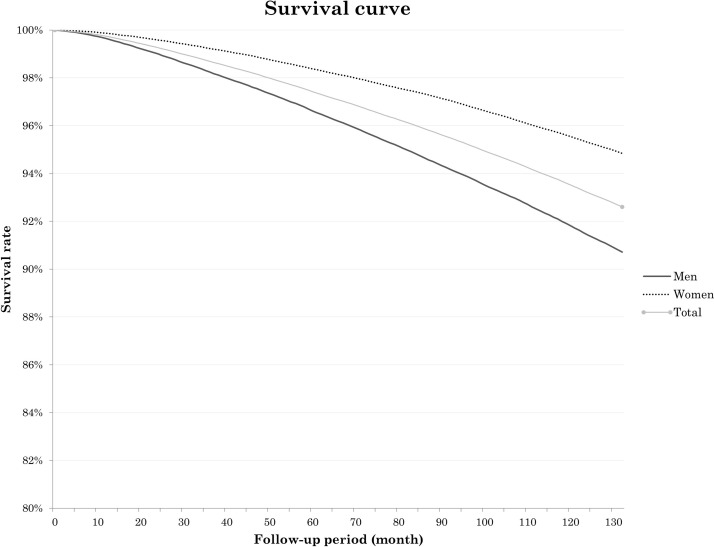
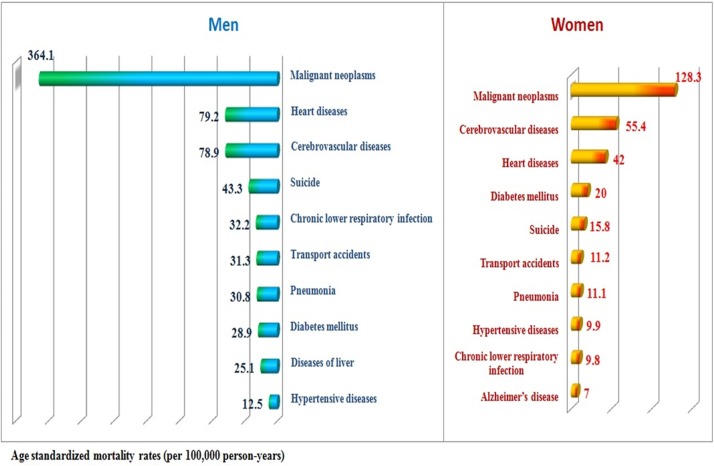
The age-standardised prevalence of anaemia, diabetes mellitus, hypertension, obesity, hypercholesterolaemia and abnormal urine protein were 9.8%, 8.2%, 35.6%, 2.7%, 14.2% and 2.0%, respectively. The age-standardised mortality rate for the first 2 years (through 2004) was 442.0 per 100 000 person-years, while the rate for 10 years (through 2012) was 865.9 per 100 000 person-years. The most common cause of death was malignant neoplasm in both sexes (364.1 per 100 000 person-years for men, 128.3 per 100 000 person-years for women).
This database can be used to study the risk factors of non-communicable diseases and dental health problems, which are important health issues that have not yet been fully investigated. The cohort will be maintained and continuously updated by the NHIS.
国家健康保险服务-健康筛查队列(NHIS-HEALS)是由韩国国民健康保险服务(NHIS)提供的健康筛查计划的参与者队列。NHIS 于 2015 年构建了 NHIS-HEALS 队列数据库。该队列的目的是为健康研究人员,特别是在非传染性疾病和健康风险因素以及政策制定者领域,提供相关和有用的数据。
为了构建 NHIS-HEALS 数据库,首先从 2002 年和 2003 年的健康筛查参与者中选择一个样本队列,他们在 2002 年的年龄在 40 至 79 岁之间,并在 2013 年进行了随访。该队列包括 514866 名健康筛查参与者,他们是 2002 年和 2003 年所有健康筛查参与者的随机选择的 10%。
贫血、糖尿病、高血压、肥胖、高胆固醇血症和异常尿蛋白的年龄标准化患病率分别为 9.8%、8.2%、35.6%、2.7%、14.2%和 2.0%。前 2 年(截至 2004 年)的年龄标准化死亡率为每 10 万人 442.0 人,而 10 年(截至 2012 年)的死亡率为每 10 万人 865.9 人。两性中最常见的死因是恶性肿瘤(男性每 10 万人 364.1 人,女性每 10 万人 128.3 人)。
该数据库可用于研究非传染性疾病和口腔健康问题的风险因素,这些都是尚未充分研究的重要健康问题。NHIS 将维护和不断更新该队列。