Wang Yun, Xing Xinrui, Cao Yan, Zhao Liang, Sun Sen, Chen Yang, Chai Yifeng, Chen Si, Zhu Zhenyu
Hebei Institute for Drug Control, No.16 Fuqiang Street, Shijiazhuang 050011, China.
School of Pharmacy, Second Military Medical University, No. 325 Guohe Road, Shanghai 200433, China.
Evid Based Complement Alternat Med. 2018 Nov 1;2018:3239785. doi: 10.1155/2018/3239785. eCollection 2018.
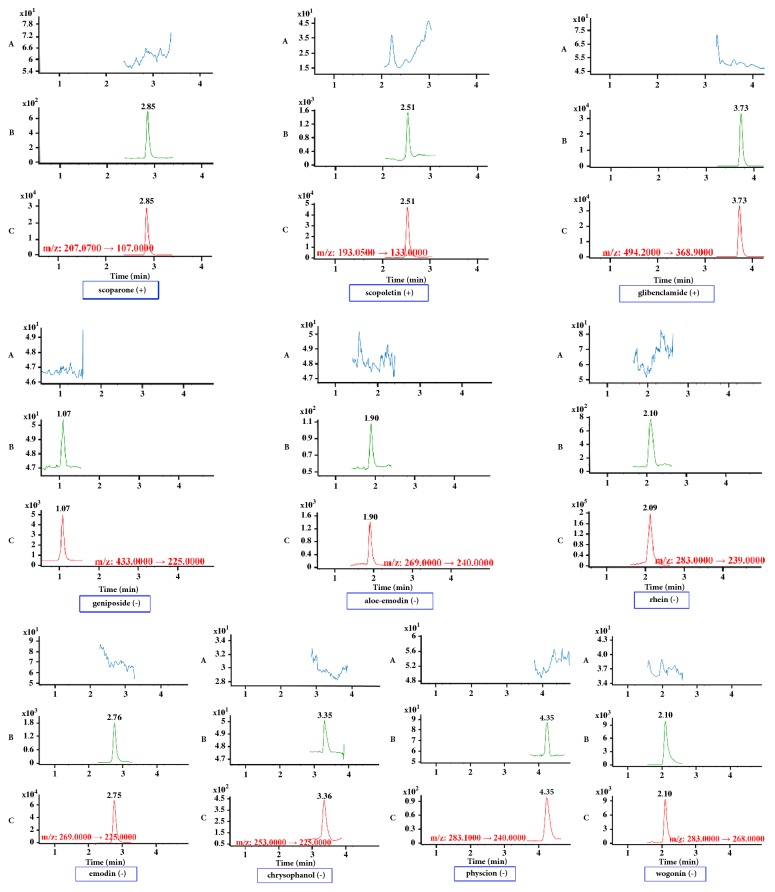
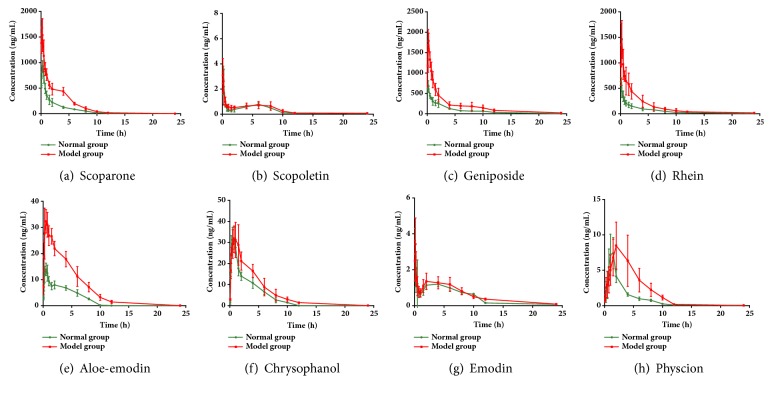
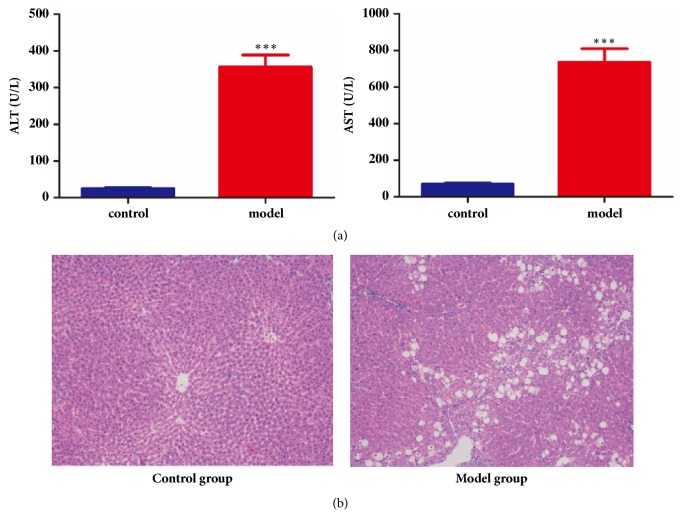
Yin Chen Hao Tang (YCHT) is one of the most famous hepatoprotective herbal formulas in China, but its pharmacokinetic investigation in model rats has been rarely conducted. In this study, the hepatic injury model was caused by intraperitoneal injections of carbon tetrachloride (CCl), and YCHT was orally administered to the model and normal rats. An ultrahigh performance liquid chromatography-tandem mass spectrometry (UHPLC-MS/MS) method was established to analyze the plasma pharmacokinetics of eight major bioactive ingredients from YCHT in both the normal and liver injured rats. The calibration curves presented good linearity (r > 0.9981) in the concentration range. The relative standard deviation (RSD%) of inter- and intraday precision was within 9.55%, and the accuracy (RE%) ranged from -10.72% to 2.46%. The extraction recovery, matrix effect, and stability were demonstrated to be within acceptable ranges. The lower limit of detection (LLOD) and lower limit of quantitation (LLOQ) were around 0.1 ng/mL and 0.5 ng/mL, respectively, which were much lower than those in other related researches. Results reveal that there are significant differences in the pharmacokinetics of scoparone, geniposide, rhein, aloe-emodin, physcion, and chrysophanol in hepatic injured rats as compared to those in control except for scopoletin and emodin. Our experimental results provide a meaningful reference for the clinical dosage of YCHT in treating liver disorders, and the improvement of LLOD and LLOQ can also broaden the range of our method's application, which is very suitable for quantitating these eight compounds with low levels.
茵陈蒿汤是中国最著名的保肝中药方剂之一,但在模型大鼠中的药代动力学研究却很少进行。在本研究中,通过腹腔注射四氯化碳(CCl)建立肝损伤模型,并对模型大鼠和正常大鼠口服茵陈蒿汤。建立了超高效液相色谱-串联质谱(UHPLC-MS/MS)法,用于分析茵陈蒿汤中8种主要生物活性成分在正常大鼠和肝损伤大鼠中的血浆药代动力学。校准曲线在浓度范围内呈现良好的线性(r>0.9981)。日内和日间精密度的相对标准偏差(RSD%)在9.55%以内,准确度(RE%)在-10.72%至2.46%之间。提取回收率、基质效应和稳定性均在可接受范围内。检测下限(LLOD)和定量下限(LLOQ)分别约为0.1 ng/mL和0.5 ng/mL,远低于其他相关研究。结果表明,除东莨菪素和大黄素外,肝损伤大鼠中滨蒿内酯、栀子苷、大黄酸、芦荟大黄素、大黄酚和大黄素甲醚的药代动力学与对照组相比存在显著差异。我们的实验结果为茵陈蒿汤治疗肝脏疾病的临床剂量提供了有意义的参考,LLOD和LLOQ的提高也拓宽了我们方法的应用范围,非常适合定量分析这些低水平的8种化合物。