Yamamoto Satoshi, Omori Kazuhiro, Mandai Hiroki, Nakayama Masaaki, Nakagawa Saki, Kobayashi Hiroya, Kunimine Tadashi, Yoshimura Hiroshi, Sakaida Kyosuke, Sako Hidefumi, Ibaragi Soichiro, Yamamoto Tadashi, Maeda Hiroshi, Suga Seiji, Takashiba Shogo
Department of Pathophysiology-Periodontal Science, Graduate School of Medicine, Dentistry and Pharmaceutical Sciences, Okayama University, Okayama, 700-8525, Japan.
Department of Periodontics and Endodontics, Okayama University Hospital, Okayama, 700-8558, Japan.
Heliyon. 2018 Nov 26;4(11):e00979. doi: 10.1016/j.heliyon.2018.e00979. eCollection 2018 Nov.
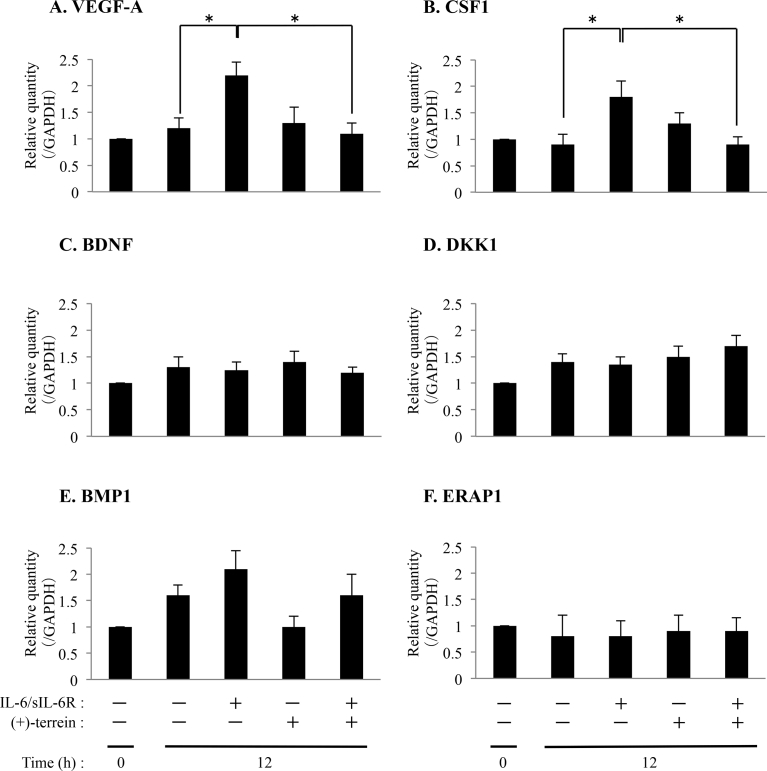
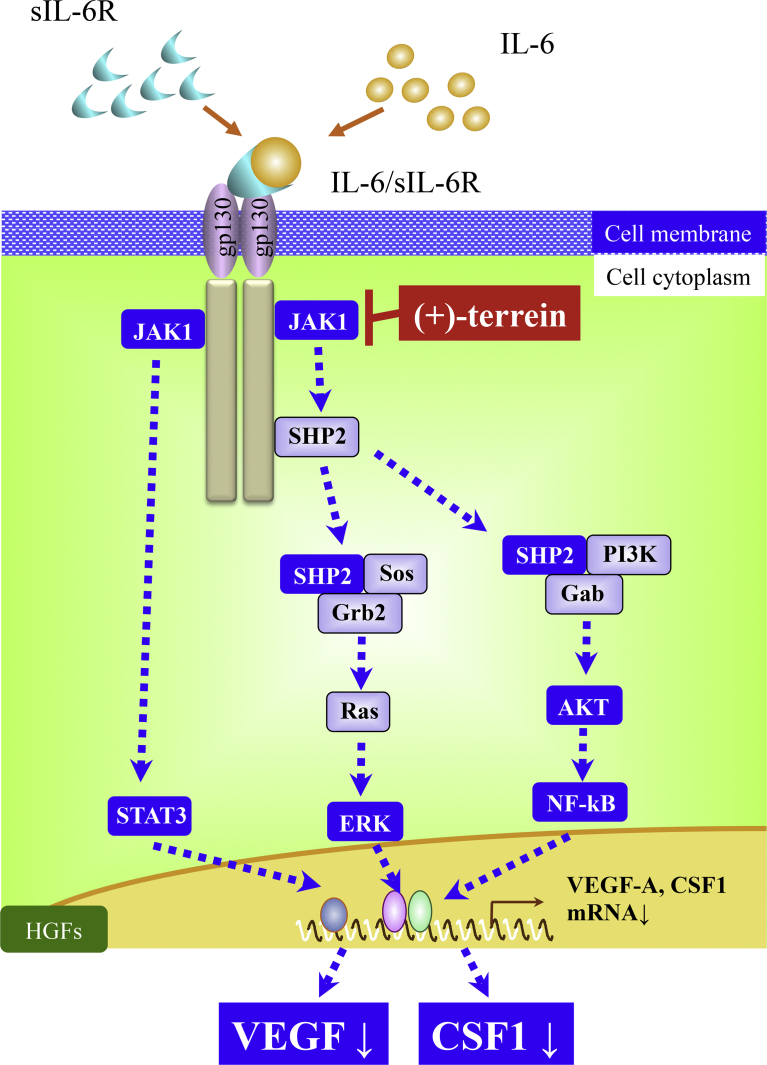
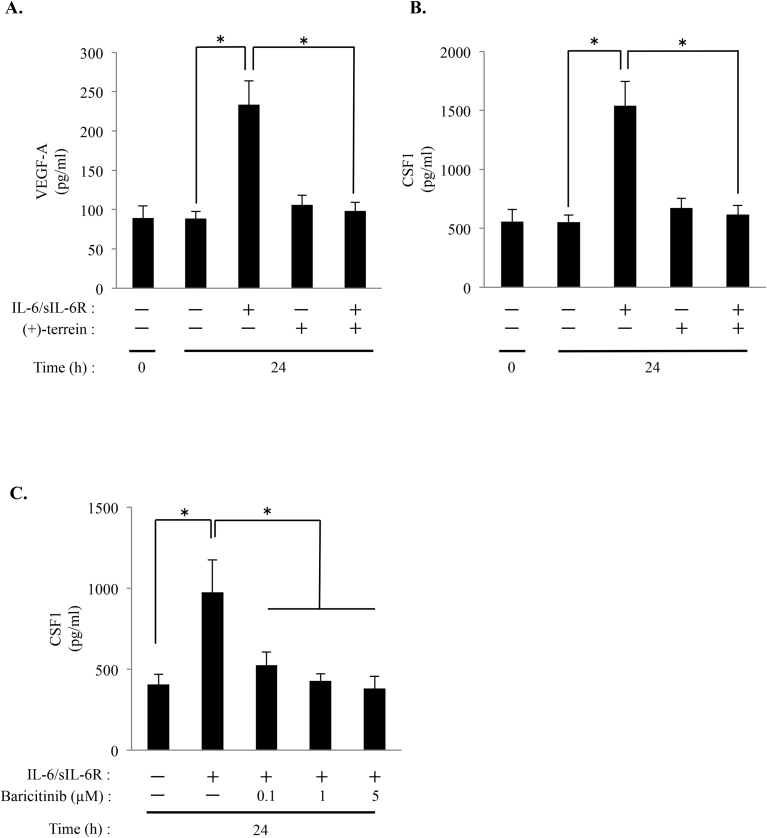
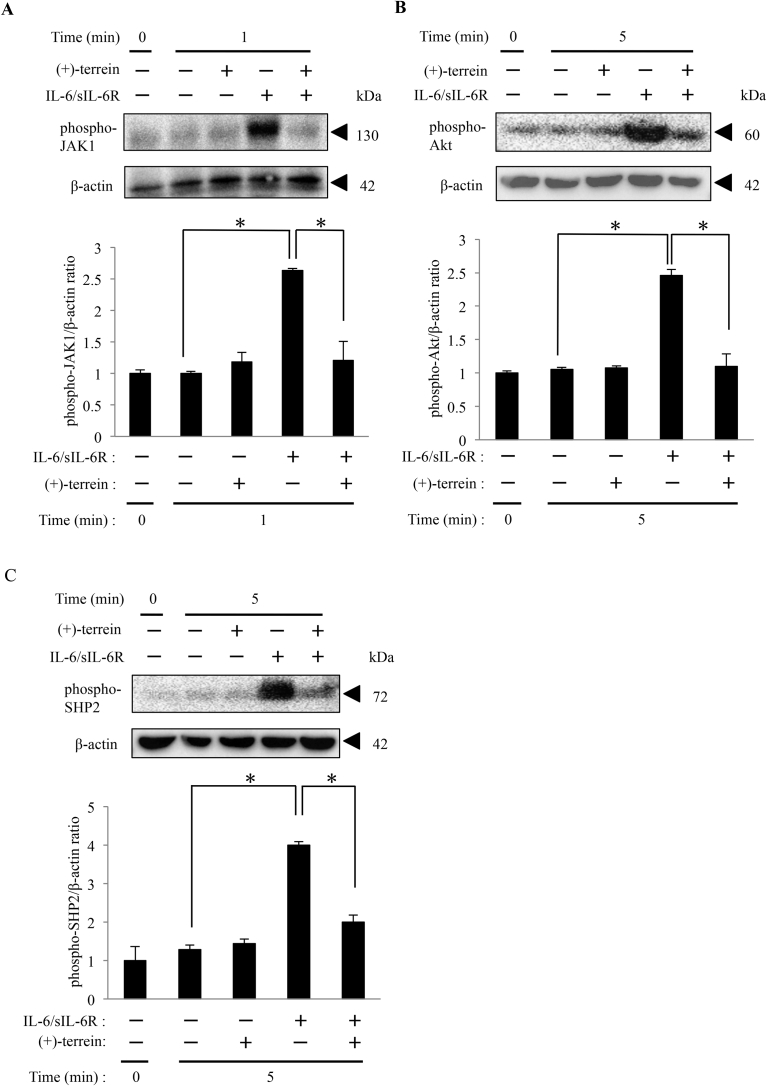
Control of bacterial infection-induced inflammatory responses is one of the effective therapeutic approaches of periodontal diseases. Natural products such as lipid mediators and metabolites from microorganisms have been used for decreasing inflammation. We previously reported that (+)-terrein inhibited activation of STAT3 and ERK1/2 in interleukin-6 (IL-6) signaling cascade, leading to prevent vascular endothelial growth factor (VEGF) secretion in human gingival fibroblasts (HGFs). However, little is still known about the role of (+)-terrein on inflammatory responses. In this study, we provided the possibility of novel action that (+)-terrein inhibits activation of Janus-activated kinase 1 (JAK1), which has a central function in IL-6 signaling cascade, and alters expression of mRNAs and proteins induced by IL-6/soluble IL-6 receptor (sIL-6R) stimulation in HGFs. First, we performed PCR array to examine IL-6/sIL-6R-induced mRNA expression, and then expression of mRNA and protein of colony stimulating factor-1 (CSF1) and VEGF were clearly determined by quantitative RT-PCR and ELISA, respectively. Treatment with (+)-terrein suppressed expression of mRNA and protein of CSF1 and VEGF by IL-6/sIL-6R stimulation. Next, to test the effect of (+)-terrein on IL-6/sIL-6R signaling cascade, we demonstrated whether (+)-terrein affects phosphorylation of JAK1 and its downstream proteins, Akt and SHP-2. Western blotting revealed that (+)-terrein inhibited IL-6/sIL-6R-induced phosphorylation of JAK1, Akt, and SHP-2. Therefore, (+)-terrein suppresses IL-6/sIL-6R-induced expression of CSF1 and VEGF via inhibition of JAK1, Akt, and SHP-2. Based on our results, we suggest that (+)-terrein is a candidate compound for anti-inflammatory effect associated with IL-6 signaling.
控制细菌感染诱导的炎症反应是牙周疾病的有效治疗方法之一。脂质介质和微生物代谢产物等天然产物已被用于减轻炎症。我们之前报道过,(+)-土曲霉毒素可抑制白细胞介素-6(IL-6)信号级联反应中信号转导和转录激活因子3(STAT3)及细胞外信号调节激酶1/2(ERK1/2)的激活,从而阻止人牙龈成纤维细胞(HGFs)分泌血管内皮生长因子(VEGF)。然而,关于(+)-土曲霉毒素在炎症反应中的作用仍知之甚少。在本研究中,我们发现了一种新的作用机制,即(+)-土曲霉毒素可抑制Janus激活激酶1(JAK1)的激活,JAK1在IL-6信号级联反应中起核心作用,并且(+)-土曲霉毒素可改变HGFs中由IL-6/可溶性IL-6受体(sIL-6R)刺激诱导的mRNA和蛋白质表达。首先,我们进行了PCR阵列检测以研究IL-6/sIL-6R诱导的mRNA表达,然后分别通过定量逆转录PCR和酶联免疫吸附测定法明确检测了集落刺激因子-1(CSF1)和VEGF的mRNA及蛋白质表达。(+)-土曲霉毒素处理可抑制IL-6/sIL-6R刺激引起的CSF1和VEGF的mRNA及蛋白质表达。接下来,为了测试(+)-土曲霉毒素对IL-6/sIL-6R信号级联反应的影响,我们检测了(+)-土曲霉毒素是否会影响JAK1及其下游蛋白Akt和SHP-2的磷酸化。蛋白质印迹法显示,(+)-土曲霉毒素可抑制IL-6/sIL-6R诱导的JAK1、Akt和SHP-2的磷酸化。因此,(+)-土曲霉毒素通过抑制JAK1、Akt和SHP-2来抑制IL-6/sIL-6R诱导的CSF1和VEGF表达。基于我们的研究结果,我们认为(+)-土曲霉毒素是一种与IL-6信号相关的具有抗炎作用的候选化合物。