The East Savo Hospital District, BOX 111, 57101, Savonlinna, Finland.
Institute of Public Health and Clinical Nutrition, Faculty of Health Sciences, University of Eastern Finland, Kuopio, Finland.
Aging Clin Exp Res. 2019 Oct;31(10):1471-1479. doi: 10.1007/s40520-018-1085-8. Epub 2018 Dec 5.
Medication-related problems and declined functional capacity are closely associated factors among older people. The purpose of this study is to describe the procedure of interprofessional medication assessment in home care context and the baseline characteristics of the study population.
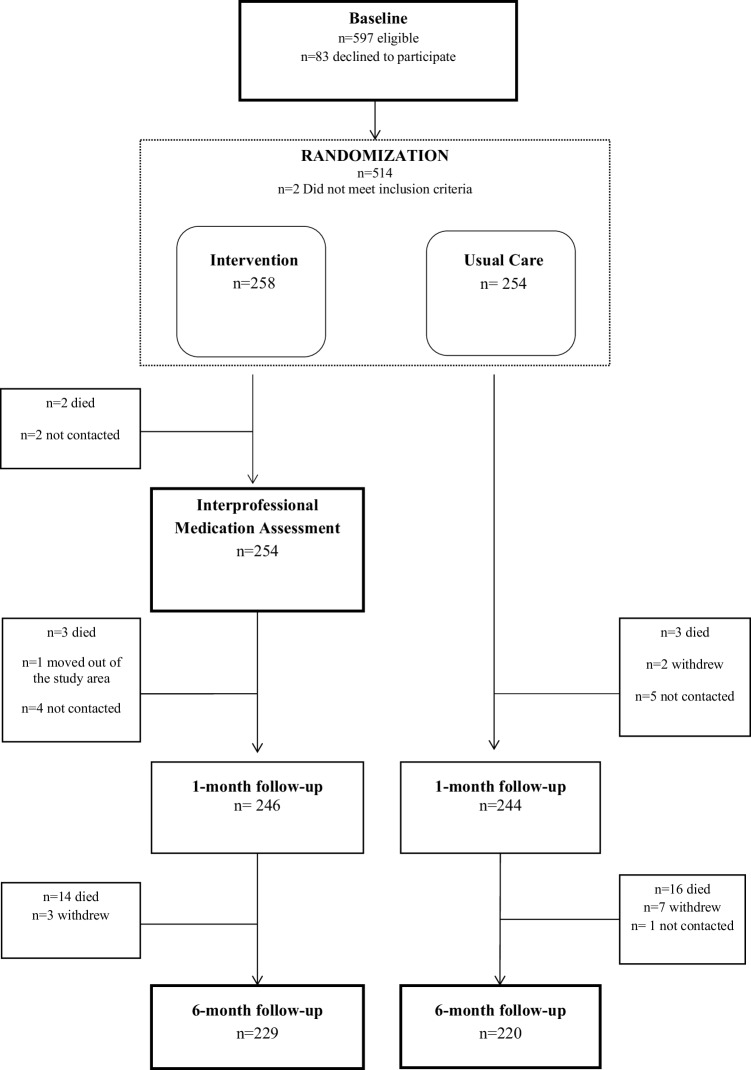
The FIMA study was a randomized, controlled intervention study comparing general practitioner-led interprofessional medication assessment and usual care. Patients' chronic diagnoses and medication use as well as physical and cognitive functions were investigated. Performance in daily activities, use of care services and help from family and relatives, self-rated health and health-related quality of life, and adverse effects commonly related to medication were assessed.
The home care patients (n = 512) had significant disease burden and functional limitations. The mean number of all medicines was 15 and that of regularly taken medicines 10. The majority of patients (87%) had excessive polypharmacy. The most commonly used (97%) ATC medicine class was nervous system medicines. Clinically relevant (class C or D SFINX record) drug-drug interactions were seen in 74% of the patients. The most frequent risks of adverse effects were risk of bleeding (66%), constipation (58%) and orthostatism (54%) occurring in over half of the patients. Medicines affecting renal function were used by 85% of the patients.
There is an evident need and justification for medication assessments in home care. In most cases, home care patients fulfill the criteria for regular medication assessments.
药物相关问题和功能能力下降是老年人密切相关的因素。本研究的目的是描述家庭护理背景下的跨专业药物评估程序以及研究人群的基线特征。
FIMA 研究是一项随机对照干预研究,比较了全科医生主导的跨专业药物评估和常规护理。调查了患者的慢性诊断和药物使用以及身体和认知功能。评估了日常活动中的表现、护理服务的使用以及家庭和亲属的帮助、自我评估的健康和与健康相关的生活质量以及与药物常见相关的不良反应。
家庭护理患者(n=512)疾病负担和功能限制显著。所有药物的平均数量为 15 种,常规服用药物的数量为 10 种。大多数患者(87%)存在过度多种药物治疗。最常用的(97%)ATC 药物类别是神经系统药物。在 74%的患者中观察到临床相关(SFINX 记录 C 类或 D 类)药物-药物相互作用。不良反应最常见的风险是出血风险(66%)、便秘(58%)和直立性低血压(54%),超过一半的患者出现这些风险。影响肾功能的药物被 85%的患者使用。
家庭护理中需要进行药物评估,这是显而易见的。在大多数情况下,家庭护理患者符合定期药物评估的标准。