Klaassen R A, Selles C A, van den Berg J W, Poelman M M, van der Harst E
1Department of Surgery, Maasstad Hospital, Maasstadweg 21, 3079 DZ Rotterdam, The Netherlands.
2Department of Surgery, Franciscus Gasthuis & Vlietland, Kleiweg 500, 3045 PM Rotterdam, The Netherlands.
BMC Obes. 2018 Dec 3;5:36. doi: 10.1186/s40608-018-0213-5. eCollection 2018.
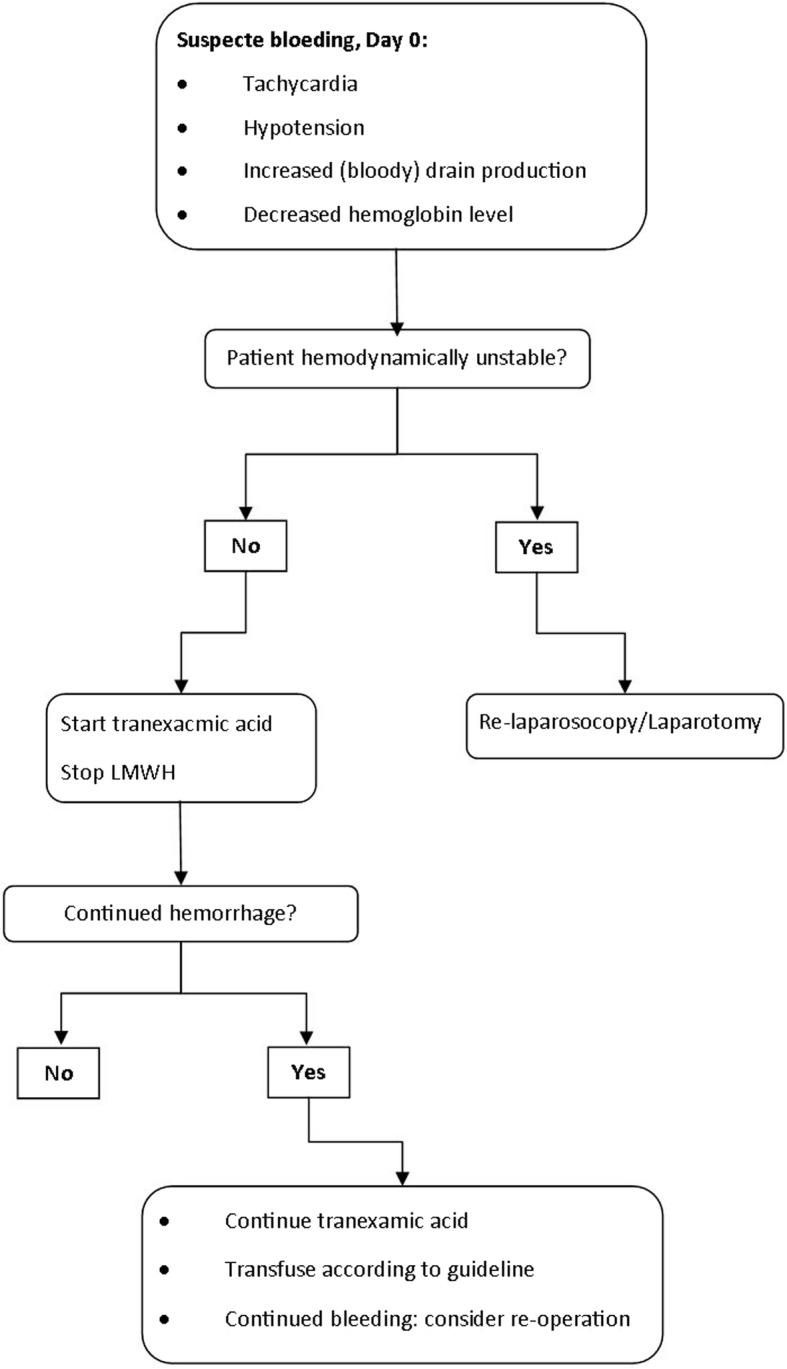
Tranexamic acid reduces blood loss associated with various surgical procedures. Postoperative bleeding caused by dissection or bleeding of the enteric staple lines is a well-known complication following bariatric surgery. Reoperation in order to restore hemostasis is frequently necessary (up to 2.5% in literature). The effect of conservative therapy using tranexamic acid for postoperative hemorrhage after bariatric surgery is still very much a novel technique. The aim is to present our results (reoperation rate and thrombo-embolic complication rate) of tranexamic acid therapy for postoperative bleeding after bariatric surgery in comparison to those in existing literature.
We retrospectively reviewed 1388 patients who underwent bariatric surgery (laparoscopic gastric bypass or laparoscopic gastric sleeve). Use of tranexamic acid, reoperation rate, transfusion rate and rate of thrombo-embolic complications were reviewed.
Forty-five of 1388 (3.2%) total patients experienced significant hemorrhage after bariatric surgery. Tranexamic acid was administered in 44 of these patients. A failure of the treatment with tranexamic acid was observed in four patients. The incidence of reoperation was 0.4% for the entire population. No thrombo-embolic complications were registered for patients receiving tranexamic acid.
These findings suggest that the administration of tranexamic acid appears to be safe in reducing the reoperation rate for bleeding after bariatric surgery.
氨甲环酸可减少与各种外科手术相关的失血。在减重手术后,因肠吻合钉线处解剖或出血导致的术后出血是一种众所周知的并发症。为恢复止血而进行再次手术通常是必要的(文献报道发生率高达2.5%)。在减重手术后使用氨甲环酸进行保守治疗对术后出血的效果仍然是一项非常新颖的技术。目的是将我们在减重手术后使用氨甲环酸治疗术后出血的结果(再次手术率和血栓栓塞并发症发生率)与现有文献中的结果进行比较。
我们回顾性分析了1388例行减重手术(腹腔镜胃旁路术或腹腔镜袖状胃切除术)的患者。记录氨甲环酸的使用情况、再次手术率、输血率和血栓栓塞并发症发生率。
1388例患者中,有45例(3.2%)在减重手术后发生了严重出血。其中44例患者使用了氨甲环酸。观察到4例患者使用氨甲环酸治疗失败。整个人群的再次手术发生率为0.4%。接受氨甲环酸治疗的患者未发生血栓栓塞并发症。
这些发现表明,在减重手术后,使用氨甲环酸似乎能安全地降低因出血而进行再次手术的发生率。