Pietras Zbigniew, Wojcik Magdalena A, Borowski Lukasz S, Szewczyk Maciej, Kulinski Tomasz M, Cysewski Dominik, Stepien Piotr P, Dziembowski Andrzej, Szczesny Roman J
Laboratory of RNA Biology and Functional Genomics, Institute of Biochemistry and Biophysics Polish Academy of Sciences, Warsaw, Poland.
Laboratory of Protein Structure, International Institute of Molecular and Cell Biology, Warsaw, Poland.
Mol Cell Oncol. 2018 Sep 20;5(6):e1516452. doi: 10.1080/23723556.2018.1516452. eCollection 2018.
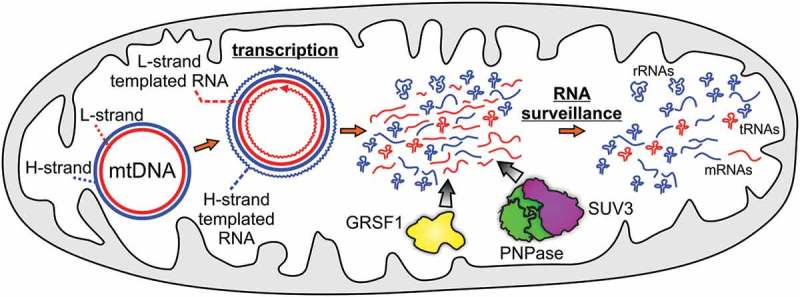
Transcription of the human mitochondrial genome produces a vast amount of non-coding antisense RNAs. These RNA species can form G-quadraplexes (G4), which affect their decay. We found that the mitochondrial degradosome, a complex of RNA helicase SUPV3L1 (best known as SUV3) and the ribonuclease PNPT1 (also known as PNPase), together with G4-melting protein GRSF1, is a key player in restricting antisense mtRNAs.
人类线粒体基因组的转录产生了大量非编码反义RNA。这些RNA种类可形成G-四链体(G4),这会影响它们的降解。我们发现,线粒体降解体,即由RNA解旋酶SUPV3L1(最为人所知的是SUV3)和核糖核酸酶PNPT1(也称为PNPase)组成的复合物,与G4解旋蛋白GRSF1一起,是限制反义线粒体RNA的关键因素。