Alcalde-Rico Manuel, Olivares-Pacheco Jorge, Alvarez-Ortega Carolina, Cámara Miguel, Martínez José Luis
Centro Nacional de Biotecnología, Consejo Superior de Investigaciones Científicas, Madrid, Spain.
Centre for Biomolecular Sciences, School of Life Sciences, University of Nottingham, Nottingham, United Kingdom.
Front Microbiol. 2018 Nov 23;9:2752. doi: 10.3389/fmicb.2018.02752. eCollection 2018.
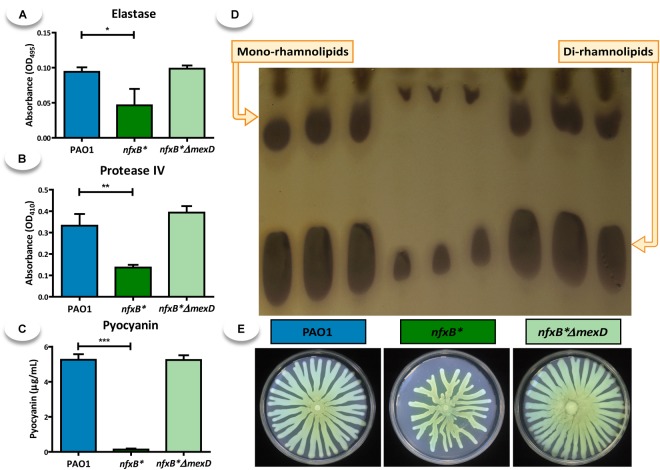
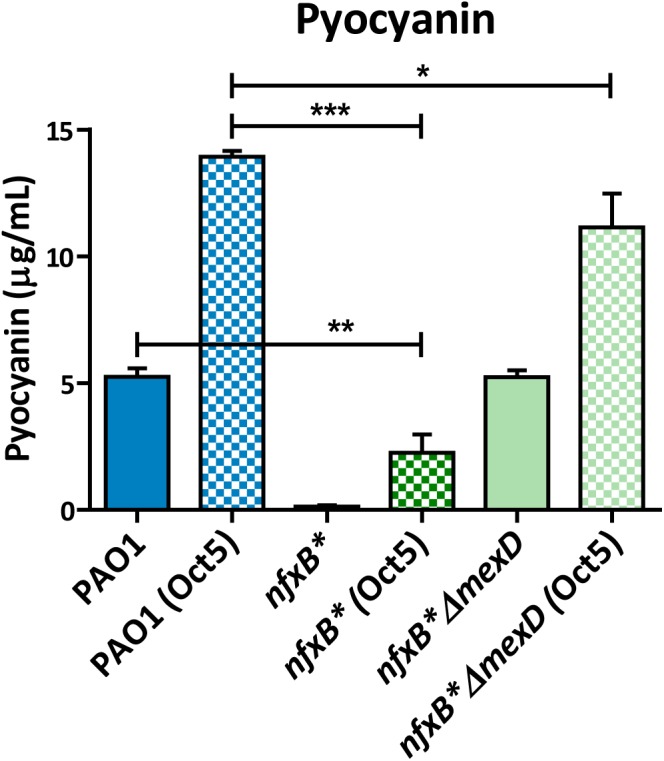
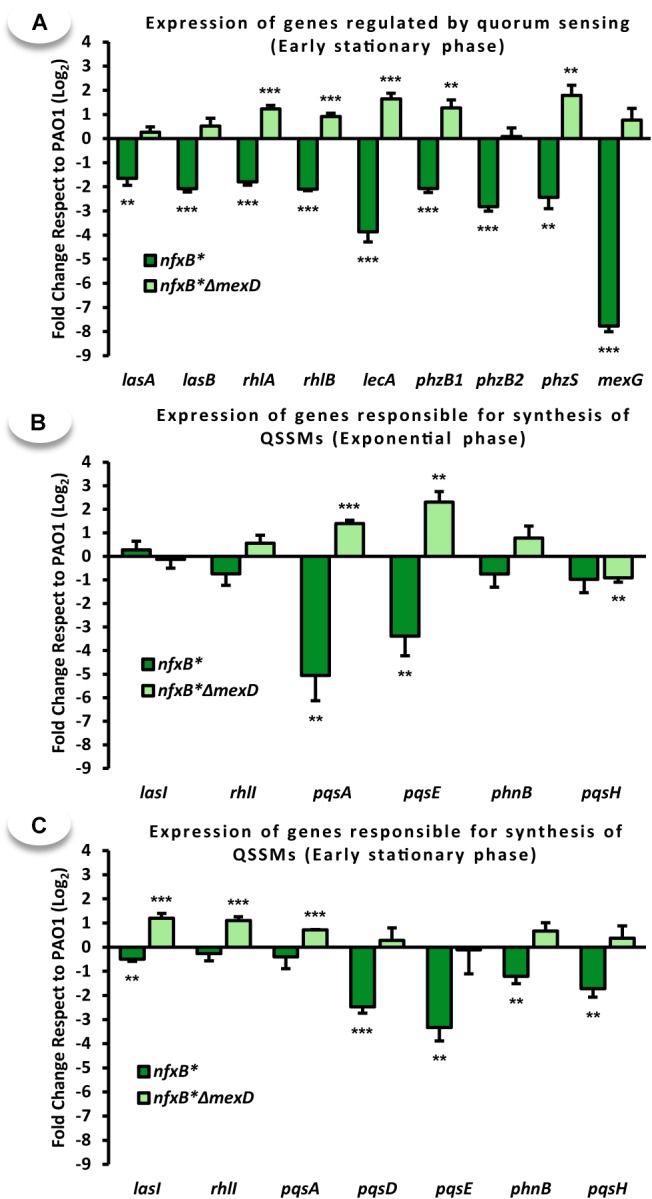
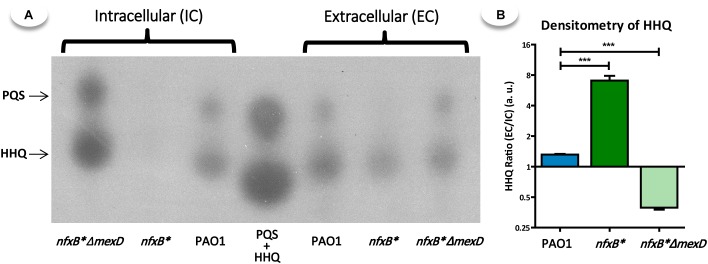
Multidrug efflux pumps constitute a category of antibiotic resistance determinants that are a part of the core bacterial genomes. Given their conservation, it is conceivable that they present functions beyond the extrusion of antibiotics currently used for therapy. stands as a relevant respiratory pathogen, with a high prevalence at hospitals and in cystic fibrosis patients. Part of its success relies on its low susceptibility to antibiotics and on the production of virulence factors, whose expression is regulated in several cases by quorum sensing (QS). We found that overexpression of the MexCD-OprJ multidrug efflux pump shuts down the QS response. Our results support that MexCD-OprJ extrudes kynurenine, a precursor of the alkyl-quinolone signal (AQS) molecules. Anthranilate and octanoate, also AQS precursors, do not seem to be extruded by MexCD-OprJ. Kynurenine extrusion is not sufficient to reduce the QS response in a mutant overexpressing this efflux pump. Impaired QS response is mainly due to the extrusion of 4-hydroxy-2-heptylquinoline (HHQ), the precursor of the Quinolone Signal (PQS), leading to low PQS intracellular levels and reduced production of QS signal molecules. As the consequence, the expression of QS-regulated genes is impaired and the production of QS-regulated virulence factors strongly decreases in a MexCD-OprN overexpressing mutant. Previous work showed that MexEF-OprJ, another efflux pump, is also able of extruding kynurenine and HHQ. However, opposite to our findings, the QS defect in a MexEF-OprN overproducer is due to kynurenine extrusion. These results indicate that, although efflux pumps can share some substrates, the affinity for each of them can be different. Although the QS response is triggered by population density, information on additional elements able of modulating such response is still scarce. This is particularly important in the case of lung chronic infections, a situation in which QS-defective mutants are accumulated. If MexCD-OprJ overexpression alleviates the cost associated to triggering the QS response when un-needed, it could be possible that MexCD-OprJ antibiotic resistant overproducer strains might be selected even in the absence of antibiotic selective pressure, acting as antibiotic resistant cheaters in heterogeneous populations.
多药外排泵是一类抗生素抗性决定因素,属于细菌核心基因组的一部分。鉴于它们的保守性,可以推测它们具有目前用于治疗的抗生素外排功能之外的其他功能。作为一种重要的呼吸道病原体,在医院和囊性纤维化患者中具有很高的患病率。其成功的部分原因在于它对抗生素的低敏感性以及毒力因子的产生,在某些情况下,毒力因子的表达受群体感应(QS)调控。我们发现MexCD - OprJ多药外排泵的过表达会关闭QS反应。我们的结果支持MexCD - OprJ会排出犬尿氨酸,它是烷基喹诺酮信号(AQS)分子的前体。邻氨基苯甲酸和辛酸,也是AQS前体,似乎不会被MexCD - OprJ排出。在过表达这种外排泵的突变体中,犬尿氨酸的排出不足以降低QS反应。QS反应受损主要是由于喹诺酮信号(PQS)的前体4 - 羟基 - 2 - 庚基喹啉(HHQ)的排出,导致细胞内PQS水平降低以及QS信号分子的产生减少。因此,在过表达MexCD - OprN的突变体中,QS调控基因的表达受损,QS调控的毒力因子的产生大幅减少。先前的研究表明,另一种外排泵MexEF - OprJ也能够排出犬尿氨酸和HHQ。然而,与我们的发现相反,MexEF - OprN过表达菌株中的QS缺陷是由于犬尿氨酸的排出。这些结果表明,尽管外排泵可以共享一些底物,但它们对每种底物的亲和力可能不同。尽管QS反应是由群体密度触发的,但关于能够调节这种反应的其他因素的信息仍然很少。这在肺部慢性感染的情况下尤为重要,在这种情况下会积累QS缺陷突变体。如果MexCD - OprJ的过表达在不需要时减轻了触发QS反应的相关成本,那么即使在没有抗生素选择压力的情况下,MexCD - OprJ抗生素抗性过表达菌株也可能被选择,在异质群体中充当抗生素抗性作弊者。