Ouedraogo Henri Gautier, Meda Ivlabehire Bertrand, Zongo Issaka, Ky-Zerbo Odette, Grosso Ashley, Samadoulougou Benoit Cesaire, Tarnagda Grissoum, Cisse Kadari, Sondo Apoline, Sawadogo Nongoba, Traoré Yves, Barro Nicolas, Baral Stefan, Kouanda Seni
Institut de Recherche en Sciences de la Santé (IRSS/CNRST), Ouagadougou, Burkina Faso.
Université Ouaga I Professeur Joseph KI-ZERBO, Ouagadougou, Burkina Faso.
Int J Microbiol. 2018 Nov 8;2018:4790560. doi: 10.1155/2018/4790560. eCollection 2018.
Syphilis among female sex workers (FSW) remains a public health concern due to its potential impact on their health and the possibility of transmission to their clients, partners, and children. Recent data on the prevalence of syphilis in the population in West Africa are scarce. The objective of this study was to measure the seroprevalence of syphilis serological markers among female sex workers in Burkina Faso.
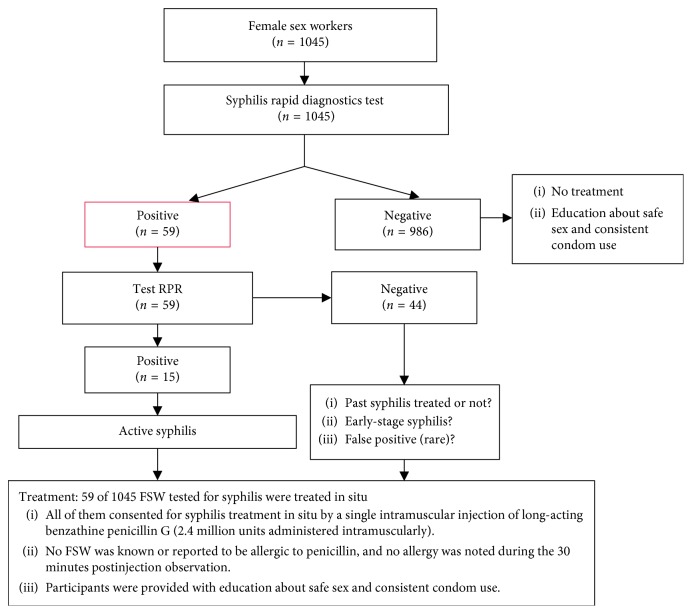
We conducted a cross-sectional survey among FSW between February 2013 and May 2014. Participants were recruited using respondent-driven sampling (RDS) methods in five cities of Burkina Faso (Ouagadougou, Bobo-Dioulasso, Koudougou, Ouahigouya, and Tenkodogo). FSW were enrolled and screened for syphilis using a syphilis serological rapid diagnostic test. Data from all cities were analyzed with Stata version 14.0.
A total of 1045 FSW were screened for syphilis. Participants' mean age was 27.2 ± 0.2 years. The syphilis serological markers were detected in 5.6% (95% CI: 4.4-7.2) of the participants whereas active syphilis was seen in 1.4% (95% CI: 0.9-2.4). RDS weighted prevalence of syphilis serological markers and active syphilis by city were, respectively, estimated to be 0.0% to 11.0% (95% CI: 8.1-14.7) and 0.0% to 2.2% (95% CI: 1.1-4.4). No syphilis markers were found among Ouahigouya FSW. Low education level and high number of clients were factors associated with syphilis markers among the FSW.
The prevalence of syphilis markers was high during this study among FSW. This highlights the need to reinforce the comprehensive preventive measures and treatment of syphilis in this population.
女性性工作者中的梅毒因其对她们健康的潜在影响以及传播给其客户、伴侣和子女的可能性,仍然是一个公共卫生问题。西非人群中梅毒流行率的最新数据匮乏。本研究的目的是测量布基纳法索女性性工作者中梅毒血清学标志物的血清流行率。
2013年2月至2014年5月期间,我们对女性性工作者进行了一项横断面调查。采用应答者驱动抽样(RDS)方法在布基纳法索的五个城市(瓦加杜古、博博迪乌拉索、库杜古、瓦希古亚和滕科多戈)招募参与者。女性性工作者登记入组,并使用梅毒血清学快速诊断试验进行梅毒筛查。来自所有城市的数据使用Stata 14.0版本进行分析。
共对1045名女性性工作者进行了梅毒筛查。参与者的平均年龄为27.2±0.2岁。5.6%(95%可信区间:4.4 - 7.2)的参与者检测到梅毒血清学标志物,而活动性梅毒的比例为1.4%(95%可信区间:0.9 - 2.4)。按城市估计,梅毒血清学标志物和活动性梅毒的RDS加权流行率分别为0.0%至11.0%(95%可信区间:8.1 - 14.7)和0.0%至2.2%(95%可信区间:1.1 - 4.4)。在瓦希古亚的女性性工作者中未发现梅毒标志物。低教育水平和大量客户是女性性工作者中与梅毒标志物相关的因素。
在本研究中,女性性工作者中梅毒标志物的流行率较高。这突出表明需要加强对该人群梅毒的综合预防措施和治疗。