Millar Sophie A, Stone Nicole L, Yates Andrew S, O'Sullivan Saoirse E
Division of Medical Sciences and Graduate Entry Medicine, School of Medicine, University of Nottingham, Royal Derby Hospital, Derby, United Kingdom.
Artelo Biosciences, San Diego, CA, United States.
Front Pharmacol. 2018 Nov 26;9:1365. doi: 10.3389/fphar.2018.01365. eCollection 2018.
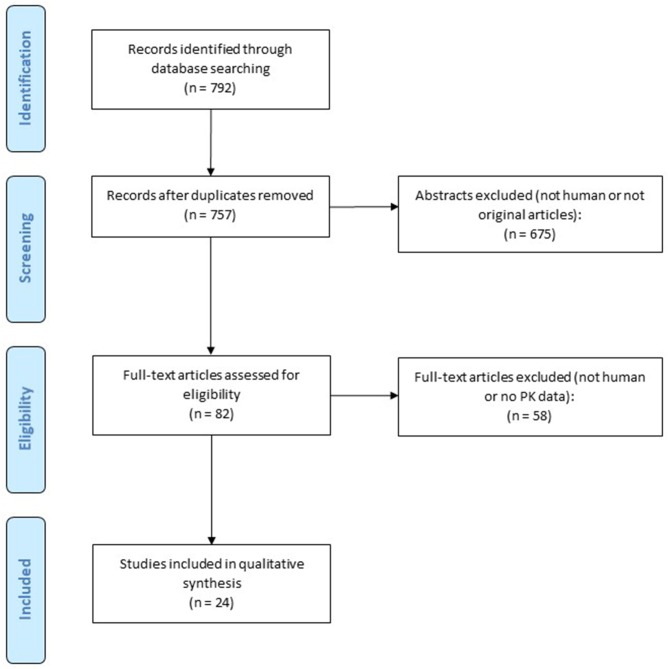
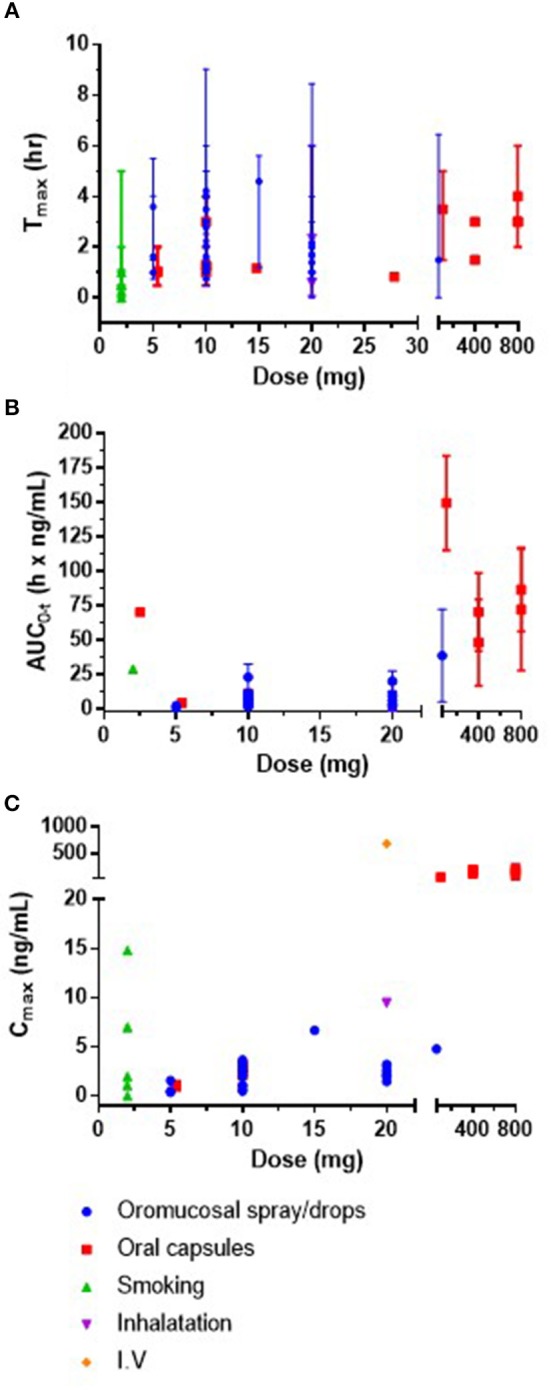
Cannabidiol is being pursued as a therapeutic treatment for multiple conditions, usually by oral delivery. Animal studies suggest oral bioavailability is low, but literature in humans is not sufficient. The aim of this review was to collate published data in this area. A systematic search of PubMed and EMBASE (including MEDLINE) was conducted to retrieve all articles reporting pharmacokinetic data of CBD in humans. Of 792 articles retireved, 24 included pharmacokinetic parameters in humans. The half-life of cannabidiol was reported between 1.4 and 10.9 h after oromucosal spray, 2-5 days after chronic oral administration, 24 h after i.v., and 31 h after smoking. Bioavailability following smoking was 31% however no other studies attempted to report the absolute bioavailability of CBD following other routes in humans, despite i.v formulations being available. The area-under-the-curve and C increase in dose-dependent manners and are reached quicker following smoking/inhalation compared to oral/oromucosal routes. C is increased during fed states and in lipid formulations. T is reached between 0 and 4 h. This review highlights the paucity in data and some discrepancy in the pharmacokinetics of cannabidiol, despite its widespread use in humans. Analysis and understanding of properties such as bioavailability and half-life is critical to future therapeutic success, and robust data from a variety of formulations is required.
大麻二酚正被用作多种病症的治疗方法,通常通过口服给药。动物研究表明口服生物利用度较低,但关于人类的文献并不充分。本综述的目的是整理该领域已发表的数据。对PubMed和EMBASE(包括MEDLINE)进行了系统检索,以检索所有报告人类CBD药代动力学数据的文章。在检索到的792篇文章中,有24篇包含人类药代动力学参数。大麻二酚的半衰期在口腔黏膜喷雾后为1.4至10.9小时,长期口服后为2至5天,静脉注射后为24小时,吸烟后为31小时。吸烟后的生物利用度为31%,然而,尽管有静脉注射制剂,但没有其他研究试图报告人类通过其他途径使用CBD后的绝对生物利用度。曲线下面积和血药浓度(C)以剂量依赖性方式增加,与口服/口腔黏膜途径相比,吸烟/吸入后达到血药浓度(C)的速度更快。在进食状态和脂质制剂中血药浓度(C)会升高。血药浓度(C)在0至4小时之间达到峰值。本综述强调了尽管大麻二酚在人类中广泛使用,但其数据匮乏且药代动力学存在一些差异。分析和了解生物利用度和半衰期等特性对于未来的治疗成功至关重要,并且需要来自各种制剂的可靠数据。