Cheng Chi-Wai, Tse Eric
Department of Medicine, The University of Hong Kong, Hong Kong, Hong Kong.
Front Pharmacol. 2018 Nov 26;9:1367. doi: 10.3389/fphar.2018.01367. eCollection 2018.
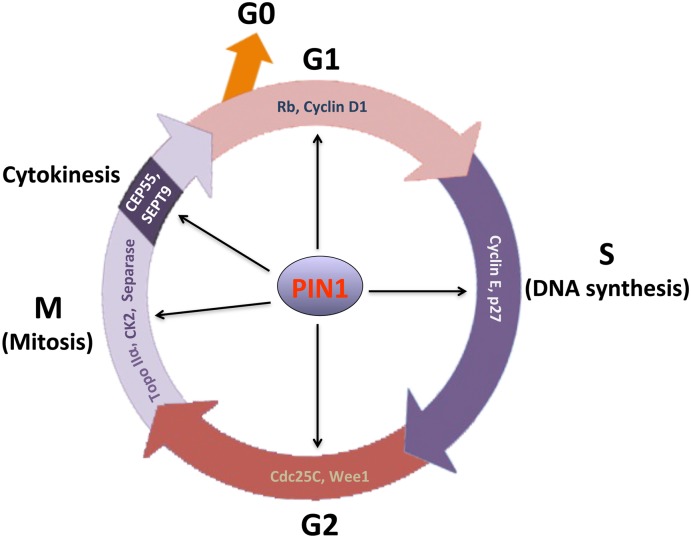
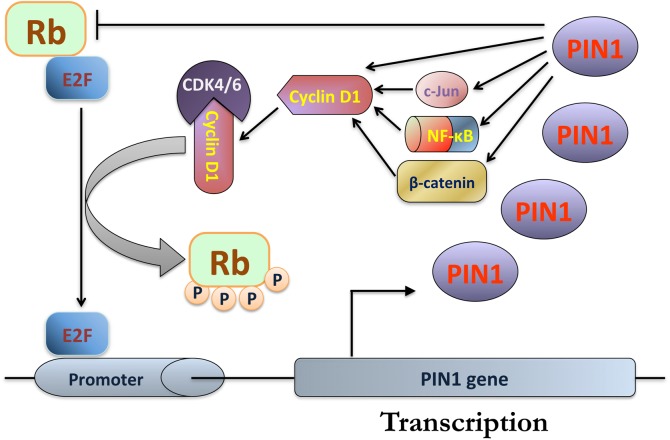
Cell cycle progression is tightly controlled by many cell cycle-regulatory proteins that are in turn regulated by a family of cyclin-dependent kinases (CDKs) through protein phosphorylation. The peptidyl-prolyl / isomerase PIN1 provides a further post-phosphorylation modification and functional regulation of these CDK-phosphorylated proteins. PIN1 specifically binds the phosphorylated serine or threonine residue preceding a proline (pSer/Thr-Pro) motif of its target proteins and catalyzes the / isomerization on the pSer/Thr-Pro peptide bonds. Through this phosphorylation-dependent prolyl isomerization, PIN1 fine-tunes the functions of various cell cycle-regulatory proteins including retinoblastoma protein (Rb), cyclin D1, cyclin E, p27, Cdc25C, and Wee1. In this review, we discussed the essential roles of PIN1 in regulating cell cycle progression through modulating the functions of these cell cycle-regulatory proteins. Furthermore, the mechanisms underlying PIN1 overexpression in cancers were also explored. Finally, we examined and summarized the therapeutic potential of PIN1 inhibitors in cancer therapy.
细胞周期进程受到许多细胞周期调节蛋白的严格控制,而这些蛋白又受到细胞周期蛋白依赖性激酶(CDK)家族通过蛋白质磷酸化的调节。肽基脯氨酰异构酶PIN1对这些CDK磷酸化的蛋白进行进一步的磷酸化后修饰和功能调节。PIN1特异性结合其靶蛋白脯氨酸(pSer/Thr-Pro)基序之前的磷酸化丝氨酸或苏氨酸残基,并催化pSer/Thr-Pro肽键上的异构化。通过这种磷酸化依赖性脯氨酰异构化,PIN1微调各种细胞周期调节蛋白的功能,包括视网膜母细胞瘤蛋白(Rb)、细胞周期蛋白D1、细胞周期蛋白E、p27、Cdc25C和Wee1。在本综述中,我们讨论了PIN1通过调节这些细胞周期调节蛋白的功能在调节细胞周期进程中的重要作用。此外,还探讨了癌症中PIN1过表达的潜在机制。最后,我们研究并总结了PIN1抑制剂在癌症治疗中的治疗潜力。