Neuroscience Research Institute and Department of Neurobiology, School of Basic Medical Sciences, Peking University, Beijing 100083, China.
Department of Internal Medicine, Peking University Hospital, Beijing 100871, China.
Neural Plast. 2018 Nov 11;2018:6109723. doi: 10.1155/2018/6109723. eCollection 2018.
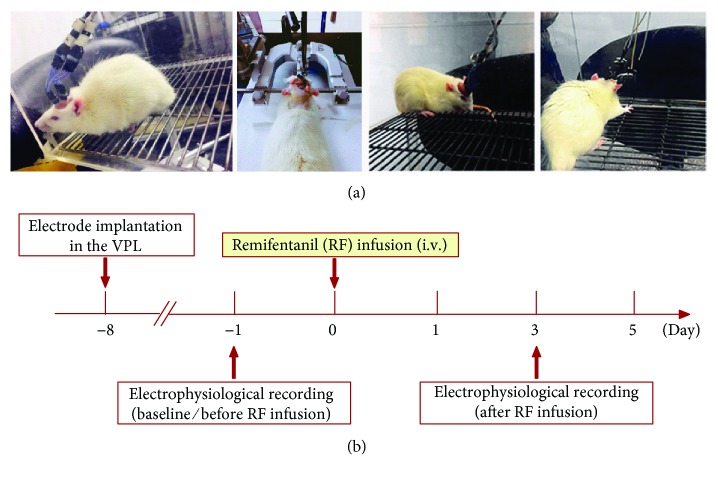
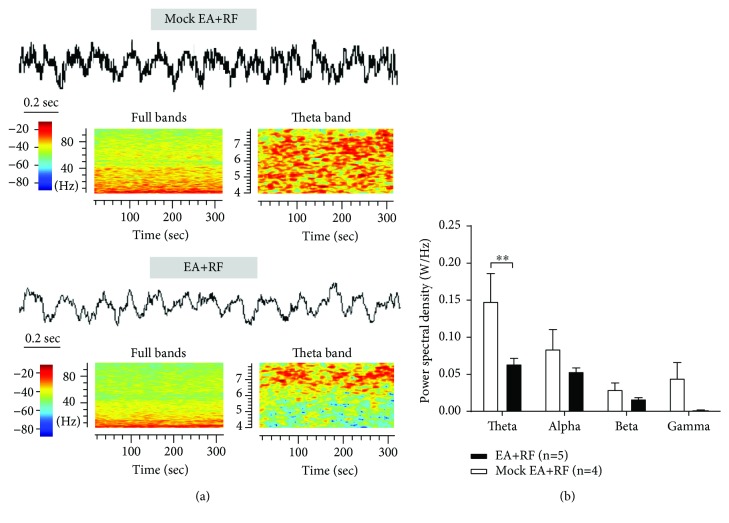
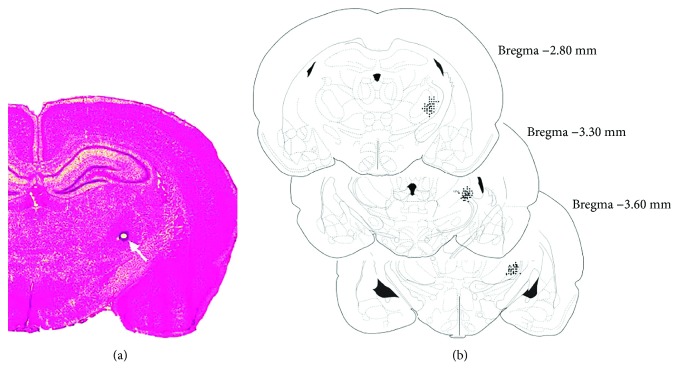
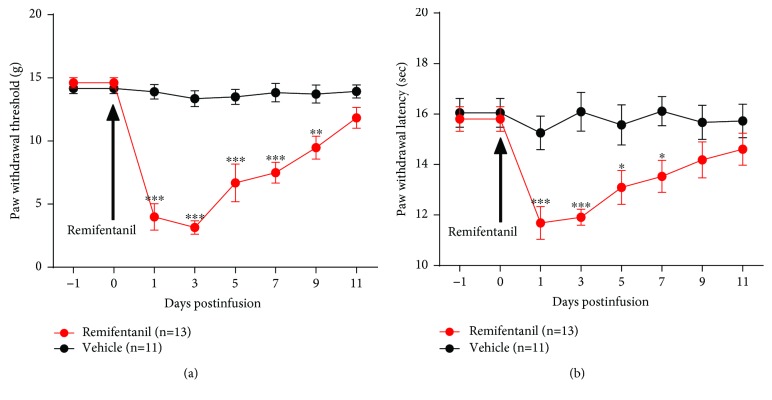
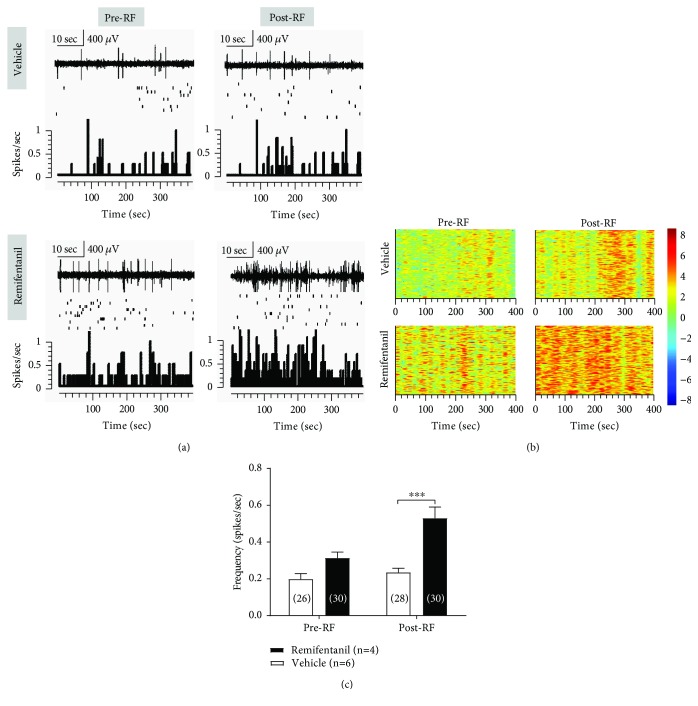
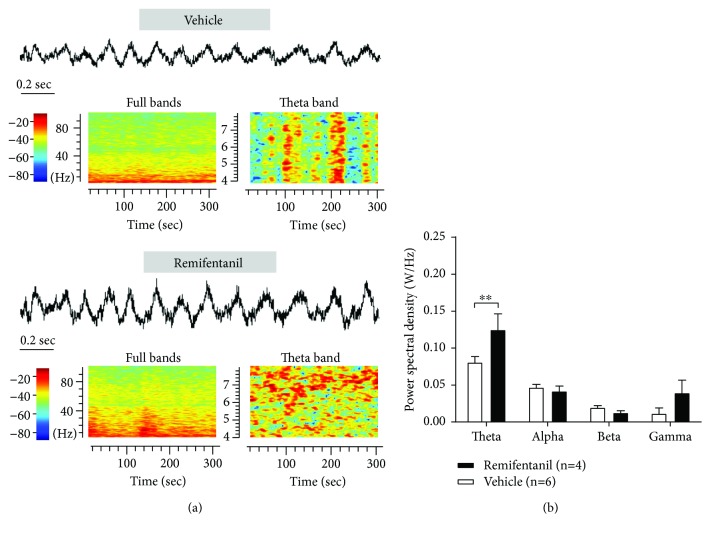
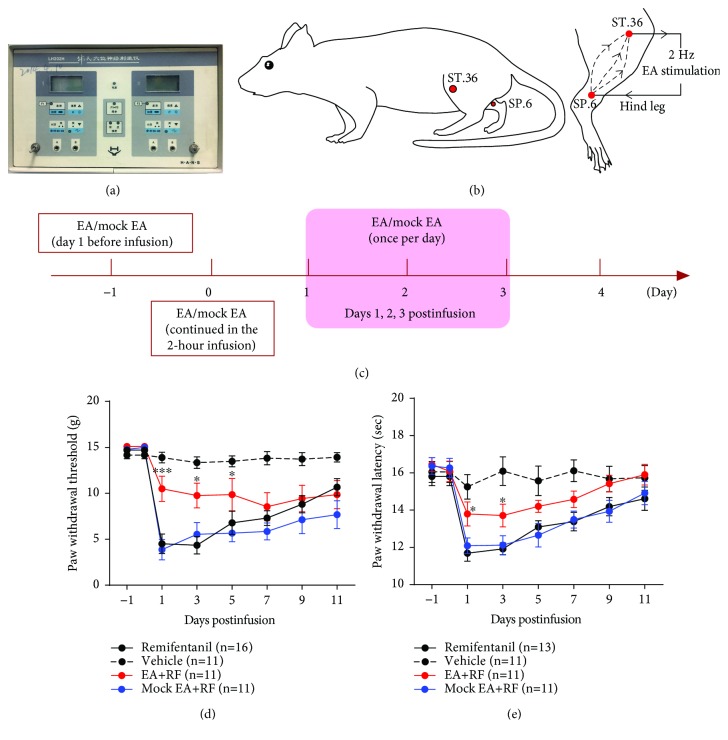
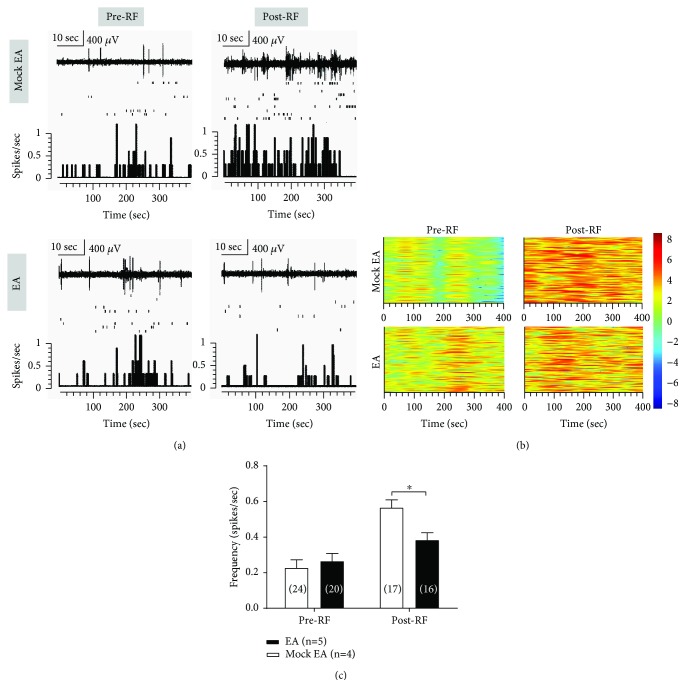
Mechanisms underlying remifentanil- (RF-) induced hyperalgesia, a phenomenon that is generally named as opioid-induced hyperalgesia (OIH), still remain elusive. The ventral posterior lateral nucleus (VPL) of the thalamus, a key relay station for the transmission of nociceptive information to the cerebral cortex, is activated by RF infusion. Electroacupuncture (EA) is an effective method for the treatment of pain. This study aimed to explore the role of VPL in the development of OIH and the effect of EA treatment on OIH in rats. RF was administered to rats via the tail vein for OIH induction. Paw withdrawal threshold (PWT) in response to mechanical stimuli and paw withdrawal latency (PWL) to thermal stimulation were tested in rats for the assessment of mechanical allodynia and thermal hyperalgesia, respectively. Spontaneous neuronal activity and local field potential (LFP) in VPL were recorded in freely moving rats using the multichannel recording technique. EA at 2 Hz frequency (pulse width 0.6 ms, 1-3 mA) was applied to the bilateral acupoints "Zusanli" (ST.36) and "Sanyinjiao" (SP.6) in rats. The results showed that both the PWT and PWL were significantly decreased after RF infusion to rats. Meanwhile, both the spontaneous neuronal firing rate and the theta band oscillation in VPL LFP were increased on day 3 post-RF infusion, indicating that the VPL may promote the development of RF-induced hyperalgesia by regulating the pain-related cortical activity. Moreover, 2 Hz-EA reversed the RF-induced decrease both in PWT and PWL of rats and also abrogated the RF-induced augmentation of the spontaneous neuronal activity and the power spectral density (PSD) of the theta band oscillation in VPL LFP. These results suggested that 2 Hz-EA attenuates the remifentanil-induced hyperalgesia via reducing the excitability of VPL neurons and the low-frequency (theta band) oscillation in VPL LFP.
瑞芬太尼诱导痛觉过敏(RF- 诱导痛觉过敏)的机制,即通常所说的阿片类药物诱导痛觉过敏(OIH),仍然难以捉摸。丘脑腹后外侧核(VPL)是痛觉信息传递到大脑皮层的关键中继站,瑞芬太尼输注可激活 VPL。电针(EA)是治疗疼痛的有效方法。本研究旨在探讨 VPL 在 OIH 发展中的作用以及 EA 治疗对大鼠 OIH 的影响。通过尾静脉给予大鼠 RF 以诱导 OIH。通过机械刺激测试大鼠的足底撤回阈值(PWT)和热刺激的足底撤回潜伏期(PWL),分别评估机械性痛觉过敏和热痛觉过敏。使用多通道记录技术在自由活动的大鼠中记录 VPL 的自发神经元活动和局部场电位(LFP)。在大鼠的双侧穴位“足三里”(ST.36)和“三阴交”(SP.6)上施加 2 Hz 频率(脉冲宽度 0.6 ms,1-3 mA)的 EA。结果表明,RF 输注后大鼠的 PWT 和 PWL 均明显降低。同时,RF 输注后第 3 天,VPL LFP 中的自发神经元放电率和θ波段振荡均增加,表明 VPL 可能通过调节与疼痛相关的皮质活动促进 RF 诱导的痛觉过敏的发展。此外,2 Hz-EA 逆转了 RF 诱导的大鼠 PWT 和 PWL 降低,并消除了 RF 诱导的 VPL LFP 中自发神经元活动和θ波段振荡的功率谱密度(PSD)增加。这些结果表明,2 Hz-EA 通过降低 VPL 神经元的兴奋性和 VPL LFP 中的低频(θ 波段)振荡来减轻瑞芬太尼诱导的痛觉过敏。