Orozco-Rocha Karina, Wong Rebeca, Obregón Alejandra Michaels
Consultora independiente,
University of Texas Medical Branch,
Real Datos Espacio. 2018 Jan-Apr;9(1):64-83.
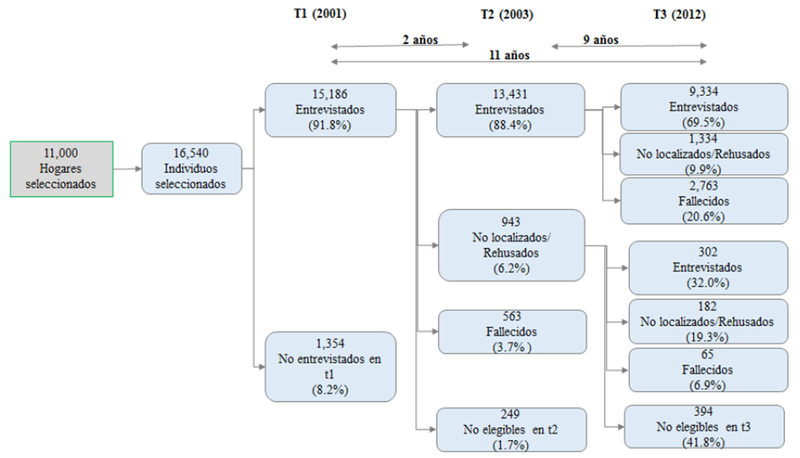
Este trabajo analiza la atrición de la Encuesta Nacional sobre Salud y Envejecimiento en México entre el 2001 y el 2012, un proyecto longitudinal sobre adultos mayores. Para la tercera ronda de este operativo estadístico, la pérdida acumulada representó la tercera parte de la muestra inicial; la principal causa fue por fallecimiento, seguida por la no localización y el rechazo. Con modelos de regresión se examinan asociaciones de características económicas, de salud y sociodemográficas de los participantes en el 2001 con cada tipo de atrición en el 2003 y el 2012. Los resultados señalan que las variables de salud tuvieron mayor asociación con la pérdida por fallecimiento, mientras que las características económicas y sociodemográficas estuvieron asociadas con la no localización y el rechazo. Documentar el carácter de la atrición proporciona valiosos elementos para investigaciones basadas en la ENASEM, pues los resultados longitudinales podrían ser afectados por un posible sesgo selectivo en la muestra. The Mexican Health and Aging Study (MHAS) is a longitudinal project focused on older population. In this paper, we analyze attrition in three rounds of the study, between 2001 and 2012. The attrition represents a third of the initial sample in wave three. Death is the main cause of attrition, followed by lo to follow-up and refusal. Using regression models we examined associations of health, economic and demographic characteristics of participants and survey characteristics in 2001 on each cause of attrition in 2003 and 2012. Results indicate that health variables such as the number of chronic diseases have a greater association with death attrition, while economic and demographic characteristics of the study participants are associated with loss to follow-up and refusal. Documenting the character of attrition provides valuable information for research based on the MHAS data, since the results of longitudinal studies could be affected by a possible selectivity bias in the sample.
本研究分析了2001年至2012年墨西哥全国健康与老龄化调查的样本流失情况,该调查是一项针对老年人的纵向研究项目。在该统计调查的第三轮中,累积流失样本占初始样本的三分之一;主要原因是死亡,其次是无法找到和拒绝参与。通过回归模型,研究了2001年参与者的经济、健康和社会人口特征与2003年和2012年各类样本流失之间的关联。结果表明,健康变量与因死亡导致的样本流失关联更大,而经济和社会人口特征则与无法找到和拒绝参与相关。记录样本流失的特征为基于墨西哥全国健康与老龄化调查开展的研究提供了有价值的信息,因为纵向研究的结果可能会受到样本中潜在选择性偏差的影响。墨西哥健康与老龄化研究(MHAS)是一项针对老年人群体的纵向项目。在本文中,我们分析了该研究在2001年至2012年三轮调查中的样本流失情况。第三轮调查中的样本流失占初始样本的三分之一。死亡是样本流失的主要原因,其次是无法追踪和拒绝参与。我们使用回归模型研究了2001年参与者的健康、经济和人口特征以及调查特征与2003年和2012年每种样本流失原因之间的关联。结果表明,诸如慢性病数量等健康变量与因死亡导致的样本流失关联更大,而研究参与者的经济和人口特征则与失访和拒绝参与相关。记录样本流失的特征为基于MHAS数据的研究提供了有价值的信息,因为纵向研究的结果可能会受到样本中潜在选择性偏差的影响。