Division of Gastroenterology and Hepatology, Department of Medicine, Taipei Veterans General Hospital, Taipei, Taiwan.
Faculty of Medicine, National Yang-Ming University School of Medicine, Taipei, Taiwan.
PLoS One. 2018 Dec 12;13(12):e0208903. doi: 10.1371/journal.pone.0208903. eCollection 2018.
The role of noninvasive liver fibrosis markers which were developed to evaluate the severity of chronic liver disease remains unclear in cirrhosis.
To evaluate the correlation between noninvasive markers and hemodynamic parameters and their prognostic performance in cirrhotic patients.
A total of 242 cirrhotic patients undergoing hemodynamic study were analyzed. The correlations between noninvasive models, including FIB-4, aspartate aminotransferase to platelet ratio index, cirrhosis discriminant score, Lok index, Goteborg University Cirrhosis Index, and albumin-bilirubin (ALBI) score and hemodynamic parameters were investigated, along with their predictive accuracy for short- and long-term survival.
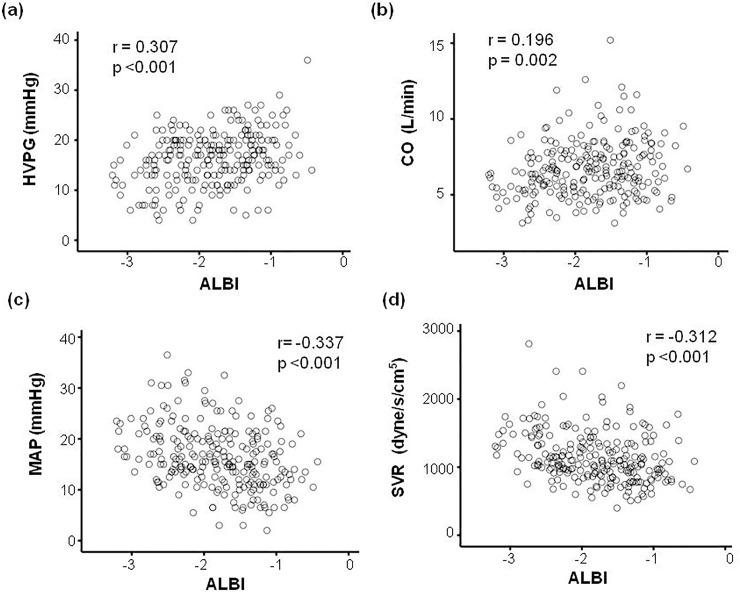
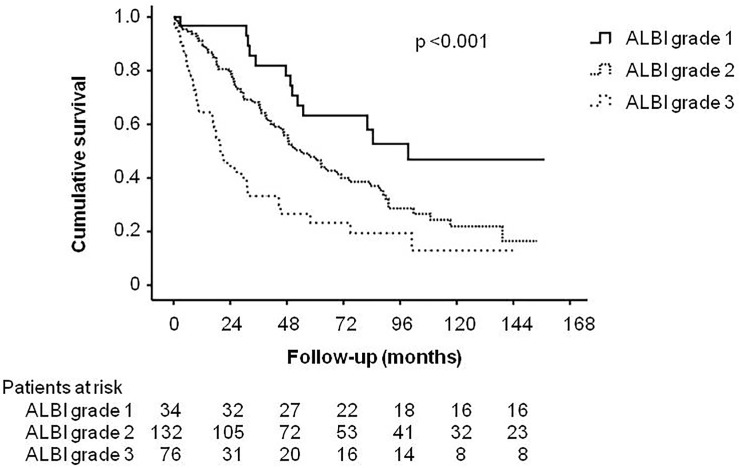
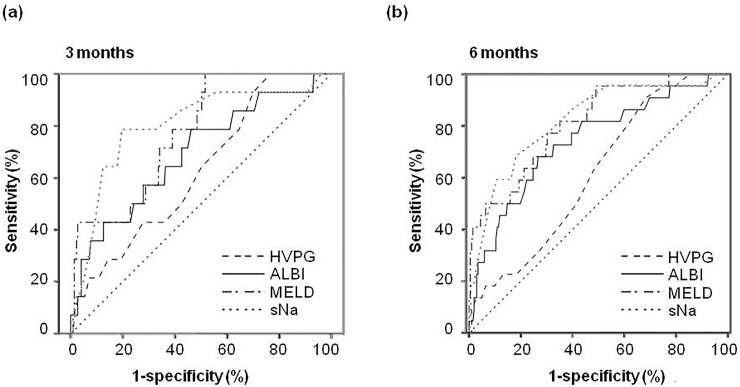
There was a significant correlation between all noninvasive markers and hepatic venous pressure gradient (HVPG), and ALBI score had the best correlation (r = 0.307, p<0.001). For the prediction of 3-month and 6-month mortality, serum sodium (sNa) levels had the highest area under curve (AUC; 0.799 and 0.818, respectively) among all parameters, and ALBI score showed the best performance (AUC = 0.691 and 0.740, respectively) compared with other 5 noninvasive models. Of 159 patients with low MELD scores (<14), high ALBI score (>-1.4) and low sNa (<135 mmol/L) predicted early mortality. In the Cox multivariate model, ALBI, MELD, HVPG and sNa were independent predictors of long-term survival.
Among noninvasive markers, ALBI score is best correlated with HVPG and associated with short-term outcome in cirrhotic patients. A high ALBI score and low sNa identify high-risk patients with low MELD scores. High MELD, HVPG, ALBI and low sNa levels are independent predictors of survival. Independent studies are required to confirm our findings.
开发非侵入性肝纤维化标志物是为了评估慢性肝病的严重程度,但在肝硬化中的作用仍不清楚。
评估非侵入性标志物与血流动力学参数之间的相关性及其在肝硬化患者中的预后表现。
对 242 例接受血流动力学研究的肝硬化患者进行分析。研究了包括 FIB-4、天冬氨酸氨基转移酶与血小板比值指数、肝硬化判别评分、Lok 指数、哥德堡大学肝硬化指数和白蛋白-胆红素(ALBI)评分在内的非侵入性模型与血流动力学参数之间的相关性,及其对短期和长期生存的预测准确性。
所有非侵入性标志物与肝静脉压力梯度(HVPG)之间均存在显著相关性,ALBI 评分相关性最好(r = 0.307,p<0.001)。对于 3 个月和 6 个月死亡率的预测,血清钠(sNa)水平的曲线下面积(AUC)最高(分别为 0.799 和 0.818),而 ALBI 评分与其他 5 种非侵入性模型相比,表现最佳(AUC 分别为 0.691 和 0.740)。在 159 例 MELD 评分较低(<14)的患者中,高 ALBI 评分(>-1.4)和低 sNa(<135 mmol/L)预测早期死亡率。在 Cox 多变量模型中,ALBI、MELD、HVPG 和 sNa 是长期生存的独立预测因子。
在非侵入性标志物中,ALBI 评分与 HVPG 相关性最好,与肝硬化患者的短期预后相关。高 ALBI 评分和低 sNa 可识别低 MELD 评分的高危患者。高 MELD、HVPG、ALBI 和低 sNa 水平是生存的独立预测因子。需要进一步的研究来证实我们的发现。