Department of Gastroenterology, The First Affiliated Hospital of Nanchang University, Nanchang, Jiangxi, China.
Dis Markers. 2020 Feb 15;2020:5193028. doi: 10.1155/2020/5193028. eCollection 2020.
. Various methods, including the Child-Pugh score, the model for end-stage liver disease (MELD) score, the MELD combined with serum sodium concentration (MELD-Na) score, the integrated MELD (iMELD) score, and the albumin-bilirubin (ALBI) score, have been widely used for predicting the survival of decompensated cirrhosis (DeCi) patients. In this study, we defined and compared the prognostic value of these scores to predict mortality in DeCi patients.
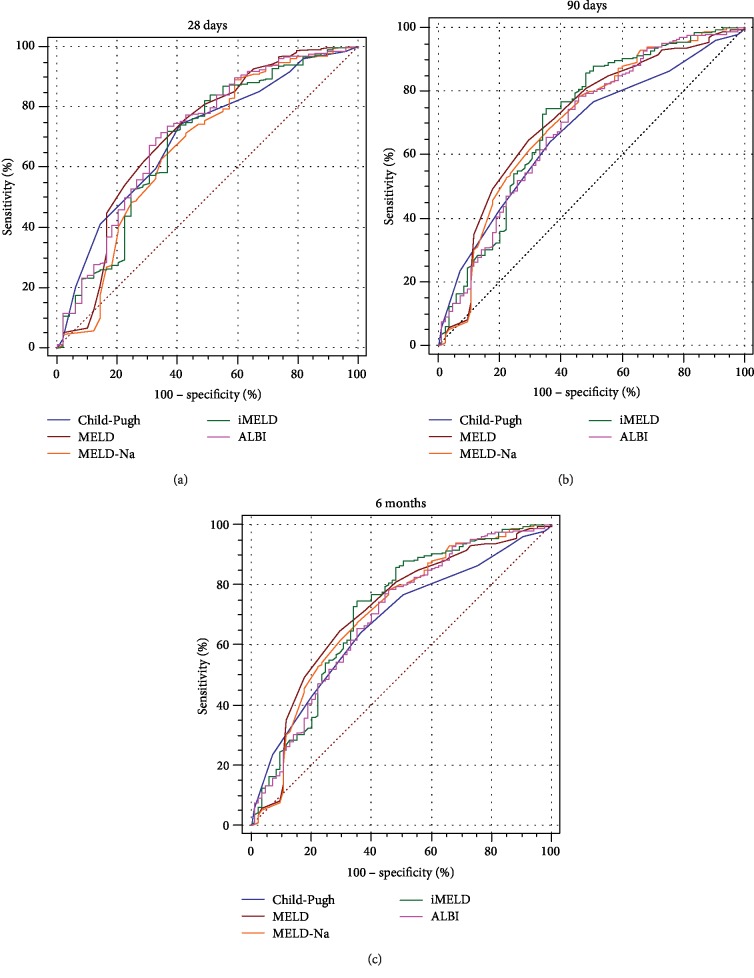
We performed a single-center, observational retrospective study and analyzed 456 DeCi patients who were hospitalized in the gastroenterology department. The biochemical examination results and demographic characteristics of the patients were obtained, and five scores were calculated upon admission after 24 hours. All patients were observed until death, loss to follow-up, or specific follow-up times (28 days, 90 days, and 6 months). A receiver operating characteristic (ROC) curve was used to evaluate the ability of these methods to predict mortality in DeCi patients.
At 28 days, 90 days, and 6 months, the cumulative number of deaths was 50 (11.0%), 76 (16.6%), and 91 (19.9%), respectively. The scores were significantly higher in nonsurviving patients than in surviving patients. All scores yielded viable values in predicting 28-day, 90-day, and 6-month prognoses for DeCi patients. The areas under the ROC curve (AUROCs) of the ALBI score were higher than those of the other scores, which were only over 0.700 at 28 days. The AUROC of the MELD score was higher than that of the other scores, including the MELD-Na and iMELD scores, at 90 days and 6 months.
All five methods (Child-Pugh score, MELD score, MELD-Na score, iMELD score, and ALBI score) provided a reliable prediction of mortality for both the short-term and long-term prognosis of patients with DeCi. The ALBI score may be particularly useful for assessing short-term outcomes, whereas the MELD score may be particularly useful for assessing long-term outcomes.
本研究旨在定义并比较这些评分系统,以预测失代偿性肝硬化(DeCi)患者的死亡率。
我们进行了一项单中心、观察性回顾性研究,分析了在消化内科住院的 456 例 DeCi 患者。获取患者的生化检查结果和人口统计学特征,并在入院后 24 小时内计算出 5 种评分。所有患者均随访至死亡、失访或达到特定随访时间(28 天、90 天和 6 个月)。采用受试者工作特征(ROC)曲线评估这些方法预测 DeCi 患者死亡率的能力。
在 28 天、90 天和 6 个月时,累计死亡人数分别为 50 例(11.0%)、76 例(16.6%)和 91 例(19.9%)。死亡患者的评分明显高于存活患者。所有评分均能有效预测 DeCi 患者 28 天、90 天和 6 个月的预后。ALBI 评分的 ROC 曲线下面积(AUROC)高于其他评分,仅在 28 天时超过 0.700。MELD 评分的 AUROC 在 90 天和 6 个月时高于其他评分,包括 MELD-Na 和 iMELD 评分。
这 5 种方法(Child-Pugh 评分、MELD 评分、MELD-Na 评分、iMELD 评分和 ALBI 评分)均能可靠地预测 DeCi 患者的短期和长期死亡率。ALBI 评分可能特别适用于评估短期预后,而 MELD 评分可能特别适用于评估长期预后。