School of Community Health Sciences, University of Nevada, 4505 S. Maryland Parkway Box 3064, Las Vegas, NV 89154, USA.
Int J Environ Res Public Health. 2018 Dec 7;15(12):2773. doi: 10.3390/ijerph15122773.
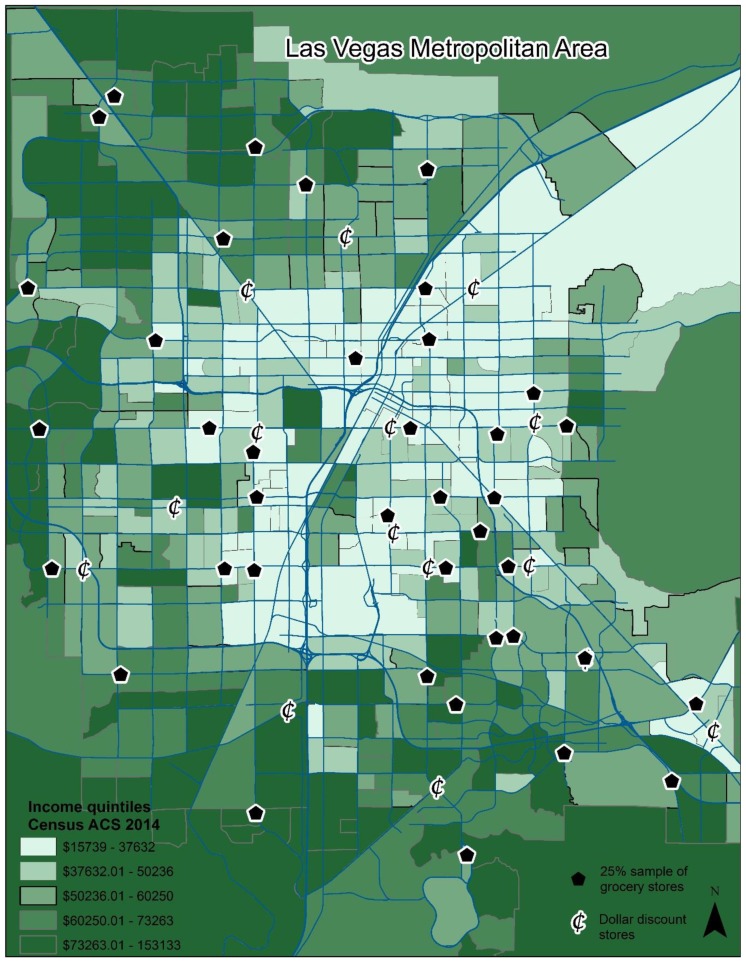
Food deserts indicate limited access to and affordability of healthy foods. One potential mediator is the availability of healthy food in non-traditional outlets such as dollar-discount stores, stores selling produce at the fixed $1 price. The purpose of this study was to compare availability, quality, price differences in 'healthier' versus 'regular' food choices, price per each food item, and summary score in dollar-discount stores to grocery stores in Las Vegas using the NEMS-S; a protocol consisting of three subscores-availability, quality, price of healthier versus regular food, and a summary score. A 25% sample of grocery stores ( = 40) and all dollar-discount stores ( = 14) were evaluated. -tests showed that dollar-discount stores were less likely to price healthy options lower than their unhealthy alternatives (mean (M) = 1.0 vs. M = 2.5; < 0.001) and had reduced availability (M = 20.50 vs. M = 23.80; < 0.001) compared to grocery stores. The quality of produce did not differ (M = 5.93 vs. M = 6.00; = 0.34). Price comparisons revealed that 84.2% of produce and 89.5% of other food items were significantly less expensive at the dollar-discount stores, with only two items being more expensive. While dollar-discount stores did have lower availability, they provided quality fresh and healthy foods which were usually less expensive. Findings indicate that dollar discount stores may be an existing community asset, and considering them as such may aid in efforts to strengthen the overall food system. Practitioners should consider dollar discount stores when assessing the community food environment and designing and implementing outreach programs, as they may bridge some disparities in access.
食品荒漠表示获取和负担健康食品的机会有限。一个潜在的中介因素是,非传统渠道(如折扣店、以固定价格 1 美元销售农产品的商店)提供健康食品的情况。本研究的目的是比较拉斯维加斯的折扣店和杂货店在“更健康”与“常规”食品选择的供应情况、质量差异、价格差异、每个食品项目的价格以及使用 NEMS-S 计算的综合得分;NEMS-S 协议包括三个子分数——供应情况、健康与常规食品的质量和价格,以及综合得分。对杂货店(=40)和所有折扣店(=14)进行了 25%的抽样评估。t 检验显示,折扣店更不可能将健康选择的价格定得低于不健康的选择(均值(M)=1.0 对比 M=2.5;<0.001),而且与杂货店相比,供应情况减少(M=20.50 对比 M=23.80;<0.001)。农产品的质量没有差异(M=5.93 对比 M=6.00;=0.34)。价格比较显示,84.2%的农产品和 89.5%的其他食品在折扣店的价格明显更低,只有两种商品更贵。虽然折扣店的供应情况较低,但它们提供了质量较高的新鲜和健康食品,通常价格更低。调查结果表明,折扣店可能是现有的社区资产,将其视为社区资产可能有助于加强整体食品系统。从业人员在评估社区食品环境以及设计和实施外展计划时,应考虑折扣店,因为它们可能在一定程度上弥合获取方面的差距。