Black Elizabeth M, Giunta Simona
Laboratory of Chromosome and Cell Biology, The Rockefeller University, 1230 York Avenue, New York, NY 10065, USA.
Genes (Basel). 2018 Dec 7;9(12):615. doi: 10.3390/genes9120615.
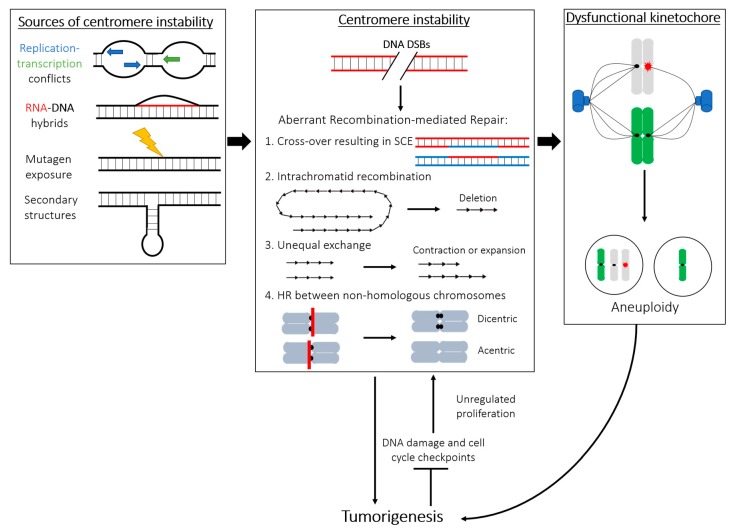
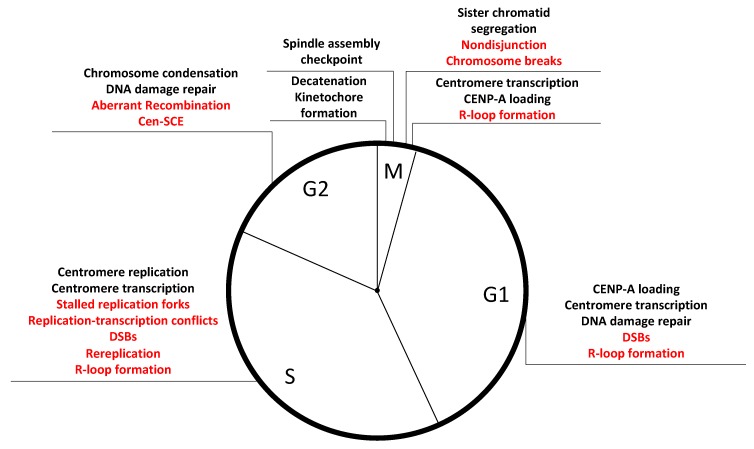
Maintenance of an intact genome is essential for cellular and organismal homeostasis. The centromere is a specialized chromosomal locus required for faithful genome inheritance at each round of cell division. Human centromeres are composed of large tandem arrays of repetitive alpha-satellite DNA, which are often sites of aberrant rearrangements that may lead to chromosome fusions and genetic abnormalities. While the centromere has an essential role in chromosome segregation during mitosis, the long and repetitive nature of the highly identical repeats has greatly hindered in-depth genetic studies, and complete annotation of all human centromeres is still lacking. Here, we review our current understanding of human centromere genetics and epigenetics as well as recent investigations into the role of centromere DNA in disease, with a special focus on cancer, aging, and human immunodeficiency⁻centromeric instability⁻facial anomalies (ICF) syndrome. We also highlight the causes and consequences of genomic instability at these large repetitive arrays and describe the possible sources of centromere fragility. The novel connection between alpha-satellite DNA instability and human pathological conditions emphasizes the importance of obtaining a truly complete human genome assembly and accelerating our understanding of centromere repeats' role in physiology and beyond.
维持完整的基因组对于细胞和机体的稳态至关重要。着丝粒是每一轮细胞分裂时基因组忠实遗传所必需的特殊染色体位点。人类着丝粒由大量串联排列的重复α-卫星DNA组成,这些区域常常是异常重排的位点,可能导致染色体融合和基因异常。虽然着丝粒在有丝分裂过程中的染色体分离中起着至关重要的作用,但高度同源重复序列的长链和重复性极大地阻碍了深入的遗传学研究,目前仍缺乏对所有人类着丝粒的完整注释。在此,我们综述了目前对人类着丝粒遗传学和表观遗传学的理解,以及近期对着丝粒DNA在疾病中的作用的研究,特别关注癌症、衰老和人类免疫缺陷-着丝粒不稳定-面部异常(ICF)综合征。我们还强调了这些大型重复序列处基因组不稳定的原因和后果,并描述了着丝粒脆弱性的可能来源。α-卫星DNA不稳定性与人类病理状况之间的新联系强调了获得真正完整的人类基因组组装以及加速我们对着丝粒重复序列在生理学及其他方面作用的理解的重要性。