Holmstrup Michael E, Kelley Michael A, Calhoun Kyla R, Kiess Caleb L
Department of Exercise and Rehabilitative Sciences, Slippery Rock University, 337 Patterson Hall, Slippery Rock, PA 16057, USA.
Sports (Basel). 2018 Dec 8;6(4):166. doi: 10.3390/sports6040166.
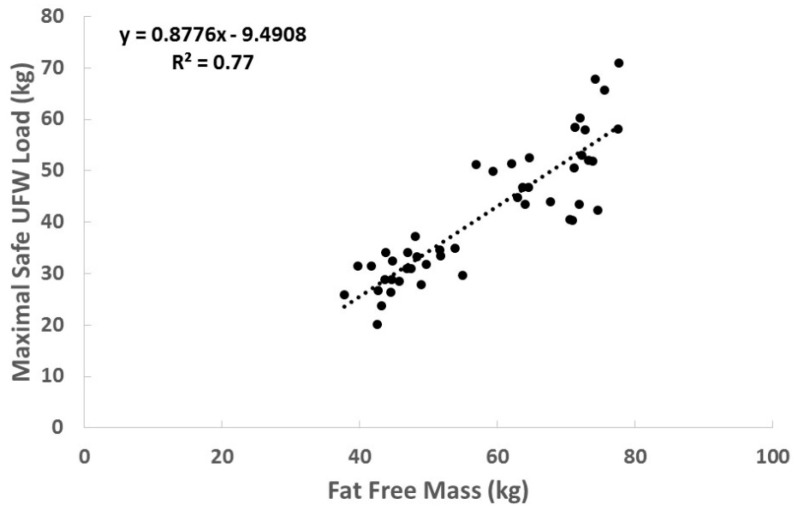
This study quantified and compared unilateral farmer's walk (UFW) performance in recreationally active males and females, and determined if additional variables allowed for the prediction of a maximal safe load. Anthropometric (height, body weight (BW), body mass index, body fat percentage, fat-free mass (FFM), and fat mass), muscular endurance (maximal duration side bridge), and balance (Balance Error Scoring System (BESS)) tests were completed. Participants performed a series of 20 s UFW trials (non-dominant side) at a cadence of 66 beats/min. The initial load was 10% of BW and increased by 10% per trial until deviations in spinal alignment or compromised gait patterns were noted, and the series was terminated. The highest load carried before technical failure was recorded. Descriptive and comparative statistics and a stepwise linear regression analysis were utilized to determine relationships between UFW performance and anthropometric, muscular endurance, and balance tests. Males (N = 25) were significantly taller (177.3 ± 6.7 vs. 164.7 ± 7.2 cm, < 0.05), heavier (81.7 ± 7.0 vs. 62.0 ± 9.4 kg, < 0.05), and leaner (14.4 ± 4.4 vs. 22.4 ± 4.8%, < 0.05) than females (N = 26). Further, males had a higher amount of FFM ( < 0.05) than females. The males (52.2 ± 9.0, 64% BW) carried a higher average UFW load than the females (32.5 ± 7.1 kg, 53% BW, < 0.05). FFM was strongly predictive of UFW load (load = -9.88876 + 0.88679 × (FFM); r² = 0.774, < 0.0001). The addition of the BESS test further increased the accuracy of the prediction equation (r² = 0.800, < 0.0001). There are differences in UFW performance ability between males and females. As our method does not account for all potential confounding variables, the use of these equations should be combined with technique analysis and participant feedback to ensure an appropriate workload.
本研究对休闲活动的男性和女性进行单侧农夫行走(UFW)表现的量化和比较,并确定是否有其他变量可用于预测最大安全负荷。完成了人体测量(身高、体重(BW)、体重指数、体脂百分比、去脂体重(FFM)和脂肪量)、肌肉耐力(最大持续时间侧桥)和平衡(平衡误差评分系统(BESS))测试。参与者以每分钟66次的节奏进行了一系列20秒的UFW试验(非优势侧)。初始负荷为体重的10%,每次试验增加10%,直到注意到脊柱排列偏差或步态模式受损,然后终止该系列试验。记录技术失败前携带的最高负荷。利用描述性和比较性统计以及逐步线性回归分析来确定UFW表现与人体测量、肌肉耐力和平衡测试之间的关系。男性(N = 25)比女性(N = 26)显著更高(177.3 ± 6.7 vs. 164.7 ± 7.2厘米,P < 0.05)、更重(81.7 ± 7.0 vs. 62.0 ± 9.4千克,P < 0.05)且更瘦(14.4 ± 4.4 vs. 22.4 ± 4.8%,P < 0.05)。此外,男性的FFM量高于女性(P < 0.05)。男性(52.2 ± 9.0,64%BW)的平均UFW负荷高于女性(32.5 ± 7.1千克,53%BW,P < 0.05)。FFM对UFW负荷具有很强的预测性(负荷 = -9.88876 + 0.88679 ×(FFM);r² = 0.774,P < 0.0001)。加入BESS测试进一步提高了预测方程的准确性(r² = 0.800,P < 0.0001)。男性和女性在UFW表现能力上存在差异。由于我们的方法没有考虑所有潜在的混杂变量,这些方程的使用应与技术分析和参与者反馈相结合,以确保适当的工作量。