Stastny Petr, Lehnert Michal, Zaatar Amr, Svoboda Zdenek, Xaverova Zuzana, Pietraszewski Przemysław
Palacky University in Olomouc, Faculty of Physical Culture, Tr. Miru 115, post. 771 11 Olomouc, Czech Republic.
Department of Theory and Practice of Sport; The Jerzy Kukuczka Academy of Physical Education in Katowice; Poland.
J Hum Kinet. 2015 Apr 7;45:157-65. doi: 10.1515/hukin-2015-0016. eCollection 2015 Mar 29.
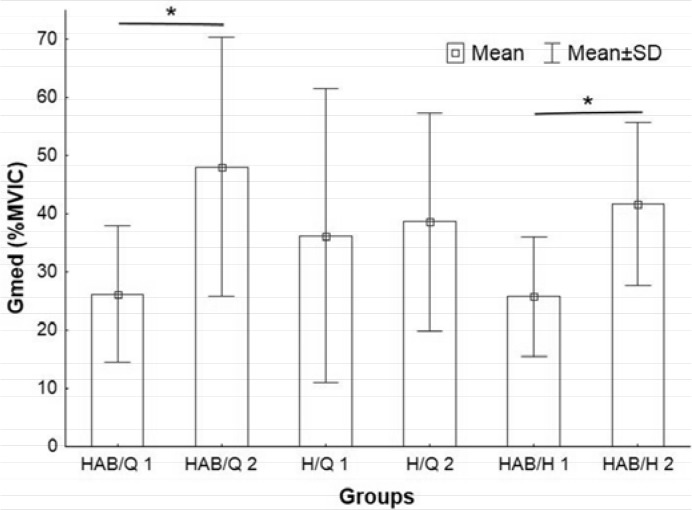
The strength ratio between hamstrings and quadriceps (H/Q) is associated with knee injuries as well as hip abductor muscle (HAB) weakness. Sixteen resistance trained men (age, 32.5 ± 4.2 years) performed 5 s maximal isometric contractions at 75° of knee flexion/extension and 15° of hip abduction on a dynamometer. After this isometric test they performed a Farmer's walk exercise to find out if the muscle strength ratio predicted the electromyography amplitude expressed as a percentage of maximum voluntary isometric contraction (%MVIC). The carried load represented a moderate intensity of 75% of the exercise six repetitions maximum (6RM). Electromyography data from the vastus medialis (VM), vastus lateralis (VL), biceps femoris (BF) and gluteus medius (Gmed) on each leg were collected during the procedure. The groups selected were participants with H/Q ≥ 0.5, HQ < 0.5, HAB/H ≥ 1, HAB/H < 1, HAB/Q ≥ 0.5 and HAB/Q < 0.5. One way ANOVA showed that Gmed activity was significantly greater in the group with HAB/H < 1 (42 ± 14 %MVIC) as compared to HAB/H ≥ 1 (26 ± 10 %MVIC) and HAB/Q < 0.5 (47 ± 19 %MVIC) compared to HAB/Q ≥ 0.5 (26 ± 12 %MVIC). The individuals with HAB/H < 1 were found to have greater activation of their Gmed during the Farmer's walk exercise. Individuals with HAB/Q < 0.5 had greater activation of the Gmed. Gmed strength ratios predict the muscle involvement when a moderate amount of the external load is used. The Farmer's walk is recommended as an exercise which can strengthen the gluteus medius, especially for individuals with a HAB/H ratio < 1 and HAB/Q < 0.5.
腘绳肌与股四头肌的力量比(H/Q)与膝关节损伤以及髋外展肌无力有关。16名经过阻力训练的男性(年龄32.5±4.2岁)在测力计上进行了膝关节屈伸75°和髋关节外展15°的5秒最大等长收缩。在这次等长测试后,他们进行了农夫行走练习,以确定肌肉力量比是否能预测以最大自主等长收缩百分比(%MVIC)表示的肌电图幅度。所携带的负荷代表了该练习6次重复最大值(6RM)的75%的中等强度。在该过程中收集了每条腿的股内侧肌(VM)、股外侧肌(VL)、股二头肌(BF)和臀中肌(Gmed)的肌电图数据。所选组为H/Q≥0.5、HQ<0.5、HAB/H≥1、HAB/H<1、HAB/Q≥0.5和HAB/Q<0.5的参与者。单因素方差分析表明,与HAB/H≥1(26±10%MVIC)相比,HAB/H<1组(42±14%MVIC)的Gmed活动明显更大;与HAB/Q≥0.5(26±12%MVIC)相比,HAB/Q<0.5组(47±19%MVIC)的Gmed活动明显更大。发现HAB/H<1的个体在农夫行走练习期间其Gmed的激活程度更高。HAB/Q<0.5的个体Gmed的激活程度更高。Gmed力量比可预测使用适量外部负荷时的肌肉参与情况。推荐农夫行走作为一种可增强臀中肌的练习,特别是对于HAB/H比<1和HAB/Q<0.5的个体。