Division of Molecular Parasitology, Proteo-Science Center, Ehime University, Toon, Ehime, 791-0295, Japan.
Mahidol Vivax Research Unit, Faculty of Tropical Medicine, Mahidol University, Bangkok, 10400, Thailand.
Malar J. 2018 Dec 13;17(1):466. doi: 10.1186/s12936-018-2617-6.
For the success of the malaria control and eradication programme it is essential to reduce parasite transmission by mosquito vectors. In the midguts of mosquitoes fed with parasite-infected blood, sexual-stage parasites fertilize to develop into motile ookinetes that traverse midgut epithelial cells and reside adjacent the basal lamina. Therefore, the ookinete is a promising target of transmission-blocking vaccines to break the parasite lifecycle in mosquito vectors. However, the molecular mechanisms of ookinete formation and invasion of epithelial cells have not been fully elucidated. A unique structure called the crystalloid body has been identified in the ookinete cytoplasm by electron microscopy, but its biological functions remain unclear.
A recombinant protein of a novel molecule, designated as crystalloid body specific PH domain-containing protein of Plasmodium yoelii (PyCryPH), was synthesized using a wheat germ cell-free system. Specific rabbit antibodies against PyCryPH were obtained to characterize the expression and localization of PyCryPH during sexual-stage parasite development. In addition, PyCryPH knockout parasites were generated by targeted gene disruption to examine PyCryPH function in mosquito-stage parasite development.
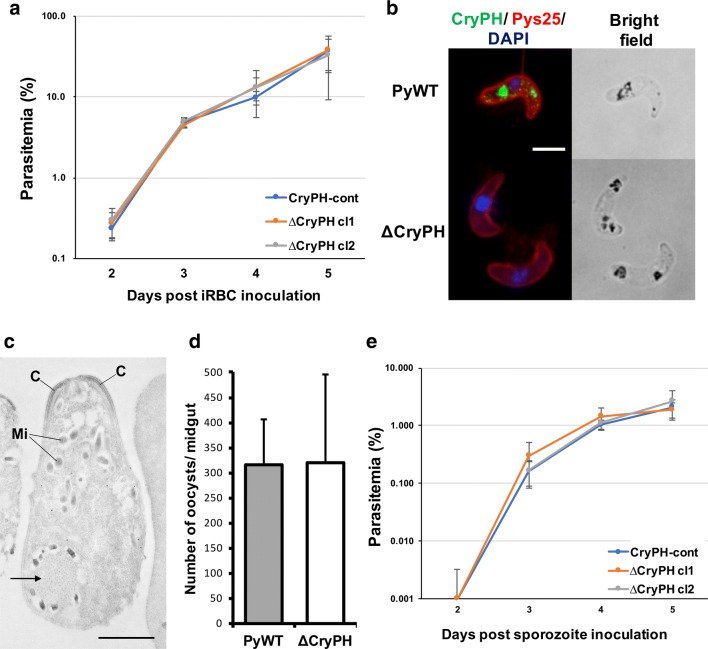
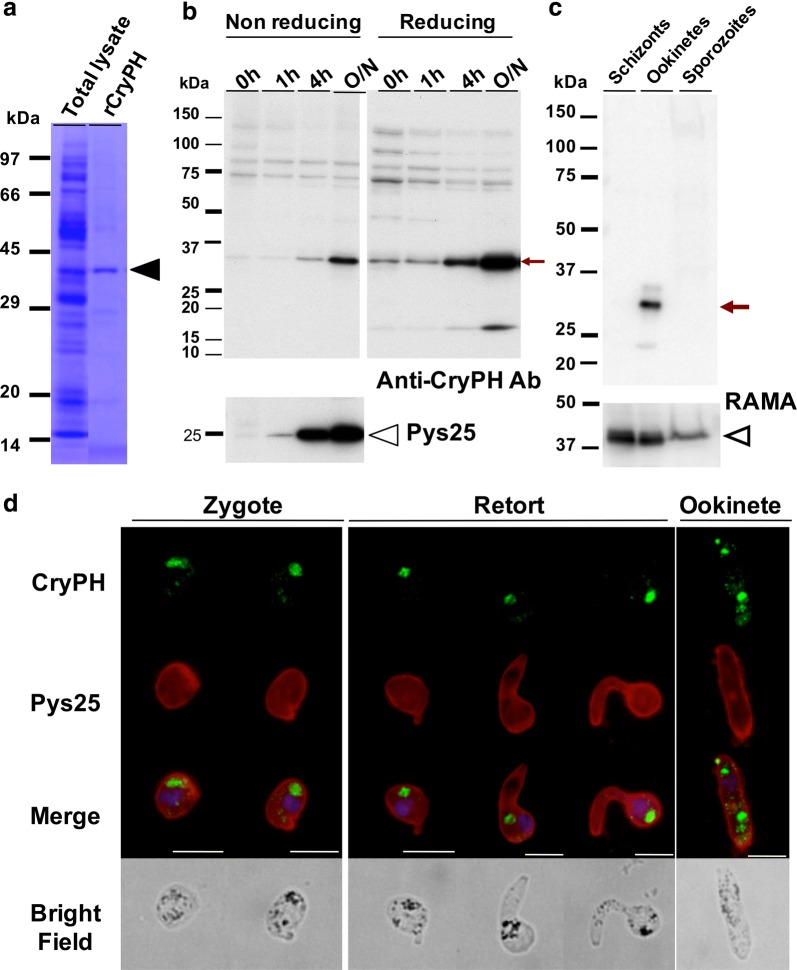
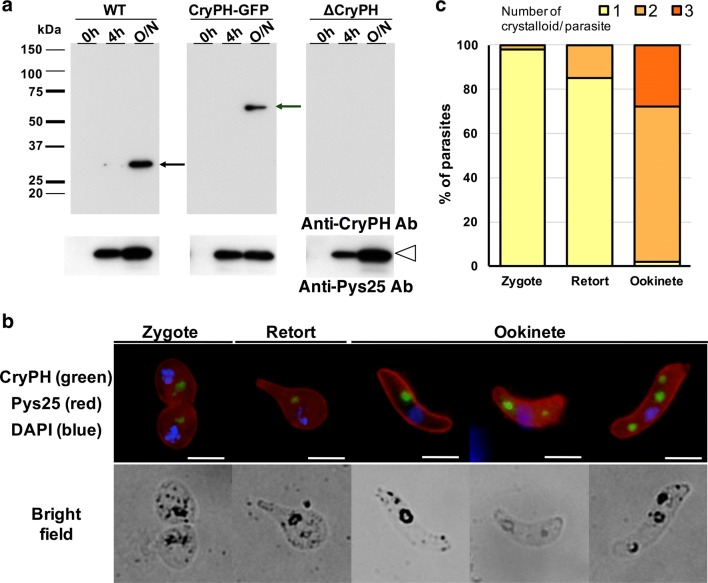
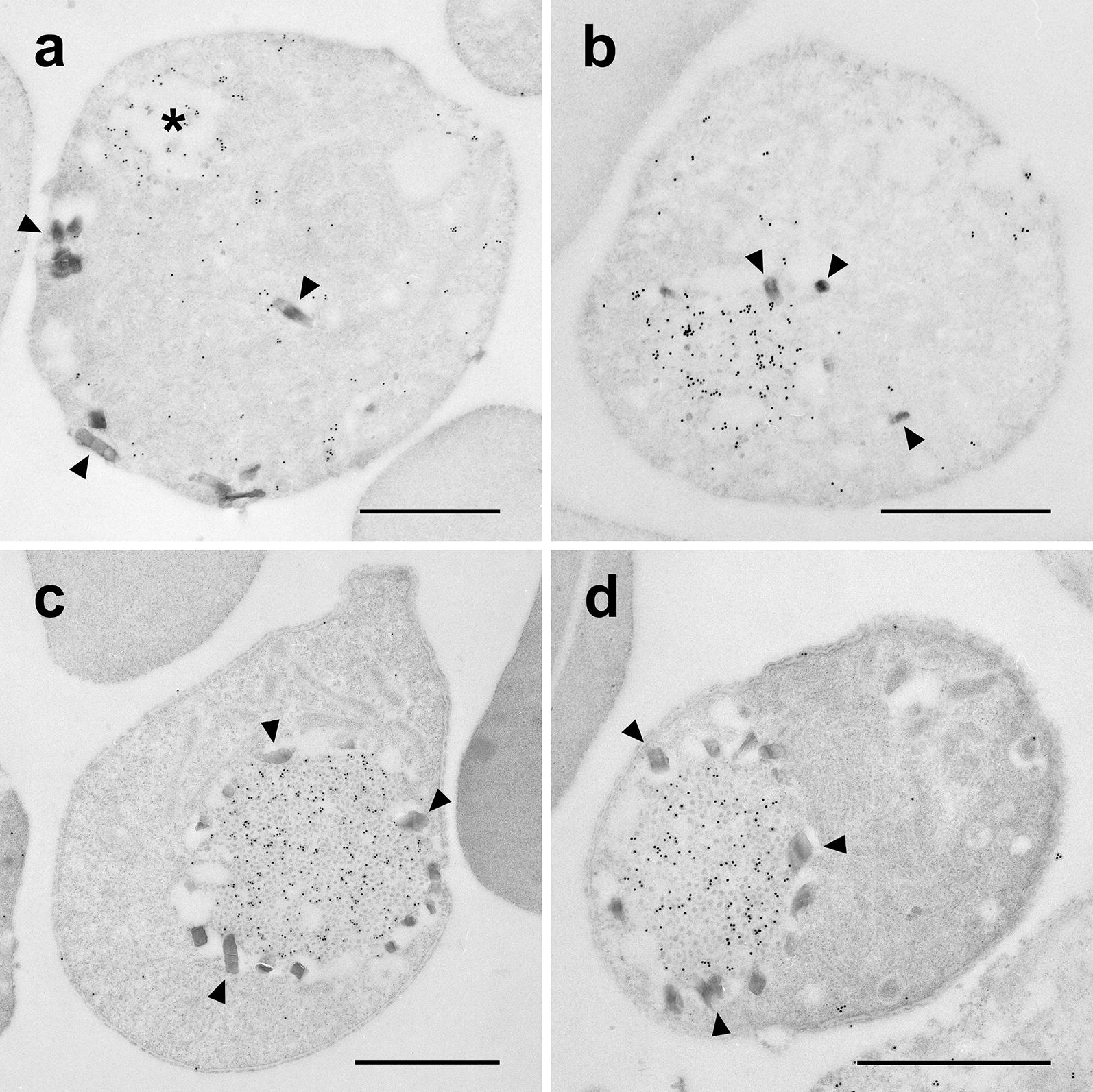
Western blot and immunofluorescence assays using specific antibodies showed that PyCryPH is specifically expressed in zygotes and ookinetes. By immunoelectron microscopy it was demonstrated that PyCryPH is localized within crystalloid bodies. Parasites with a disrupted PyCryPH gene developed normally into ookinetes and formed oocysts on the basal lamina of midguts. In addition, the number of sporozoites residing in salivary glands was comparable to that of wild-type parasites.
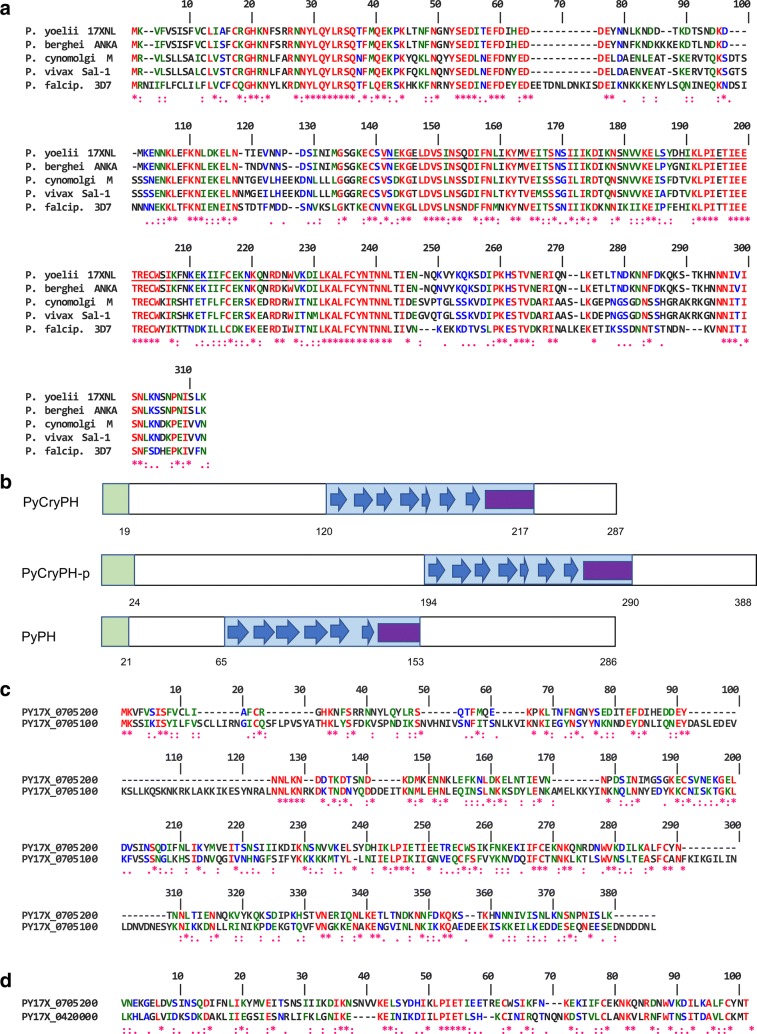
CryPH, containing a signal peptide and PH domain, is predominantly expressed in zygotes and ookinetes and is localized to crystalloid bodies in P. yoelii. CryPH accumulates in vesicle-like structures prior to the appearance of typical crystalloid bodies. Unlike other known crystalloid body localized proteins, CryPH does not appear to have a multiple domain architecture characteristic of the LAP/CCp family proteins. Although CryPH is highly conserved among Plasmodium, Babesia, Theileria, and Cryptosporidium, PyCryPH is dispensable for the development of invasive ookinetes and sporozoites in mosquito bodies.
为了成功实施疟疾控制和消除规划,减少疟疾病媒蚊虫的寄生虫传播至关重要。在感染寄生虫的血液喂养的蚊子的中肠中,有性期寄生虫受精发育成可运动的卵囊,穿过中肠上皮细胞并位于基底膜附近。因此,卵囊是阻断传播疫苗的一个有前途的靶点,可以打破疟疾病媒中的寄生虫生命周期。然而,卵囊的形成和侵入上皮细胞的分子机制尚未完全阐明。电子显微镜已在卵囊细胞质中鉴定出一种称为晶体体的独特结构,但它的生物学功能仍不清楚。
使用小麦胚细胞无细胞系统合成了一种新型分子的重组蛋白,命名为约氏疟原虫晶体体特异 PH 结构域蛋白(PyCryPH)。获得针对 PyCryPH 的特异性兔抗体,以表征其在有性期寄生虫发育过程中的表达和定位。此外,通过靶向基因敲除生成 PyCryPH 缺失寄生虫,以检查其在蚊期寄生虫发育中的功能。
使用特异性抗体的 Western blot 和免疫荧光分析表明,PyCryPH 特异性表达于合子和卵囊。通过免疫电子显微镜显示,PyCryPH 定位于晶体体中。PyCryPH 基因缺失的寄生虫正常发育为卵囊,并在中肠基底膜上形成卵囊。此外,寄生于唾液腺的子孢子数量与野生型寄生虫相当。
PyCryPH 包含信号肽和 PH 结构域,主要在合子和卵囊中表达,并定位于 P. yoelii 的晶体体中。CryPH 在典型晶体体出现之前积累在囊泡样结构中。与其他已知的晶体体定位蛋白不同,CryPH 似乎没有 LAP/CCp 家族蛋白的特征的多结构域架构。尽管 CryPH 在疟原虫、巴贝斯虫、泰勒虫和隐孢子虫中高度保守,但 PyCryPH 对于蚊体中侵入性卵囊和子孢子的发育是可有可无的。