• 文献检索
  • 文档翻译
  • 深度研究
  • 学术资讯
  • Suppr Zotero 插件Zotero 插件
  • 邀请有礼
  • 套餐&价格
  • 历史记录
应用&插件
Suppr Zotero 插件Zotero 插件浏览器插件Mac 客户端Windows 客户端微信小程序
定价
高级版会员购买积分包购买API积分包
服务
文献检索文档翻译深度研究API 文档MCP 服务
关于我们
关于 Suppr公司介绍联系我们用户协议隐私条款
关注我们

Suppr 超能文献

核心技术专利:CN118964589B侵权必究
粤ICP备2023148730 号-1Suppr @ 2026

文献检索

告别复杂PubMed语法,用中文像聊天一样搜索,搜遍4000万医学文献。AI智能推荐,让科研检索更轻松。

立即免费搜索

文件翻译

保留排版,准确专业,支持PDF/Word/PPT等文件格式,支持 12+语言互译。

免费翻译文档

深度研究

AI帮你快速写综述,25分钟生成高质量综述,智能提取关键信息,辅助科研写作。

立即免费体验

使用心理人工智能(苔丝)缓解抑郁和焦虑症状:随机对照试验。

Using Psychological Artificial Intelligence (Tess) to Relieve Symptoms of Depression and Anxiety: Randomized Controlled Trial.

作者信息

Fulmer Russell, Joerin Angela, Gentile Breanna, Lakerink Lysanne, Rauws Michiel

机构信息

Northwestern University, Evanston, IL, United States.

X2AI Inc, San Francisco, CA, United States.

出版信息

JMIR Ment Health. 2018 Dec 13;5(4):e64. doi: 10.2196/mental.9782.

DOI:10.2196/mental.9782
PMID:30545815
原文链接:https://pmc.ncbi.nlm.nih.gov/articles/PMC6315222/
Abstract

BACKGROUND

Students in need of mental health care face many barriers including cost, location, availability, and stigma. Studies show that computer-assisted therapy and 1 conversational chatbot delivering cognitive behavioral therapy (CBT) offer a less-intensive and more cost-effective alternative for treating depression and anxiety. Although CBT is one of the most effective treatment methods, applying an integrative approach has been linked to equally effective posttreatment improvement. Integrative psychological artificial intelligence (AI) offers a scalable solution as the demand for affordable, convenient, lasting, and secure support grows.

OBJECTIVE

This study aimed to assess the feasibility and efficacy of using an integrative psychological AI, Tess, to reduce self-identified symptoms of depression and anxiety in college students.

METHODS

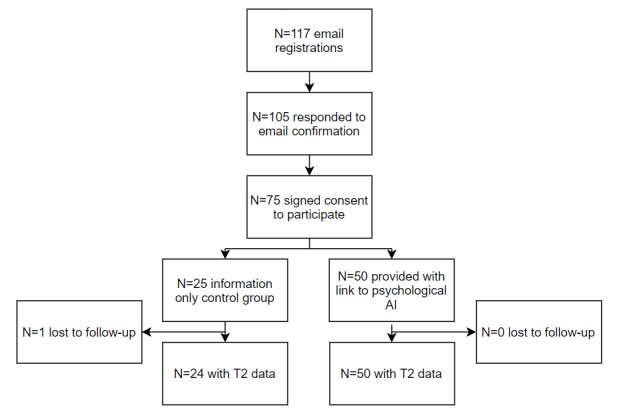
In this randomized controlled trial, 75 participants were recruited from 15 universities across the United States. All participants completed Web-based surveys, including the Patient Health Questionnaire (PHQ-9), Generalized Anxiety Disorder Scale (GAD-7), and Positive and Negative Affect Scale (PANAS) at baseline and 2 to 4 weeks later (T2). The 2 test groups consisted of 50 participants in total and were randomized to receive unlimited access to Tess for either 2 weeks (n=24) or 4 weeks (n=26). The information-only control group participants (n=24) received an electronic link to the National Institute of Mental Health's (NIMH) eBook on depression among college students and were only granted access to Tess after completion of the study.

RESULTS

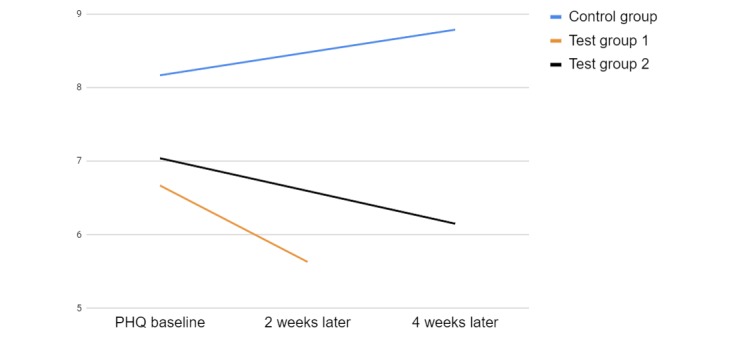
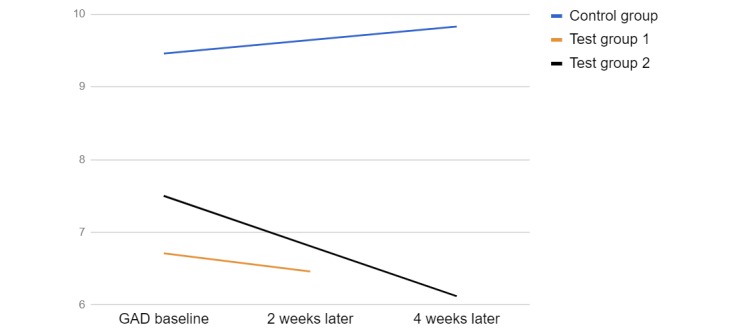
A sample of 74 participants completed this study with 0% attrition from the test group and less than 1% attrition from the control group (1/24). The average age of participants was 22.9 years, with 70% of participants being female (52/74), mostly Asian (37/74, 51%), and white (32/74, 41%). Group 1 received unlimited access to Tess, with daily check-ins for 2 weeks. Group 2 received unlimited access to Tess with biweekly check-ins for 4 weeks. The information-only control group was provided with an electronic link to the NIMH's eBook. Multivariate analysis of covariance was conducted. We used an alpha level of .05 for all statistical tests. Results revealed a statistically significant difference between the control group and group 1, such that group 1 reported a significant reduction in symptoms of depression as measured by the PHQ-9 (P=.03), whereas those in the control group did not. A statistically significant difference was found between the control group and both test groups 1 and 2 for symptoms of anxiety as measured by the GAD-7. Group 1 (P=.045) and group 2 (P=.02) reported a significant reduction in symptoms of anxiety, whereas the control group did not. A statistically significant difference was found on the PANAS between the control group and group 1 (P=.03) and suggests that Tess did impact scores.

CONCLUSIONS

This study offers evidence that AI can serve as a cost-effective and accessible therapeutic agent. Although not designed to appropriate the role of a trained therapist, integrative psychological AI emerges as a feasible option for delivering support.

TRIAL REGISTRATION

International Standard Randomized Controlled Trial Number: ISRCTN61214172; https://doi.org/10.1186/ISRCTN61214172.
https://cdn.ncbi.nlm.nih.gov/pmc/blobs/6676/6315222/2169d099abb2/mental_v5i4e64_fig5.jpg
https://cdn.ncbi.nlm.nih.gov/pmc/blobs/6676/6315222/50278fff4105/mental_v5i4e64_fig1.jpg
https://cdn.ncbi.nlm.nih.gov/pmc/blobs/6676/6315222/e2666e4a91d4/mental_v5i4e64_fig2.jpg
https://cdn.ncbi.nlm.nih.gov/pmc/blobs/6676/6315222/808d4a636ce9/mental_v5i4e64_fig3.jpg
https://cdn.ncbi.nlm.nih.gov/pmc/blobs/6676/6315222/3c6d8d2a0ec5/mental_v5i4e64_fig4.jpg
https://cdn.ncbi.nlm.nih.gov/pmc/blobs/6676/6315222/2169d099abb2/mental_v5i4e64_fig5.jpg
https://cdn.ncbi.nlm.nih.gov/pmc/blobs/6676/6315222/50278fff4105/mental_v5i4e64_fig1.jpg
https://cdn.ncbi.nlm.nih.gov/pmc/blobs/6676/6315222/e2666e4a91d4/mental_v5i4e64_fig2.jpg
https://cdn.ncbi.nlm.nih.gov/pmc/blobs/6676/6315222/808d4a636ce9/mental_v5i4e64_fig3.jpg
https://cdn.ncbi.nlm.nih.gov/pmc/blobs/6676/6315222/3c6d8d2a0ec5/mental_v5i4e64_fig4.jpg
https://cdn.ncbi.nlm.nih.gov/pmc/blobs/6676/6315222/2169d099abb2/mental_v5i4e64_fig5.jpg
摘要

背景

需要心理健康护理的学生面临诸多障碍,包括费用、地点、可及性和污名化等。研究表明,计算机辅助治疗以及提供认知行为疗法(CBT)的对话式聊天机器人为治疗抑郁症和焦虑症提供了一种强度较低且更具成本效益的选择。尽管CBT是最有效的治疗方法之一,但采用综合方法也与同样有效的治疗后改善效果相关。随着对经济实惠、便捷、持久且安全的支持需求的增长,综合心理人工智能(AI)提供了一种可扩展的解决方案。

目的

本研究旨在评估使用综合心理AI Tess减轻大学生自我报告的抑郁和焦虑症状的可行性和有效性。

方法

在这项随机对照试验中,从美国15所大学招募了75名参与者。所有参与者在基线时以及2至4周后(T2)完成基于网络的调查,包括患者健康问卷(PHQ - 9)、广泛性焦虑障碍量表(GAD - 7)和正负性情绪量表(PANAS)。两个试验组共有50名参与者,随机分为两组,一组可无限制使用Tess两周(n = 24),另一组可无限制使用Tess四周(n = 26)。仅提供信息的对照组参与者(n = 24)收到了美国国立精神卫生研究所(NIMH)关于大学生抑郁症的电子书的电子链接,且仅在研究完成后才能使用Tess。

结果

74名参与者完成了本研究,试验组的损耗率为0%,对照组的损耗率低于1%(1/24)。参与者的平均年龄为22.9岁,70%的参与者为女性(52/74),大多数是亚洲人(37/74,51%)和白人(32/74,41%)。第一组可无限制使用Tess,并在两周内每天进行签到。第二组可无限制使用Tess,并在四周内每两周进行一次签到。仅提供信息的对照组收到了NIMH电子书的电子链接。进行了多变量协方差分析。所有统计检验的α水平均为0.05。结果显示,对照组与第一组之间存在统计学上的显著差异,即第一组报告称,用PHQ - 9测量的抑郁症状有显著减轻(P = 0.03),而对照组则没有。用GAD - 7测量的焦虑症状方面,对照组与试验组1和2之间均存在统计学上的显著差异。第一组(P = 0.045)和第二组(P = 0.02)报告称焦虑症状有显著减轻,而对照组则没有。对照组与第一组在PANAS上存在统计学上的显著差异(P = 0.03),这表明Tess确实影响了得分。

结论

本研究提供了证据,表明AI可以作为一种具有成本效益且易于获得的治疗手段。尽管并非旨在取代训练有素的治疗师的角色,但综合心理AI已成为提供支持的一种可行选择。

试验注册

国际标准随机对照试验编号:ISRCTN61214172;https://doi.org/10.1186/ISRCTN61214172。

相似文献

1
Using Psychological Artificial Intelligence (Tess) to Relieve Symptoms of Depression and Anxiety: Randomized Controlled Trial.使用心理人工智能(苔丝)缓解抑郁和焦虑症状:随机对照试验。
JMIR Ment Health. 2018 Dec 13;5(4):e64. doi: 10.2196/mental.9782.
2
Delivering Cognitive Behavior Therapy to Young Adults With Symptoms of Depression and Anxiety Using a Fully Automated Conversational Agent (Woebot): A Randomized Controlled Trial.使用全自动对话代理(Woebot)为有抑郁和焦虑症状的年轻人提供认知行为疗法:一项随机对照试验。
JMIR Ment Health. 2017 Jun 6;4(2):e19. doi: 10.2196/mental.7785.
3
Using AI chatbots to provide self-help depression interventions for university students: A randomized trial of effectiveness.使用人工智能聊天机器人为大学生提供自助式抑郁症干预措施:一项有效性随机试验。
Internet Interv. 2022 Jan 6;27:100495. doi: 10.1016/j.invent.2022.100495. eCollection 2022 Mar.
4
Comparing the Efficacy of Electronically Delivered Cognitive Behavioral Therapy (e-CBT) to Weekly Online Mental Health Check-Ins for Generalized Anxiety Disorder-A Randomized Controlled Trial: Comparaison de l'efficacité de la thérapie cognitivo-comportementale délivrée par voie électronique (e-TCC) aux contrôles hebdomadaires en ligne de santé mentale pour le trouble d'anxiété généralisée - un essai randomisé contrôlé.比较电子传递认知行为疗法 (e-CBT) 与每周在线心理健康检查治疗广泛性焦虑症的疗效:一项随机对照试验
Can J Psychiatry. 2024 Sep;69(9):695-707. doi: 10.1177/07067437241261933. Epub 2024 Jul 21.
5
Feasibility and impact of a mental health chatbot on postpartum mental health: a randomized controlled trial.心理健康聊天机器人对产后心理健康的可行性及影响:一项随机对照试验
AJOG Glob Rep. 2023 Mar 29;3(3):100165. doi: 10.1016/j.xagr.2023.100165. eCollection 2023 Aug.
6
Artificial Intelligence-Based Chatbot for Anxiety and Depression in University Students: Pilot Randomized Controlled Trial.基于人工智能的大学生焦虑抑郁聊天机器人:初步随机对照试验
JMIR Form Res. 2021 Aug 12;5(8):e20678. doi: 10.2196/20678.
7
Efficacy of a Six-Week-Long Therapist-Guided Online Therapy Versus Self-help Internet-Based Therapy for COVID-19-Induced Anxiety and Depression: Open-label, Pragmatic, Randomized Controlled Trial.为期六周的治疗师指导在线治疗与基于互联网的自助治疗对新冠病毒感染所致焦虑和抑郁的疗效:开放标签、实用性随机对照试验
JMIR Ment Health. 2021 Feb 12;8(2):e26683. doi: 10.2196/26683.
8
Effects of an Artificial Intelligence Platform for Behavioral Interventions on Depression and Anxiety Symptoms: Randomized Clinical Trial.人工智能行为干预平台对抑郁和焦虑症状的影响:随机临床试验。
J Med Internet Res. 2023 Jul 10;25:e46781. doi: 10.2196/46781.
9
Effectiveness of a web-based cognitive-behavioral tool to improve mental well-being in the general population: randomized controlled trial.一种基于网络的认知行为工具对改善普通人群心理健康的有效性:随机对照试验。
J Med Internet Res. 2012 Dec 31;15(1):e2. doi: 10.2196/jmir.2240.
10
The Feasibility, Acceptability, and Efficacy of Delivering Internet-Based Self-Help and Guided Self-Help Interventions for Generalized Anxiety Disorder to Indian University Students: Design of a Randomized Controlled Trial.为印度大学生提供基于互联网的广泛性焦虑症自助及引导式自助干预措施的可行性、可接受性和有效性:一项随机对照试验的设计
JMIR Res Protoc. 2015 Dec 11;4(4):e136. doi: 10.2196/resprot.4783.

引用本文的文献

1
Convergence of disciplines: a systematic review of multidisciplinary development approaches in artificial intelligence.学科融合:对人工智能多学科发展方法的系统综述
Front Digit Health. 2025 Aug 13;7:1400338. doi: 10.3389/fdgth.2025.1400338. eCollection 2025.
2
Systematic review of artificial intelligence enabled psychological interventions for depression and anxiety: A comprehensive analysis.人工智能辅助抑郁症和焦虑症心理干预的系统评价:全面分析
Ind Psychiatry J. 2025 May-Aug;34(2):158-166. doi: 10.4103/ipj.ipj_363_24. Epub 2025 Feb 6.
3
Telehealth and Pharmacotherapy: The Role of Synchronous and Novel Asynchronous Digital Health Tools in Psychiatry.

本文引用的文献

1
Feasibility of pediatric obesity and prediabetes treatment support through Tess, the AI behavioral coaching chatbot.通过 Tess,即 AI 行为辅导聊天机器人,实现儿科肥胖和糖尿病前期治疗支持的可行性。
Transl Behav Med. 2019 May 16;9(3):440-447. doi: 10.1093/tbm/ibz043.
2
Evaluating a Web-Based Social Anxiety Intervention Among University Students: Randomized Controlled Trial.评估一项针对大学生的基于网络的社交焦虑干预措施:随机对照试验。
J Med Internet Res. 2018 Mar 21;20(3):e91. doi: 10.2196/jmir.8630.
3
User Acceptance of Computerized Cognitive Behavioral Therapy for Depression: Systematic Review.
远程医疗与药物治疗:同步及新型异步数字健康工具在精神病学中的作用。
Pharmaceut Med. 2025 Aug 25. doi: 10.1007/s40290-025-00579-6.
4
Artificial Intelligence for Psychotherapy: A Review of the Current State and Future Directions.用于心理治疗的人工智能:现状与未来方向综述
Indian J Psychol Med. 2024 Jul 28;47(4):314-325. doi: 10.1177/02537176241260819. eCollection 2025 Jul.
5
Conversational AI Phone Calls to Support Patients With Atrial Fibrillation: Randomized Controlled Trial.用于支持心房颤动患者的对话式人工智能电话:随机对照试验。
JMIR Cardio. 2025 Aug 19;9:e64326. doi: 10.2196/64326.
6
Determinants of rural middle school students' adoption of AI chatbots for mental health.农村中学生采用人工智能聊天机器人促进心理健康的影响因素。
Front Public Health. 2025 Jul 17;13:1619535. doi: 10.3389/fpubh.2025.1619535. eCollection 2025.
7
Empowering breast cancer clients through AI chatbots: transforming knowledge and attitudes for enhanced nursing care.通过人工智能聊天机器人增强乳腺癌患者的能力:转变知识和态度以提升护理质量。
BMC Nurs. 2025 Jul 29;24(1):994. doi: 10.1186/s12912-025-03585-w.
8
Population-Based Digital Health Interventions to Deliver at-Home COVID-19 Testing: SCALE-UP II Randomized Clinical Trial.基于人群的数字健康干预措施用于提供家庭新冠病毒检测:扩大规模II随机临床试验
J Med Internet Res. 2025 Jul 28;27:e74145. doi: 10.2196/74145.
9
Beneficial effect of artificial intelligence care call on memory and depression in community dwelling individuals with dementia.人工智能关怀呼叫对社区痴呆患者记忆力和抑郁的有益影响。
Sci Rep. 2025 Jul 25;15(1):27116. doi: 10.1038/s41598-025-12895-7.
10
Chatbot-Delivered Interventions for Improving Mental Health Among Young People: A Systematic Review and Meta-Analysis.用于改善青少年心理健康的聊天机器人干预措施:系统评价与荟萃分析
Worldviews Evid Based Nurs. 2025 Aug;22(4):e70059. doi: 10.1111/wvn.70059.
用户对抑郁症计算机化认知行为疗法的接受度:系统评价
J Med Internet Res. 2017 Sep 13;19(9):e309. doi: 10.2196/jmir.7662.
4
Delivering Cognitive Behavior Therapy to Young Adults With Symptoms of Depression and Anxiety Using a Fully Automated Conversational Agent (Woebot): A Randomized Controlled Trial.使用全自动对话代理(Woebot)为有抑郁和焦虑症状的年轻人提供认知行为疗法:一项随机对照试验。
JMIR Ment Health. 2017 Jun 6;4(2):e19. doi: 10.2196/mental.7785.
5
Acceptability and proof of concept of internet-delivered treatment for depression, anxiety, and stress in university students: protocol for an open feasibility trial.针对大学生抑郁症、焦虑症和压力的互联网治疗的可接受性及概念验证:一项开放性可行性试验方案
Pilot Feasibility Stud. 2016 Jun 15;2:28. doi: 10.1186/s40814-016-0068-9. eCollection 2016.
6
Smartphone-Based Conversational Agents and Responses to Questions About Mental Health, Interpersonal Violence, and Physical Health.基于智能手机的对话代理以及对心理健康、人际暴力和身体健康相关问题的回应。
JAMA Intern Med. 2016 May 1;176(5):619-25. doi: 10.1001/jamainternmed.2016.0400.
7
Utilizing a Personal Smartphone Custom App to Assess the Patient Health Questionnaire-9 (PHQ-9) Depressive Symptoms in Patients With Major Depressive Disorder.利用个人智能手机定制应用程序评估患有重度抑郁症患者的患者健康问卷-9(PHQ-9)抑郁症状。
JMIR Ment Health. 2015 Mar 24;2(1):e8. doi: 10.2196/mental.3889. eCollection 2015 Jan-Mar.
8
Patient Smartphone Ownership and Interest in Mobile Apps to Monitor Symptoms of Mental Health Conditions: A Survey in Four Geographically Distinct Psychiatric Clinics.患者拥有智能手机以及对使用移动应用程序来监测心理健康状况症状的兴趣:在四个地理位置不同的精神科诊所进行的调查。
JMIR Ment Health. 2014 Dec 23;1(1):e5. doi: 10.2196/mental.4004. eCollection 2014 Jul-Dec.
9
Computer-assisted cognitive-behavior therapy for depression.计算机辅助认知行为疗法治疗抑郁症。
Psychotherapy (Chic). 2014 Jun;51(2):191-7. doi: 10.1037/a0032406. Epub 2013 Sep 23.
10
The Efficacy of Cognitive Behavioral Therapy: A Review of Meta-analyses.认知行为疗法的疗效:荟萃分析综述
Cognit Ther Res. 2012 Oct 1;36(5):427-440. doi: 10.1007/s10608-012-9476-1. Epub 2012 Jul 31.