• 文献检索
  • 文档翻译
  • 深度研究
  • 学术资讯
  • Suppr Zotero 插件Zotero 插件
  • 邀请有礼
  • 套餐&价格
  • 历史记录
应用&插件
Suppr Zotero 插件Zotero 插件浏览器插件Mac 客户端Windows 客户端微信小程序
定价
高级版会员购买积分包购买API积分包
服务
文献检索文档翻译深度研究API 文档MCP 服务
关于我们
关于 Suppr公司介绍联系我们用户协议隐私条款
关注我们

Suppr 超能文献

核心技术专利:CN118964589B侵权必究
粤ICP备2023148730 号-1Suppr @ 2026

文献检索

告别复杂PubMed语法,用中文像聊天一样搜索,搜遍4000万医学文献。AI智能推荐,让科研检索更轻松。

立即免费搜索

文件翻译

保留排版,准确专业,支持PDF/Word/PPT等文件格式,支持 12+语言互译。

免费翻译文档

深度研究

AI帮你快速写综述,25分钟生成高质量综述,智能提取关键信息,辅助科研写作。

立即免费体验

心理健康聊天机器人对产后心理健康的可行性及影响:一项随机对照试验

Feasibility and impact of a mental health chatbot on postpartum mental health: a randomized controlled trial.

作者信息

Suharwardy Sanaa, Ramachandran Maya, Leonard Stephanie A, Gunaseelan Anita, Lyell Deirdre J, Darcy Alison, Robinson Athena, Judy Amy

机构信息

Department of Obstetrics and Gynecology, Division of Maternal Fetal Medicine and Obstetrics, Stanford University, Stanford, CA (Dr. Suharwardy, Dr. Ramachandran, Dr. Leonard, Dr Gunaseelan, Dr Lyell, and Dr Judy).

Woebot Health, San Francisco, CA (Drs Darcy and Robinson).

出版信息

AJOG Glob Rep. 2023 Mar 29;3(3):100165. doi: 10.1016/j.xagr.2023.100165. eCollection 2023 Aug.

DOI:10.1016/j.xagr.2023.100165
PMID:37560011
原文链接:https://pmc.ncbi.nlm.nih.gov/articles/PMC10407813/
Abstract

BACKGROUND

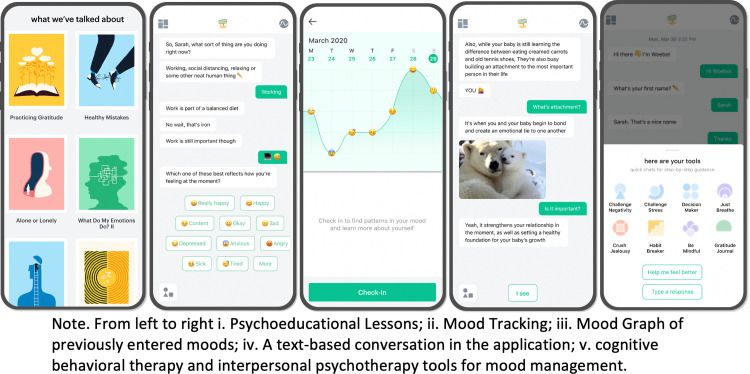
Perinatal mood disorders are common yet underdiagnosed and un- or undertreated. Barriers exist to accessing perinatal mental health services, including limited availability, time, and cost. Automated conversational agents (chatbots) can deliver evidence-based cognitive behavioral therapy content through text message-based conversations and reduce depression and anxiety symptoms in select populations. Such digital mental health technologies are poised to overcome barriers to mental health care access but need to be evaluated for efficacy, as well as for preliminary feasibility and acceptability among perinatal populations.

OBJECTIVE

To evaluate the acceptability and preliminary efficacy of a mental health chatbot for mood management in a general postpartum population.

STUDY DESIGN

An unblinded randomized controlled trial was conducted at a tertiary academic center. English-speaking postpartum women aged 18 years or above with a live birth and access to a smartphone were eligible for enrollment prior to discharge from delivery hospitalization. Baseline surveys were administered to all participants prior to randomization to a mental health chatbot intervention or to usual care only. The intervention group downloaded the mental health chatbot smartphone application with perinatal-specific content, in addition to continuing usual care. Usual care consisted of routine postpartum follow up and mental health care as dictated by the patient's obstetric provider. Surveys were administered during delivery hospitalization (baseline) and at 2-, 4-, and 6-weeks postpartum to assess depression and anxiety symptoms. The primary outcome was a change in depression symptoms at 6-weeks as measured using two depression screening tools: Patient Health Questionnaire-9 and Edinburgh Postnatal Depression Scale. Secondary outcomes included anxiety symptoms measured using Generalized Anxiety Disorder-7, and satisfaction and acceptability using validated scales. Based on a prior study, we estimated a sample size of 130 would have sufficient (80%) power to detect a moderate effect size (d=.4) in between group difference on the Patient Health Questionnaire-9.

RESULTS

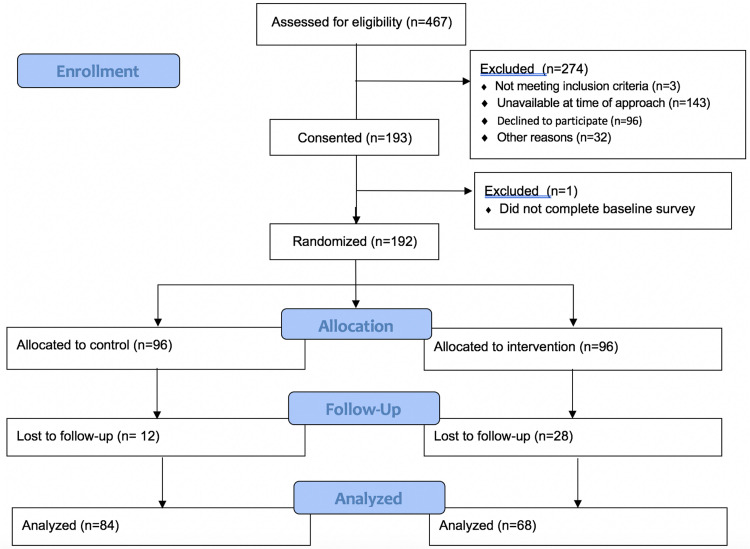
A total of 192 women were randomized equally 1:1 to the chatbot or usual care; of these, 152 women completed the 6-week survey (n=68 chatbot, n=84 usual care) and were included in the final analysis. Mean baseline mental health assessment scores were below positive screening thresholds. At 6-weeks, there was a greater decrease in Patient Health Questionnaire-9 scores among the chatbot group compared to the usual care group (mean decrease=1.32, standard deviation=3.4 vs mean decrease=0.13, standard deviation=3.01, respectively). 6-week mean Edinburgh Postnatal Depression Scale and Generalized Anxiety Disorder-7 scores did not differ between groups and were similar to baseline. 91% (n=62) of the chatbot users were satisfied or highly satisfied with the chatbot, and 74% (n=50) of the intervention group reported use of the chatbot at least once in 2 weeks prior to the 6-week survey. 80% of study participants reported being comfortable with the use of a mobile smartphone application for mood management.

CONCLUSION

Use of a chatbot was acceptable to women in the early postpartum period. The sample did not screen positive for depression at baseline and thus the potential of the chatbot to reduce depressive symptoms in this population was limited. This study was conducted in a general obstetric population. Future studies of longer duration in high-risk postpartum populations who screen positive for depression are needed to further understand the utility and efficacy of such digital therapeutics for that population.

摘要

背景

围产期情绪障碍很常见,但诊断不足且未得到充分治疗或治疗不充分。获得围产期心理健康服务存在障碍,包括可及性有限、时间和成本问题。自动化对话代理(聊天机器人)可以通过基于文本消息的对话提供循证认知行为疗法内容,并减轻特定人群的抑郁和焦虑症状。此类数字心理健康技术有望克服获得心理健康护理的障碍,但需要评估其疗效以及在围产期人群中的初步可行性和可接受性。

目的

评估一款心理健康聊天机器人在一般产后人群中进行情绪管理的可接受性和初步疗效。

研究设计

在一家三级学术中心进行了一项非盲随机对照试验。年龄在18岁及以上、有活产且能使用智能手机的讲英语的产后妇女在分娩住院出院前有资格入组。在随机分配到心理健康聊天机器人干预组或仅接受常规护理组之前,对所有参与者进行基线调查。干预组除继续接受常规护理外,还下载了具有围产期特定内容的心理健康聊天机器人智能手机应用程序。常规护理包括由患者的产科医生规定的产后常规随访和心理健康护理。在分娩住院期间(基线)以及产后2周、4周和6周进行调查,以评估抑郁和焦虑症状。主要结局是使用两种抑郁筛查工具(患者健康问卷-9和爱丁堡产后抑郁量表)测量的产后6周时抑郁症状的变化。次要结局包括使用广泛性焦虑障碍-7测量的焦虑症状,以及使用经过验证的量表测量的满意度和可接受性。根据先前的一项研究,我们估计样本量为130将有足够的(80%)效力检测患者健康问卷-9组间差异中的中等效应量(d = 0.4)。

结果

共有192名妇女按1:1比例随机分为聊天机器人组或常规护理组;其中,152名妇女完成了6周的调查(聊天机器人组n = 68,常规护理组n = 84)并纳入最终分析。平均基线心理健康评估分数低于阳性筛查阈值。在产后6周时,与常规护理组相比,聊天机器人组的患者健康问卷-9分数下降幅度更大(平均下降分别为1.32,标准差 = 3.4与平均下降0.13,标准差 = 3.01)。两组间产后6周的平均爱丁堡产后抑郁量表和广泛性焦虑障碍-7分数无差异,且与基线相似。91%(n = 62)的聊天机器人用户对聊天机器人感到满意或非常满意,74%(n = 50)的干预组报告在6周调查前的2周内至少使用过一次聊天机器人。80%的研究参与者报告对使用移动智能手机应用程序进行情绪管理感到满意。

结论

产后早期妇女可接受使用聊天机器人。该样本在基线时未筛查出抑郁阳性,因此聊天机器人在该人群中减轻抑郁症状的潜力有限。本研究是在一般产科人群中进行的。需要对抑郁筛查呈阳性的高危产后人群进行更长时间的未来研究,以进一步了解此类数字疗法对该人群的效用和疗效。
https://cdn.ncbi.nlm.nih.gov/pmc/blobs/b6f2/10407813/5013409dcaaf/gr2.jpg
https://cdn.ncbi.nlm.nih.gov/pmc/blobs/b6f2/10407813/5929b51cb4c0/gr1.jpg
https://cdn.ncbi.nlm.nih.gov/pmc/blobs/b6f2/10407813/5013409dcaaf/gr2.jpg
https://cdn.ncbi.nlm.nih.gov/pmc/blobs/b6f2/10407813/5929b51cb4c0/gr1.jpg
https://cdn.ncbi.nlm.nih.gov/pmc/blobs/b6f2/10407813/5013409dcaaf/gr2.jpg

相似文献

1
Feasibility and impact of a mental health chatbot on postpartum mental health: a randomized controlled trial.心理健康聊天机器人对产后心理健康的可行性及影响:一项随机对照试验
AJOG Glob Rep. 2023 Mar 29;3(3):100165. doi: 10.1016/j.xagr.2023.100165. eCollection 2023 Aug.
2
Folic acid supplementation and malaria susceptibility and severity among people taking antifolate antimalarial drugs in endemic areas.在流行地区,服用抗叶酸抗疟药物的人群中,叶酸补充剂与疟疾易感性和严重程度的关系。
Cochrane Database Syst Rev. 2022 Feb 1;2(2022):CD014217. doi: 10.1002/14651858.CD014217.
3
4
Effectiveness of a Web-based and Mobile Therapy Chatbot on Anxiety and Depressive Symptoms in Subclinical Young Adults: Randomized Controlled Trial.基于网络和移动治疗的聊天机器人对亚临床青年成人焦虑和抑郁症状的有效性:随机对照试验
JMIR Form Res. 2024 Mar 20;8:e47960. doi: 10.2196/47960.
5
Chatbot-Delivered Cognitive Behavioral Therapy in Adolescents With Depression and Anxiety During the COVID-19 Pandemic: Feasibility and Acceptability Study.新冠疫情期间针对抑郁和焦虑青少年的聊天机器人认知行为疗法:可行性与可接受性研究
JMIR Form Res. 2022 Nov 22;6(11):e40242. doi: 10.2196/40242.
6
Mental Health Chatbot for Young Adults With Depressive Symptoms During the COVID-19 Pandemic: Single-Blind, Three-Arm Randomized Controlled Trial.新冠疫情期间抑郁症状青年使用心理健康聊天机器人:单盲、三臂随机对照试验。
J Med Internet Res. 2022 Nov 21;24(11):e40719. doi: 10.2196/40719.
7
The effect of digital health interventions on postpartum depression or anxiety: a systematic review and meta-analysis of randomized controlled trials.数字健康干预对产后抑郁或焦虑的影响:随机对照试验的系统评价和荟萃分析。
Am J Obstet Gynecol. 2024 Jan;230(1):12-43. doi: 10.1016/j.ajog.2023.06.028. Epub 2023 Jun 15.
8
A Digital Mental Health Intervention in an Orthopedic Setting for Patients With Symptoms of Depression and/or Anxiety: Feasibility Prospective Cohort Study.骨科环境中针对有抑郁和/或焦虑症状患者的数字心理健康干预:可行性前瞻性队列研究
JMIR Form Res. 2022 Feb 21;6(2):e34889. doi: 10.2196/34889.
9
Mobile app-based chatbot to deliver cognitive behavioral therapy and psychoeducation for adults with attention deficit: A development and feasibility/usability study.基于移动应用程序的聊天机器人为注意力缺陷的成年人提供认知行为疗法和心理教育:一项开发和可行性/可用性研究。
Int J Med Inform. 2021 Jun;150:104440. doi: 10.1016/j.ijmedinf.2021.104440. Epub 2021 Mar 23.
10
A Mobile Health Mindfulness Intervention for Women With Moderate to Moderately Severe Postpartum Depressive Symptoms: Feasibility Study.一项针对有中度至中度严重产后抑郁症状女性的移动健康正念干预:可行性研究。
JMIR Ment Health. 2020 Nov 12;7(11):e17405. doi: 10.2196/17405.

引用本文的文献

1
Acceptability and efficacy of a smartphone application intervention for mental health care based on interpersonal psychotherapy for improving depression symptoms in prenatal women: Protocol for a randomized controlled trial.基于人际心理治疗的智能手机应用程序干预对改善产前女性抑郁症状的心理健康护理的可接受性和有效性:一项随机对照试验方案
Internet Interv. 2025 Aug 5;41:100838. doi: 10.1016/j.invent.2025.100838. eCollection 2025 Sep.
2
Development and evaluation of a lightweight large language model chatbot for medication enquiry.用于药物咨询的轻量级大语言模型聊天机器人的开发与评估
PLOS Digit Health. 2025 Sep 4;4(9):e0000961. doi: 10.1371/journal.pdig.0000961. eCollection 2025 Sep.
3

本文引用的文献

1
Anatomy of a Woebot® (WB001): agent guided CBT for women with postpartum depression.Woebot(WB001)的解剖:针对产后抑郁女性的基于代理的认知行为疗法。
Expert Rev Med Devices. 2022 Apr;19(4):287-301. doi: 10.1080/17434440.2022.2075726.
2
Sensitivity to change and minimal clinically important difference of Edinburgh postnatal depression scale.爱丁堡产后抑郁量表的变化敏感性和最小临床重要差异。
Asian J Psychiatr. 2021 Dec;66:102873. doi: 10.1016/j.ajp.2021.102873. Epub 2021 Sep 29.
3
A randomized controlled trial of a therapeutic relational agent for reducing substance misuse during the COVID-19 pandemic.
Navigating promise and perils: applying artificial intelligence to the perinatal mental health care cascade.
应对希望与风险:将人工智能应用于围产期心理健康照护流程
Npj Health Syst. 2025;2(1):26. doi: 10.1038/s44401-025-00030-7. Epub 2025 Jul 23.
4
Persuasive chatbot-based interventions for depression: a list of recommendations for improving reporting standards.基于聊天机器人的抑郁症劝导干预措施:提高报告标准的建议清单
Front Psychiatry. 2025 Jun 19;16:1429304. doi: 10.3389/fpsyt.2025.1429304. eCollection 2025.
5
Large language models and women's health: a digital companion for informed decision-making.大语言模型与女性健康:助力明智决策的数字伴侣。
Arch Gynecol Obstet. 2025 Jun 21. doi: 10.1007/s00404-025-08065-9.
6
Leveraging psychedelic neuroscience to boost human creativity using artificial intelligence.利用迷幻神经科学,借助人工智能提升人类创造力。
Front Artif Intell. 2025 Jun 4;8:1589086. doi: 10.3389/frai.2025.1589086. eCollection 2025.
7
A framework for developing spouse-inclusive digital applications in preventing perinatal depression and anxiety.一个用于开发包含配偶的数字应用程序以预防围产期抑郁和焦虑的框架。
Int J Nurs Sci. 2025 Apr 21;12(3):246-252. doi: 10.1016/j.ijnss.2025.04.014. eCollection 2025 May.
8
Balancing risks and benefits: clinicians' perspectives on the use of generative AI chatbots in mental healthcare.权衡风险与收益:临床医生对生成式人工智能聊天机器人在精神卫生保健中应用的看法。
Front Digit Health. 2025 May 29;7:1606291. doi: 10.3389/fdgth.2025.1606291. eCollection 2025.
9
Effectiveness of digital health interventions for perinatal depression: a systematic review and meta-analysis.数字健康干预对围产期抑郁症的有效性:一项系统评价和荟萃分析。
Oxf Open Digit Health. 2024 Aug 3;2:oqae026. doi: 10.1093/oodh/oqae026. eCollection 2024.
10
Chatbot to Support the Mental Health Needs of Pregnant and Postpartum Women (Moment for Parents): Design and Pilot Study.支持孕妇和产后妇女心理健康需求的聊天机器人(家长时刻):设计与试点研究
JMIR Form Res. 2025 Apr 8;9:e72469. doi: 10.2196/72469.
一项关于治疗性关系代理在 COVID-19 大流行期间减少药物滥用的随机对照试验。
Drug Alcohol Depend. 2021 Oct 1;227:108986. doi: 10.1016/j.drugalcdep.2021.108986. Epub 2021 Aug 27.
4
Evidence of Human-Level Bonds Established With a Digital Conversational Agent: Cross-sectional, Retrospective Observational Study.与数字对话代理建立的人类水平情感联系的证据:横断面回顾性观察研究。
JMIR Form Res. 2021 May 11;5(5):e27868. doi: 10.2196/27868.
5
A Therapeutic Relational Agent for Reducing Problematic Substance Use (Woebot): Development and Usability Study.用于减少问题性物质使用的治疗性关系代理(Woebot):开发和可用性研究。
J Med Internet Res. 2021 Mar 23;23(3):e24850. doi: 10.2196/24850.
6
Screening for perinatal depression with the Patient Health Questionnaire depression scale (PHQ-9): A systematic review and meta-analysis.用患者健康问卷抑郁量表(PHQ-9)筛查围产期抑郁:系统评价和荟萃分析。
Gen Hosp Psychiatry. 2021 Jan-Feb;68:74-82. doi: 10.1016/j.genhosppsych.2020.12.007. Epub 2020 Dec 21.
7
Conversational Agents in the Treatment of Mental Health Problems: Mixed-Method Systematic Review.用于治疗心理健康问题的对话代理:混合方法系统评价
JMIR Ment Health. 2019 Oct 18;6(10):e14166. doi: 10.2196/14166.
8
Use of Text Messaging for Postpartum Depression Screening and Information Provision.使用短信进行产后抑郁筛查和信息提供。
Psychiatr Serv. 2019 May 1;70(5):389-395. doi: 10.1176/appi.ps.201800269. Epub 2019 Feb 5.
9
ACOG Committee Opinion No. 757: Screening for Perinatal Depression.美国妇产科医师学会委员会意见 No.757:围产期抑郁筛查。
Obstet Gynecol. 2018 Nov;132(5):e208-e212. doi: 10.1097/AOG.0000000000002927.
10
Delivering Cognitive Behavior Therapy to Young Adults With Symptoms of Depression and Anxiety Using a Fully Automated Conversational Agent (Woebot): A Randomized Controlled Trial.使用全自动对话代理(Woebot)为有抑郁和焦虑症状的年轻人提供认知行为疗法:一项随机对照试验。
JMIR Ment Health. 2017 Jun 6;4(2):e19. doi: 10.2196/mental.7785.