Braitman Abby L, Battles Allison R, Kelley Michelle L, Hamrick Hannah C, Cramer Robert J, Ehlke Sarah, Bravo Adrian J
Department of Psychology, Old Dominion University.
Virginia Consortium Program in Clinical Psychology.
Traumatology (Tallahass Fla). 2018 Dec;24(4):301-312. doi: 10.1037/trm0000158. Epub 2018 May 3.
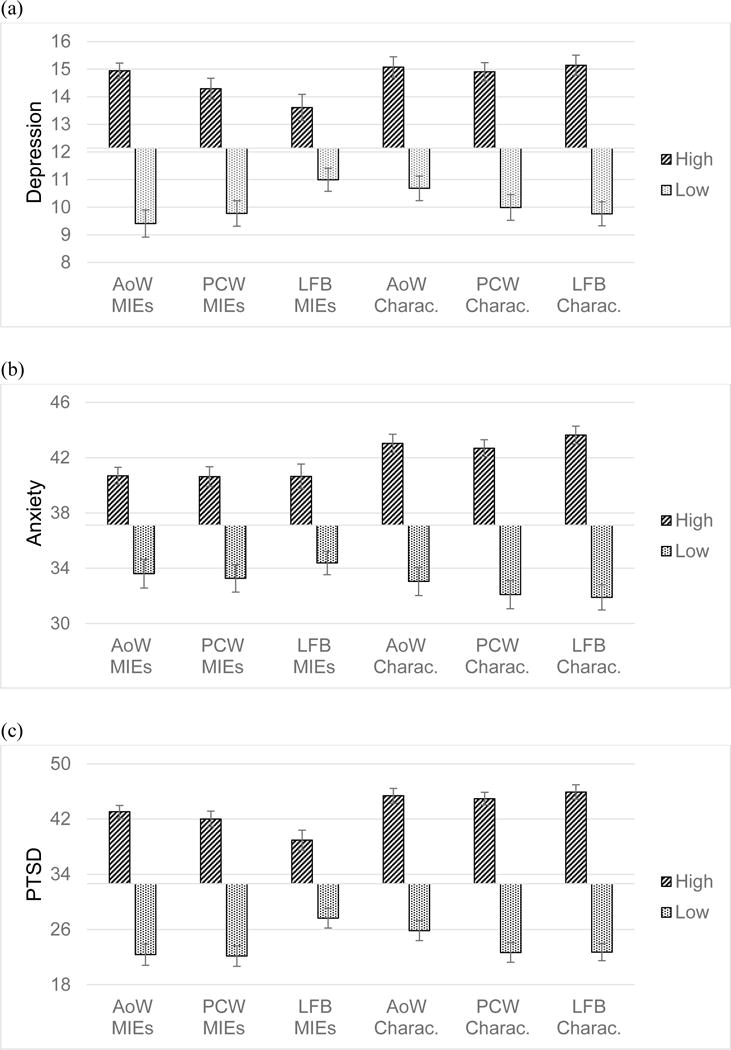
Moral injury (MI) results from perpetration of or exposure to distressing events, known as morally injurious events (MIEs), that challenge moral beliefs and values. Due to the type of involvement in recent military conflicts, many veterans report MIEs that may cause dissonance and, in turn, MI. Although two existing measures assess MIEs, neither currently assesses the defining characteristics of MI (i.e., guilt, shame, difficulty forgiving self and others, and withdrawal). The present study reports the initial psychometric test of a modified version (Robbins, Kelley, Hamrick, Bravo, & White, 2017) of the Moral Injury Questionnaire - Military version (MIQ-M; Currier, Holland, Drescher, & Foy, 2015) in a sample of 328 military personnel (e.g., veterans, National Guard/reservists, active duty members). The MIQ-M was modified to assess both MIEs and the defining characteristics of MI. Exploratory factor analyses suggested a three-factor model of MIEs consisting of , , and The modified MIQ-M factors were correlated with defining characteristics of MI. In addition, each MIE factor and associated defining characteristics of MI were positively correlated with symptoms of posttraumatic stress disorder, depression, and anxiety, as well as substance use. The modified MIQ-M is a reliable measure of MI that is comprised of three subscales that are associated with, but distinct from, mental health outcomes. Although findings are promising, further research evaluating the applicability of the modified MIQ-M in clinical settings is required to establish construct validity of the defining characteristics and secondary manifestations of MI.
道德伤害(MI)源于实施或接触令人痛苦的事件,即所谓的道德伤害性事件(MIEs),这些事件挑战道德信念和价值观。由于近期军事冲突中的参与类型,许多退伍军人报告了可能导致认知失调进而引发道德伤害的道德伤害性事件。尽管现有两项测量工具可评估道德伤害性事件,但目前均未评估道德伤害的定义特征(即内疚、羞耻、难以原谅自己和他人以及退缩)。本研究报告了对道德伤害问卷军事版(MIQ-M;柯里尔、霍兰德、德雷舍尔和福伊,2015年)的修改版(罗宾斯、凯利、哈姆里克、布拉沃和怀特,2017年)在328名军事人员(如退伍军人、国民警卫队/预备役军人、现役军人)样本中的初步心理测量测试。对MIQ-M进行了修改,以评估道德伤害性事件和道德伤害的定义特征。探索性因素分析提出了一个由[具体内容缺失]组成的道德伤害性事件三因素模型。修改后的MIQ-M因素与道德伤害的定义特征相关。此外,每个道德伤害性事件因素以及与之相关的道德伤害定义特征与创伤后应激障碍、抑郁和焦虑症状以及物质使用均呈正相关。修改后的MIQ-M是一种可靠的道德伤害测量工具,由三个与心理健康结果相关但又不同的子量表组成。尽管研究结果很有前景,但仍需要进一步研究评估修改后的MIQ-M在临床环境中的适用性,以确立道德伤害定义特征和次要表现的结构效度。