Animal and Dairy Science Department, University of Georgia, Athens, GA, 30602, USA.
Warmwater Aquaculture Research Unit (WARU), USDA-ARS, Stoneville, MS, 30776, USA.
Genet Sel Evol. 2018 Dec 14;50(1):66. doi: 10.1186/s12711-018-0435-5.
Catfish farming is the largest segment of US aquaculture and research is ongoing to improve production efficiency, including genetic selection programs to improve economically important traits. The objectives of this study were to investigate the use of genomic selection to improve breeding value accuracy and to identify major single nucleotide polymorphisms (SNPs) associated with harvest weight and residual carcass weight in a channel catfish population. Phenotypes were available for harvest weight (n = 27,160) and residual carcass weight (n = 6020), and 36,365 pedigree records were available. After quality control, genotypes for 54,837 SNPs were available for 2911 fish. Estimated breeding values (EBV) were obtained with traditional pedigree-based best linear unbiased prediction (BLUP) and genomic (G)EBV were estimated with single-step genomic BLUP (ssGBLUP). EBV and GEBV prediction accuracies were evaluated using different validation strategies. The ability to predict future performance was calculated as the correlation between EBV or GEBV and adjusted phenotypes.
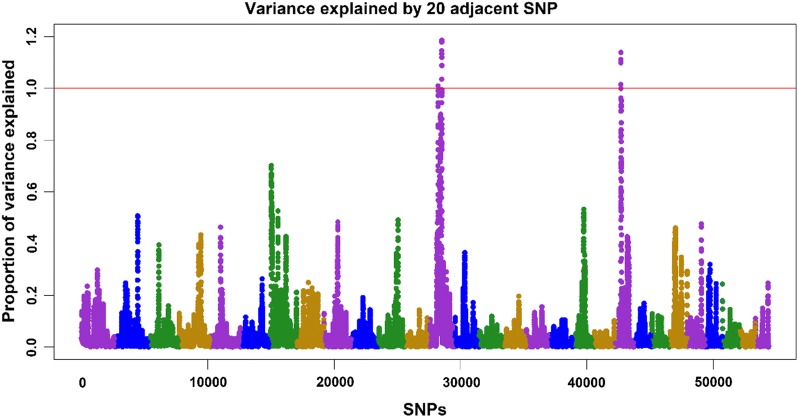
Compared to the pedigree BLUP, ssGBLUP increased predictive ability up to 28% and 36% for harvest weight and residual carcass weight, respectively; and GEBV were superior to EBV for all validation strategies tested. Breeding value inflation was assessed as the regression coefficient of adjusted phenotypes on breeding values, and the results indicated that genomic information reduced breeding value inflation. Genome-wide association studies based on windows of 20 adjacent SNPs indicated that both harvest weight and residual carcass weight have a polygenic architecture with no major SNPs (the largest SNPs explained 0.96 and 1.19% of the additive genetic variation for harvest weight and residual carcass weight respectively).
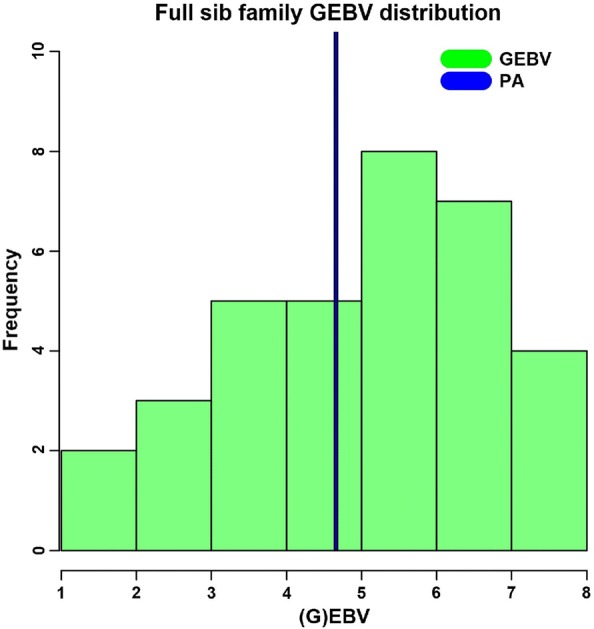
Genomic evaluation improves the ability to predict future performance relative to traditional BLUP and will allow more accurate identification of genetically superior individuals within catfish families.
鲶鱼养殖是美国水产养殖中最大的部分,目前正在进行研究以提高生产效率,包括遗传选择计划以改善经济上重要的性状。本研究的目的是研究基因组选择在提高育种值准确性方面的应用,并鉴定与收获体重和残余胴体重量相关的主要单核苷酸多态性 (SNP)。收获体重(n=27160)和残余胴体重量(n=6020)的表型可用,有 36365 条系谱记录可用。经过质量控制后,可用 2911 条鱼的 54837 个 SNP 的基因型。使用传统的基于系谱的最佳线性无偏预测(BLUP)获得估计育种值(EBV),并使用一步法基因组 BLUP(ssGBLUP)估计基因组(G)EBV。使用不同的验证策略评估 EBV 和 GEBV 的预测准确性。未来表现的预测能力计算为 EBV 或 GEBV 与调整表型之间的相关性。
与系谱 BLUP 相比,ssGBLUP 分别提高了收获体重和残余胴体重量的预测能力高达 28%和 36%;在所有测试的验证策略中,GEBV 均优于 EBV。作为调整后的表型对育种值的回归系数,评估了育种值的膨胀,结果表明基因组信息减少了育种值的膨胀。基于 20 个相邻 SNP 的窗口的全基因组关联研究表明,收获体重和残余胴体重量都具有多基因结构,没有主要 SNP(最大 SNP 分别解释了收获体重和残余胴体重量的加性遗传变异的 0.96%和 1.19%)。
基因组评估提高了相对于传统 BLUP 预测未来表现的能力,并将允许更准确地识别鲶鱼家族中具有遗传优势的个体。