Department of Zoology, University of Oxford, Oxford, OX1 3PS, U.K.
School of Biological Sciences, The University of Hong Kong, Kadoorie Biological Sciences Building, Hong Kong, SAR, China.
Biol Rev Camb Philos Soc. 2019 Jun;94(3):999-1022. doi: 10.1111/brv.12488. Epub 2018 Dec 13.
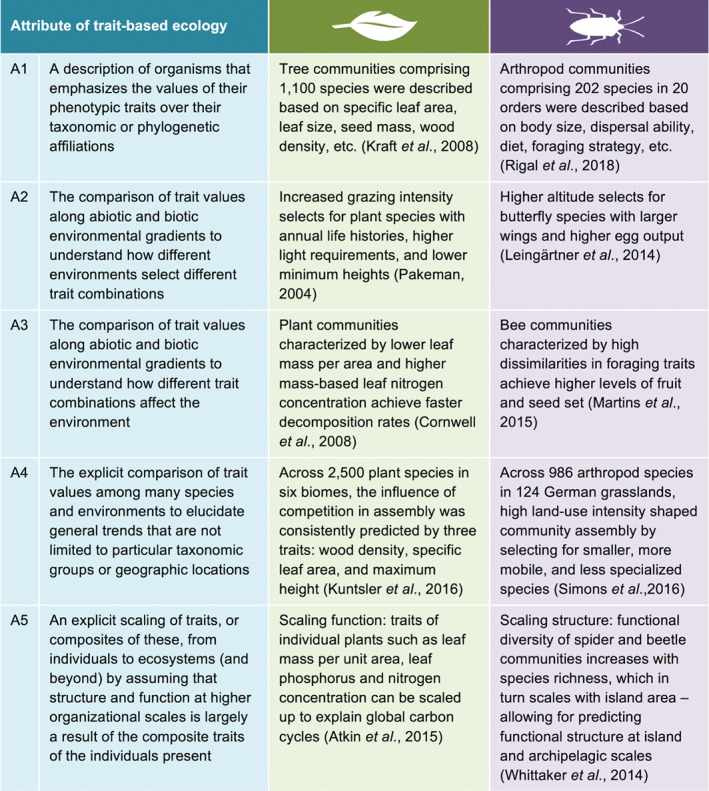
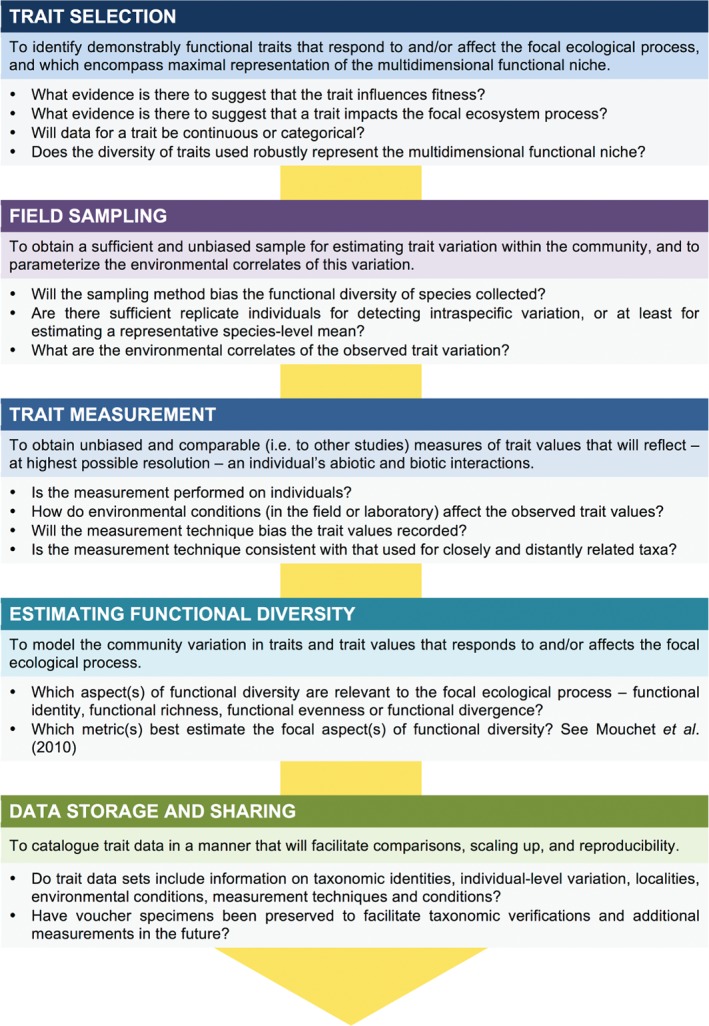
In focusing on how organisms' generalizable functional properties (traits) interact mechanistically with environments across spatial scales and levels of biological organization, trait-based approaches provide a powerful framework for attaining synthesis, generality and prediction. Trait-based research has considerably improved understanding of the assembly, structure and functioning of plant communities. Further advances in ecology may be achieved by exploring the trait-environment relationships of non-sessile, heterotrophic organisms such as terrestrial arthropods, which are geographically ubiquitous, ecologically diverse, and often important functional components of ecosystems. Trait-based studies and trait databases have recently been compiled for groups such as ants, bees, beetles, butterflies, spiders and many others; however, the explicit justification, conceptual framework, and primary-evidence base for the burgeoning field of 'terrestrial arthropod trait-based ecology' have not been well established. Consequently, there is some confusion over the scope and relevance of this field, as well as a tendency for studies to overlook important assumptions of the trait-based approach. Here we aim to provide a broad and accessible overview of the trait-based ecology of terrestrial arthropods. We first define and illustrate foundational concepts in trait-based ecology with respect to terrestrial arthropods, and justify the application of trait-based approaches to the study of their ecology. Next, we review studies in community ecology where trait-based approaches have been used to elucidate how assembly processes for terrestrial arthropod communities are influenced by niche filtering along environmental gradients (e.g. climatic, structural, and land-use gradients) and by abiotic and biotic disturbances (e.g. fire, floods, and biological invasions). We also review studies in ecosystem ecology where trait-based approaches have been used to investigate biodiversity-ecosystem function relationships: how the functional diversity of arthropod communities relates to a host of ecosystem functions and services that they mediate, such as decomposition, pollination and predation. We then suggest how future work can address fundamental assumptions and limitations by investigating trait functionality and the effects of intraspecific variation, assessing the potential for sampling methods to bias the traits and trait values observed, and enhancing the quality and consolidation of trait information in databases. A roadmap to guide observational trait-based studies is also presented. Lastly, we highlight new areas where trait-based studies on terrestrial arthropods are well positioned to advance ecological understanding and application. These include examining the roles of competitive, non-competitive and (multi-)trophic interactions in shaping coexistence, and macro-scaling trait-environment relationships to explain and predict patterns in biodiversity and ecosystem functions across space and time. We hope this review will spur and guide future applications of the trait-based framework to advance ecological insights from the most diverse eukaryotic organisms on Earth.
在关注生物体的可推广功能特性(特征)如何在跨空间尺度和生物组织层次的环境中机械地相互作用时,基于特征的方法为实现综合、普遍性和预测提供了一个强大的框架。基于特征的研究极大地提高了对植物群落组成、结构和功能的理解。通过探索非固着、异养生物(如陆地节肢动物)的特征-环境关系,生态学界可能会取得进一步的进展,这些生物在地理上无处不在,生态多样,通常是生态系统的重要功能组成部分。最近已经为蚂蚁、蜜蜂、甲虫、蝴蝶、蜘蛛和许多其他群体编制了基于特征的研究和特征数据库;然而,“陆地节肢动物基于特征的生态学”这一新兴领域的明确理由、概念框架和主要证据基础尚未得到很好的建立。因此,对于该领域的范围和相关性存在一些混淆,并且研究倾向于忽略基于特征方法的重要假设。在这里,我们旨在提供一个广泛而易于理解的陆地节肢动物基于特征的生态学概述。我们首先定义并说明了与陆地节肢动物相关的基于特征的生态学的基础概念,并证明了基于特征的方法在研究它们的生态学中的应用。接下来,我们回顾了社区生态学中的研究,其中基于特征的方法已被用于阐明陆地节肢动物群落的组装过程如何受到环境梯度(例如气候、结构和土地利用梯度)沿生态位过滤的影响,以及受到非生物和生物干扰(例如火灾、洪水和生物入侵)的影响。我们还回顾了生态系统生态学中的研究,其中基于特征的方法已被用于研究节肢动物群落的功能多样性与它们介导的许多生态系统功能和服务之间的关系,例如分解、授粉和捕食。然后,我们建议通过研究特征功能和种内变异的影响、评估采样方法对观察到的特征和特征值的偏倚潜力以及提高数据库中特征信息的质量和整合性,如何解决未来的工作中的基本假设和局限性。还提出了指导观测性基于特征的研究的路线图。最后,我们强调了基于特征的研究在陆地节肢动物方面的新领域,这些研究有望推进生态学的理解和应用。这些领域包括研究竞争、非竞争和(多)营养相互作用在塑造共存中的作用,以及宏观尺度的特征-环境关系,以解释和预测生物多样性和生态系统功能在空间和时间上的模式。我们希望本综述将激发并指导未来基于特征的框架的应用,以推进对地球上最具多样性的真核生物的生态见解。